

Monday starts with three spreadsheets that should say the same thing and don’t. A lease file sits on paper in a cabinet. Two tools need someone to copy data between them by hand. And you have a page of notes on how all of it could work better, which nobody has asked to see.
If that’s your week, you’re probably the one pushing for change. You might lead tools, operations, or digital work in property management, real estate investment, or asset management, where information sits across several systems. The business already earns revenue, and your goal in modernizing a real estate business like this one is to help it run more efficiently, make better use of its information, and keep pace with the changes around it.
This guide covers why good ideas stall when they start at the bottom, how to get leadership behind one focused project, how to describe that project in the terms owners use, and what to do in your first 30 days.
What Modernizing a Real Estate Business Really Means
Modernizing a real estate business means improving how an established company operates, uses its information, and makes decisions. Depending on the company, that can involve connecting existing systems, reducing manual work, or introducing software for processes current tools can’t support.
The practical challenge is deciding which processes to improve first and how existing systems can support those changes. That choice shapes the value of modernization the company sees.
Why Now: The Market, the Ecosystem and Technology Are Shifting
Real estate companies face growing pressure to make better use of technology while staying disciplined about spending. Three developments make this a good time to reassess how the business operates.
The market is rewarding selective investment
Deloitte’s 2027 Commercial Real Estate Outlook surveyed 950 executives at commercial real estate owners and investment companies with at least $250 million in assets under management.
It describes a more cautious outlook, tighter budgets, and growing gaps across the market, which push leaders to decide asset by asset where investment makes sense. More than 90% still plan to increase spending on data and technology in the coming year, up from 76% in the previous survey.
For you, a larger budget doesn’t guarantee approval: you still need to show which business problem your project addresses and what changes once it’s solved.
Expectations around connected operations are changing
Owners and operators increasingly need information that moves between departments and supports decisions across the portfolio, a shift traced in PropTech trends 2026.
Companies built more recently may have had the opportunity to design connected operations from the outset. Established businesses, meanwhile, often need to integrate systems and processes introduced at different stages of growth.
AI depends on how information is organized and maintained
If the same building has different identifiers in property management, finance, and leasing systems, an AI assistant may struggle to retrieve and reconcile the right records. Organizing those records is an important part of preparing for AI, alongside the design, permissions, and testing of the application itself.
Deloitte also found that 67% of those commercial real estate executives say AI and data fluency will be among the most important capabilities for future leaders.
Why Technology Initiatives Stall Without Leadership Support
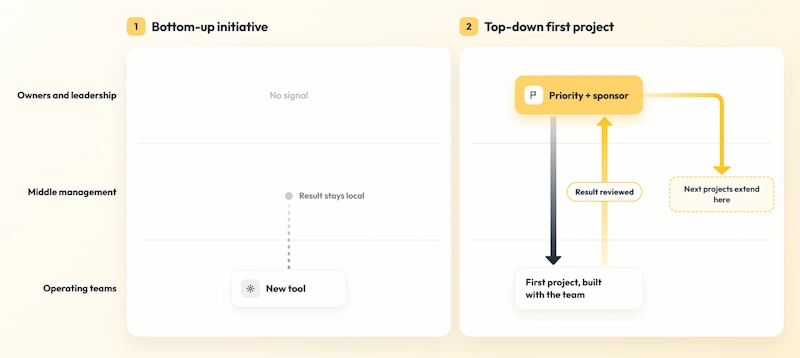
Bottom-up initiatives can struggle to scale when teams lack leadership support, clear ownership, or a path to wider adoption. A typical example is a new tool for agents or site teams, introduced without the owners first backing its use.
You introduce a new tool and train the agents. They try it, then return to texting and calling clients because those habits are already part of their daily workflow.
If the new tool adds steps without making their work noticeably easier, there’s little reason to keep using it, particularly when leadership hasn’t made adoption a priority.
Leadership has a different problem. If owners haven’t asked for the change, they have no reason to track it, so even a real improvement for one team may never reach the people who decide on further investment, however good the idea behind it.
How to Get Leadership Buy-In: Start Top-Down With One Focused Project
You get leadership buy-in for a technology project by securing an owner’s support for one focused, high-impact initiative. A top-down first project usually follows four steps:
- Start with a recognized priority. Pick a problem leadership already cares about.
- Agree on one problem and a sponsor. Scope the work to one question or workflow, with an executive sponsor accountable for it.
- Involve the people who do the work. The employees responsible for the affected workflow help define requirements and test the first version.
- Define a result leadership can review. Agree up front what should change and when leadership will see it.
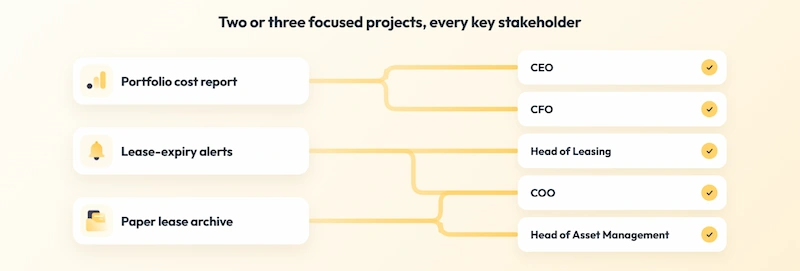
Imagine the CEO asking how much the portfolio costs to operate each month. The answer means pulling figures from several spreadsheets and reconciling them by hand. A focused reporting project, such as a real estate dashboard that brings those numbers into one consistent view, could give leadership a more reliable basis for reviewing costs and considering the next investment.
The same reporting project can serve several leaders at once. It answers the CEO’s question, gives the CFO a consistent view of operating costs, and shows operations where manual reconciliation slows the team down. Once leadership has reviewed that result, the next initiative can address another stakeholder’s priority.
Speak Leadership’s Language: Value, Assets and Revenue
Connect a technology project to the outcomes owners care about: enterprise value, the usefulness of company data, potential new revenue, and how the investment is funded.
Enterprise value
Enterprise value reflects what the business is worth as a whole. Better operating performance, more reliable information, and stronger decisions can contribute to long-term value, which matters when owners consider refinancing, a sale, or further investment. Technology is one input into that case, alongside the portfolio and the market.
Data as an asset
Structured, well-maintained company data supports due diligence, refinancing, and better operational decisions. When the company has the rights to retain and use that information, it can remain useful as employees, software, and processes change.
New revenue streams
Connected data and internal tools may also support products or services, such as market insights for partners or digital services for tenants. Whether these become viable revenue depends on customer demand, data rights, and the company’s ability to build and maintain the offering.
Capital investment
Capital investment. CAPEX (capital expenditure) generally refers to spending on acquiring, improving, or developing long-term assets. OPEX (operating expenditure) covers the ongoing costs of running the business.
Software subscriptions are generally treated as operating expenses. Certain costs related to developing or implementing internal-use software, including some implementation costs for cloud-hosted solutions, may qualify for capitalization, depending on the applicable accounting standards, the nature of the work, and the company’s accounting policies.
These standards also change: FASB updated its internal-use software guidance in 2025, with the new requirements mandatory for annual periods beginning after December 15, 2027.
How much of the project can be capitalized is a question for your finance team, so confirm the details with them.
| What you might say | What leadership hears | Say this instead |
| “We need a new tool.” | “Another cost, another login.” | “This creates a capability the company can maintain and extend as its needs change.” |
| “It’ll save the team time.” | “Nice, but what changes for the business?” | “It can reduce manual work and give the team more capacity for higher-value tasks.” |
| “Our data is a mess.” | “An IT problem.” | “Organized data supports better decisions and, where there’s a viable use case, new services.” |
| “Customers would love this feature.” | “A nice-to-have.” | “This could become a new revenue stream.” |
| “It’s a monthly subscription.” | “An ongoing operating expense.” | “Let’s evaluate the full cost against the company’s long-term needs. Finance can confirm the appropriate funding and accounting treatment.” |
What a Good First Project Looks Like
Those three criteria do the filtering:
- High impact. It answers a question leadership already asks, or removes work that costs real time and money.
- Visible to most stakeholders. Several leaders see the result in their own work, so support doesn’t rest on one person.
- Quick to show results. A first version reaches real users while the sponsor is still engaged. Some projects need more groundwork than others, so scope the first version around what the team can realistically deliver.
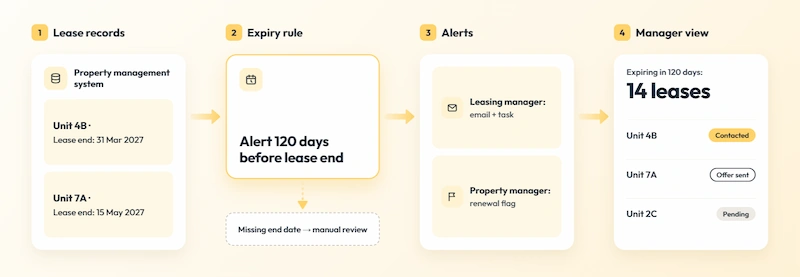
Lease-expiry alerts can be a useful first project when teams track upcoming renewals through manual checks. As a simple form of real estate workflow automation, an alert can notify the right people ahead of key dates, helping them coordinate follow-up and giving managers clearer visibility into upcoming lease events.
Another option is a searchable archive of paper lease records, useful when employees regularly dig through physical files for property information. It takes more groundwork than an alert: scanning, OCR, document classification, indexing, access rules, and often integration with existing systems. Starting with one document type or one property group keeps the first version realistic.
At ORIL, we built the construction innovation dashboard for Robins & Morton, a construction company, starting with an MVP for idea submission, tracking, and basic collaboration, built to work with its existing IT infrastructure. Integrated communication tools and detailed analytics came in a later phase, giving managers one place to oversee multiple innovation projects.
Before development starts, agree on a few practical details:
- Which systems provide the required information, and how often it needs updating
- Who is responsible for data quality and corrections
- Which existing tools can be reused, and where new software is needed
- How the first version will be tested with the people who will use it
Momentum: How the First Win Makes the Next One Easier
A first project creates momentum by giving leadership evidence to assess before approving further investment. The momentum loop describes how one successful project can build support for the next:
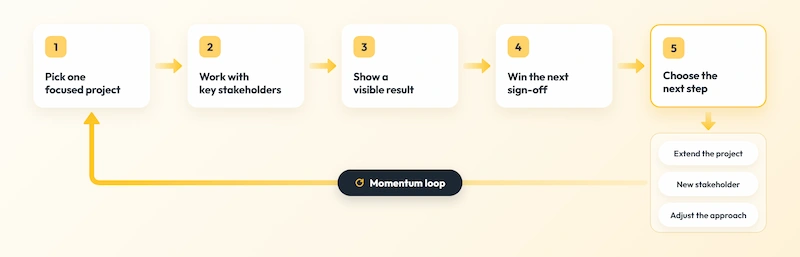
Use leadership’s review of the first result to agree on what happens next: extend the project, address another stakeholder’s problem, or adjust the approach before investing further.
With leadership support in place, innovation in real estate companies can extend into middle management and other departments, building on the systems, processes, and relationships the first project established.
Your First 30 Days as the Innovator
In your first 30 days, modernizing a real estate business means learning where work gets stuck and preparing a focused proposal leadership can evaluate.
1.Week 1: Listen to key stakeholders. Ask where time and money get lost, and write down the exact words people use to describe the problem.
2.Week 2: Find the one question leadership can’t answer quickly. Look for a question leaders ask regularly that still requires gathering information by hand from several sources.
3.Week 3: Describe the fix in leadership’s language. Explain the expected business value, the effect on operating costs, and any potential to support new revenue. If you present it as a capital investment, check the accounting treatment with your finance team.
4.Week 4: Find an executive sponsor and a delivery partner, and propose one focused project. Agree on a realistic milestone for showing the first result, based on the proposed scope.
One Visible Result, Then the Next
This approach also changes your own position in the company. Each result you deliver shows leadership that you can turn an operational problem into a business outcome. The next time a hard question comes up about costs, data, or a slow process, you’re the person they ask where to start.
If you’re helping your company reduce manual work and connect information across spreadsheets, documents, and business systems, you need someone who can build while you make the case to leadership. At ORIL, we work with real estate innovators across the full modernization cycle. We help translate business priorities into a focused software scope, design the solution, and build the systems and integrations needed to deliver it.
As each win earns the next sign-off, we support and extend what’s live and take on the bigger projects that follow. Talk with us about where your company stands today and the result your leadership needs to see.


