

Real estate companies already hold detailed records of their leases, units, work orders, and project costs, much of it collected as a by-product of daily operations. That information is an asset the business has already paid for.
A chatbot that answers questions about the portfolio is often the first use leadership sees. It’s an entry point.
The larger payoff comes when the same data feeds the tools development teams use to budget new projects, the apps residents use to report problems, and the portals investors use to follow performance. That’s where AI applications for real estate companies start to address specific business needs.
Before any of those get built, one practical check sets the order: whether the company’s data can support each idea today.
What Are AI Applications for Real Estate Companies?
AI applications for real estate companies are tools that use AI and connected company data to support specific business activities. They range from natural-language assistants to features inside the applications that property managers, residents, investors, and development teams use every day.
Applications built around AI in real estate rest on three layers, each with its own job:
- Data foundation: integrated, structured company data, with access rules that control who can see what.
- Application layer: the digital products and tools that use that data.
- AI capabilities: features added to those applications where they bring concrete value.
The Add-On Principle: Build the Foundation Once, Reuse It Across Applications
The add-on principle describes what happens once a real estate company’s data foundation is in place: a new application can reuse existing connections instead of starting with its own integrations.
A resident app, an investor portal, and a cost benchmarking tool can draw on relevant connected records where the required data is available and access is permitted. Each still needs its own design, development, testing, and rollout, but the underlying data work doesn’t start from scratch.
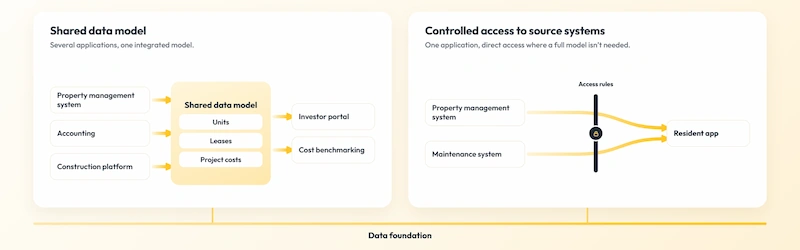
Depending on the use case, the data foundation may be a shared data model, an integration layer, controlled access to individual source systems, or a combination of these.
JLL’s 2025 Global Real Estate Technology Survey found that 88% of investors, owners, and landlords have started piloting AI, most with an average of five use cases underway.
Five Capabilities Supported by Unified Data
- Natural-language assistant: a leasing director asks which buildings have leases expiring next quarter and gets the answer without waiting for a report.
- Workflow automation: a vacancy recorded in the property management system triggers an alert for the leasing team, a basic example of real estate workflow automation.
- Data enrichment: market, neighborhood, ownership, and regulatory information is added to relevant property records.
- Dashboards and analytics: portfolio, financial, and operational data presented in views tailored to the decisions each team makes.
- Applications: internal tools, resident services, investor portals, and data products that put connected company information to work for different users.
Not every application needs AI. Some of the most valuable improvements come from reliable integrations, structured data, and straightforward workflow automation. AI becomes useful where a task requires interpretation, pattern recognition, prediction, or natural-language interaction.
Dashboards are often where connected data first shows its value. Our real estate data visualization work builds portfolio dashboards with drill-down to individual assets and the records behind each figure.
The Application Layer: Where Data Becomes Useful
The illustrative examples below show how connected property data can support internal teams, residents, investors, and external partners.
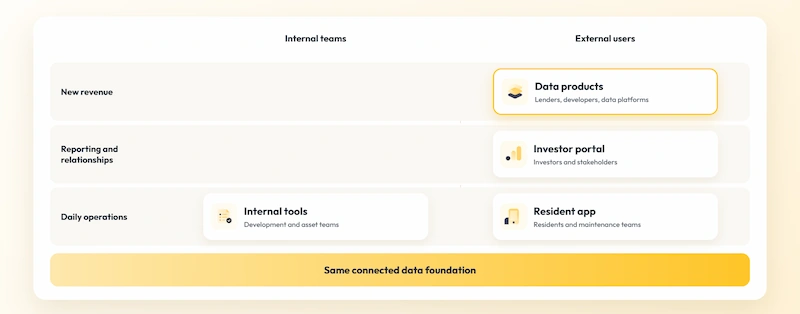
These four categories are a sample of what connected data can support. Other examples include construction progress and change-order tracking, smart building and equipment monitoring, energy and emissions reporting, lease abstraction, and listing and lead management tools for brokerages.
Internal Tools: Cost Benchmarking and an Asset Manager’s Field App
Internal tools help development and asset management teams make decisions using information that would otherwise sit across separate project and property records.
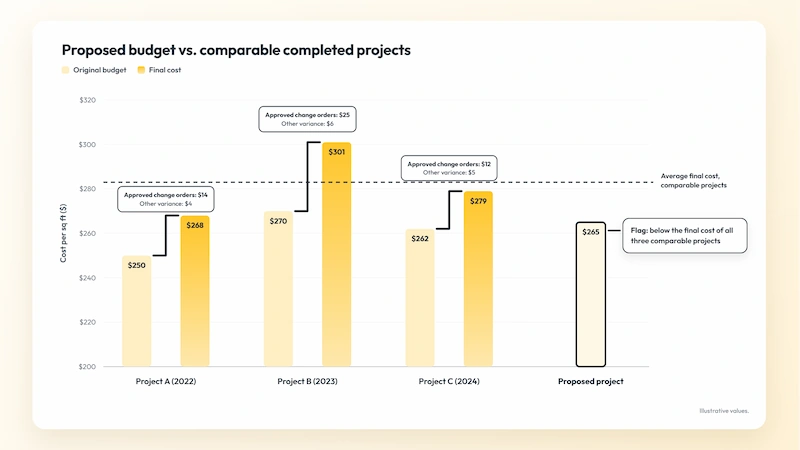
Cost benchmarking for new developments
- Who uses it: a development director planning a new development.
- The question: “What should this project cost, given our past comparable projects?”
- What changes: the team can compare the proposed budget with records from completed projects, including original budgets, approved change orders, and final costs. This gives the development director a historical reference when preparing the new budget.
- Where AI fits: identifying potentially comparable projects and flagging where their recorded costs differ from the proposed budget. The team still reviews whether those projects are truly comparable.
An asset manager’s field app
- Who uses it: an asset manager on a site visit.
- The question: “What’s happening in this building right now?”
- What changes: the asset manager reviews leases, open work orders, and occupancy on a phone and can record an issue that is passed to the relevant maintenance workflow.
- Where AI fits: questions about the building in plain language, such as which work orders have stayed open the longest.
Resident and Tenant Apps Built on Real Building Data
A resident app connected to building and maintenance records can link a request to the relevant unit, lease, and service history. This gives the property management team useful context when reviewing and handling the request.
- Who uses it: residents, property managers, and maintenance teams.
- The question: “I reported a leak. What happens now?”
- What changes: the app passes the request into the maintenance workflow, where it can be reviewed, turned into a work order, and assigned to the appropriate team or contractor. Real estate workflow automation can handle the steps the team chooses to automate, and the resident follows the status in the app.
- The building data behind it: a connected water sensor can trigger a potential leak alert linked to the relevant unit. That depends on smart building and IoT software that maps each sensor to the correct property, applies threshold rules to its readings, and routes the event into the maintenance workflow.
- Where AI fits: classifying requests by type, suggesting an urgency level for staff review, and answering routine questions from connected building records.
Investor Portals With Up-to-Date, Consistent Numbers
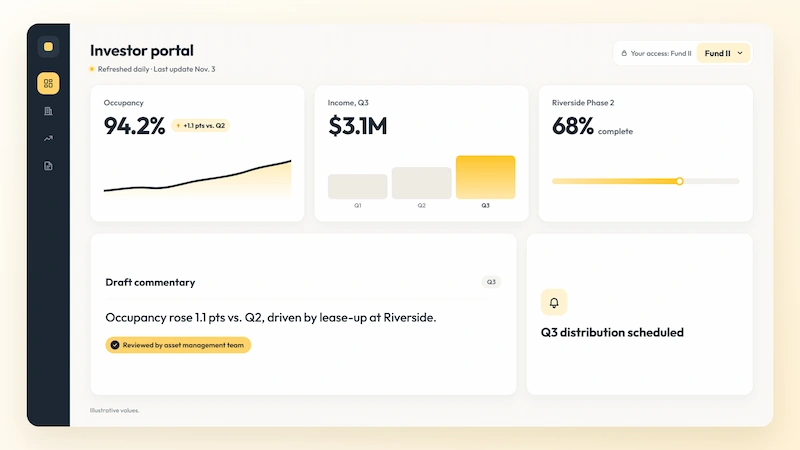
An investor portal built on a shared data foundation can present figures consistent with internal reporting, provided both use the same metric definitions, reporting periods, and calculation rules.
- Who uses it: investors and other stakeholders, supported by the asset management team.
- The question: “How is the portfolio performing this quarter?”
- What changes: instead of relying only on spreadsheet packs prepared each quarter, investors can see occupancy, income, and project progress in a portal refreshed on an agreed schedule. The asset management team can spend less time assembling routine reports.
- Where AI fits: draft commentary on what changed since the last period, which the team reviews before investors see it.
Access permissions need to be defined before a stakeholder portal goes live. Investors should only see the funds, assets, and reports assigned to their accounts, which makes access design as much a part of the project as reporting.
Real Estate Data Products and Partnerships
Real estate companies can sometimes turn selected, aggregated property insights into products or partnerships.
- Who uses it: partners such as lenders, investors, developers, or data platforms.
- The question: “What are rents doing in this submarket?” or “What does this building type cost to build here?”
- What changes: the company packages selected insights, such as submarket rent trends or construction cost benchmarks, into real estate data products for partners. Depending on demand, licensing rights, and the cost of maintaining the dataset, these can become an additional revenue stream.
- Where AI fits: it may not need to. A well-structured dataset with a reliable update schedule can be the product itself.
Before offering a data product, a company needs to confirm it has the right to use and license the underlying information, under its permissions and contracts. Privacy review also has to consider whether individuals could be identified by combining the dataset with other available information, a risk that NIST’s guidance on de-identifying datasets addresses in detail. Personal resident and tenant data should not be treated as a commercial asset by default.
How to Decide What to Build First: Run Every Idea Through the Data Test
Deciding what to build often follows steps like these. The order and depth vary with the company’s systems and the stage its product is at, and at ORIL, we adapt them case by case:
1.Discovery and use-case assessment: assess business priorities, identify candidate use cases, and define the data requirements for each one, using the same approach as our product strategy and design work.
2.Proof of concept on real data: test whether the available data can support the proposed application.
3.Build and pilot: develop the application, define permissions and integrations, and release it to a limited group of intended users.
4.Validation and expansion: measure adoption and performance against agreed metrics, then decide whether to expand the application and which use case to assess next.
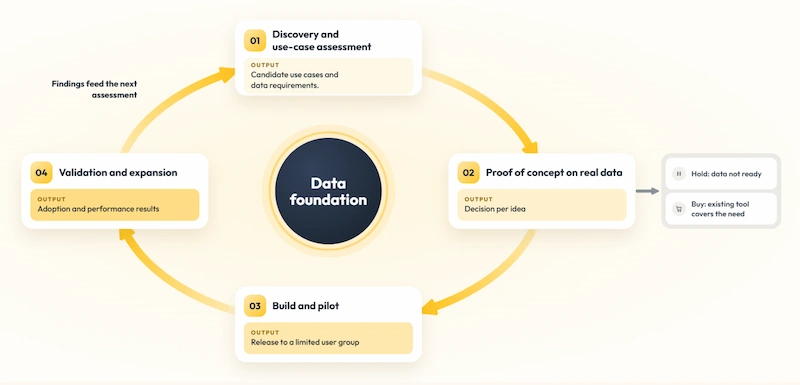
The same assessment helps decide whether to build or buy. An existing application, or a standard piece of real estate automation such as an alert, may already cover a requirement. Custom development makes more sense when the solution depends on company-specific data, workflows, or functionality that sets the business apart.
A Hypothetical Example: Three Ideas Through the Data Test
Consider a mid-sized multifamily operator with lease records in its property management system (PMS), financial information in an accounting platform, and project costs in a separate construction system.
Discovery surfaces three candidate use cases, and the proof of concept on real data gives each one a different answer:
| Idea | What the proof of concept showed | Decision |
| Investor portal | Occupancy, income, and project progress could be reconciled across the connected systems using agreed reporting definitions | Build first, with permissions defined for each fund |
| Cost benchmarking | Historical projects lacked complete final-cost records for meaningful comparisons | Hold until more complete cost data is available |
| Resident app | An existing application could cover the resident-facing features, subject to integration with the maintenance workflow | Buy, and assess the integration requirements |
The investor portal then moves into development and user validation, where the team checks whether investors can find the information they need without requesting separate reports.
How ORIL Helps Real Estate Companies Build on Their Data
At ORIL, we help real estate companies turn the data they already have into applications their teams, residents, and investors use. Where that work starts depends on what the company needs first:
- Data Enablement, the main path: we connect and structure a real estate company’s data, then develop the AI capabilities and applications that data can support. The setup depends on the use case, and not every company needs an enterprise data warehouse or full centralization.
- First capabilities: depending on the use case, initial applications may include a natural-language assistant, dashboards, or reporting tools, built through our AI enablement for PropTech work.
- Narrower entry points: real estate data integration for connecting systems such as a PMS, CRM, and construction platforms; data enrichment for adding market, ownership, neighborhood, and regulatory information to property records.
- New markets: bringing a new market’s MLS and property data into the company’s existing data model and business systems, as in our new-market data integration work.
- Acquisitions: combining two companies’ data environments into one operating model after a deal, through post-acquisition data integration.
Whichever path a company starts on, we work as its engineering partner. Our digital product development services cover discovery, architecture, data work, implementation, testing, and deployment. The aim is software the team can trust with a specific business task, with a clear business outcome such as faster reporting, fewer manual steps, or a new revenue stream.
Where It Leads: What Comes After the First Application
A strong first application is a focused one: it solves a problem the business already has and works reliably with the data available. Its results give the team a firmer basis for choosing which AI applications for real estate companies to build next.


