

PropTech teams sometimes plan an AI initiative by starting with the wrong question. They ask which model to use before they can answer a more basic one: is our property data ready for any of it?
AI pilots may stall not because the models underperform, but because the property data feeding them is fragmented across MLS feeds, PMS records, and CRM exports, duplicated across sources, and missing the ownership, tax, and location context a model needs to reason. MIT’s NANDA research found that up to 95% of generative AI pilots never reach production. That failure often traces to the data layer.
This article is about property data for AI: what “AI-ready” actually means for a real estate platform, and how to get there. AI-ready property data meets a few conditions. It’s complete, consistently identified across systems, and standardized to a common schema. And it’s enriched with external context, governed with clear lineage, and current enough that an AI system can reason over it without producing unreliable results.
AI readiness also depends on discoverable metadata, consistent business definitions, and secure access controls. An AI model can only reason effectively when it understands both the data and the business context behind it.
This is where ORIL starts AI engagement, because raw data pipelines have quietly become the core infrastructure of modern PropTech, deciding whether an algorithm succeeds or fails long before the first prompt is written.
Why Most AI Initiatives Fail Before the First Model Is Deployed
Most AI programs that underdeliver in PropTech have a data-readiness gap. The organizations that close that gap tend to pull ahead. IBM found that 68% of AI-first organizations have mature data and governance frameworks, compared with just 32% of other organizations. The differentiator is the foundation, not the model.
In real estate, the failure causes are specific, and they show up as business consequences:
- Fragmented MLS, PMS, and CRM systems let a model see conflicting versions of the same property.
- Without entity resolution, duplicate listings inflate comparable-sales figures.
- Without governance, no one can explain or defend an AI-generated valuation to a client or regulator.
- Stale listings lead a model to recommend units already off-market.
The cost lands later, as rework, a stalled pilot, or an AI feature that produces results the team can’t stand behind.
What Makes Property Data AI-Ready?
AI-ready property data is data an AI system can retrieve and reason over without producing unreliable results. In real estate, that comes down to a handful of dimensions, each with a practical test.
- Accuracy. The recorded square footage, price, and listing status match reality. In AI systems, accuracy also depends on how label noise and measurement error affect model training.
- Completeness. Coverage extends across edge cases (rural parcels, mixed-use buildings, and unusual ownership structures). As IBM notes, gaps in coverage produce models that “perform well on average but fail in underrepresented scenarios.”
- Consistency. Records referring to the same real-world property can be reliably resolved into a unified property identity across MLS, PMS, CRM, public records, and other datasets.
- Integrity and lineage. Any value can be traced back to its source and its preparation reproduced. This matters most for defensible valuations, where you may need to show your work.
- Timeliness. Freshness is high-stakes in real estate. For fast-moving markets such as residential sales and rentals, listings that are even 24 to 48 hours stale can already produce misleading recommendations.
- Relevance. Enrichment layers such as tax, zoning, and demographics improve prediction, rather than just adding bulk to the record.
Two further dimensions matter specifically in PropTech. Standardization means aligning to the Real Estate Standards Organization (RESO) data model so records speak a common language. Accessibility, or retrievability, means an AI system can actually query the data in real time. These dimensions only hold if the data lands somewhere built to enforce them, which is the job of scalable data platforms rather than a patchwork of point integrations.
The ORIL Property Data Readiness Framework
The ORIL Property Data Readiness Framework describes how to move property data from raw sources to something an AI system can rely on, in six sequential stages.
Collect
Inventory every source that carries property data: MLS feeds, PMS and CRM records, public records, valuation providers. An inventory built without a specific downstream use in mind tends to over-collect low-value sources and under-collect the ones a model will actually depend on.
Integrate
Bring those sources into one pipeline. A PMS integration is a standing data relationship, not a delivered feature. The schema drifts, fields get deprecated, and access terms change, so an integration scoped as a one-time build accrues maintenance debt from day one.
Transform
Normalize the integrated data to a common schema and resolve it to a single property identity through entity resolution, producing RESO-aligned, deduplicated records. Enrichment and modeling both assume one property equals one record. If unresolved duplicates and schema mismatches pass through untouched, every downstream layer inherits them.
Enrich
Layer in external context such as tax history, ownership, zoning, and geographic data to move from base records to decision-grade ones. Enrichment amplifies whatever it’s applied to, so appending context to un-transformed data scales the errors along with the signal.
Govern
Establish lineage, ownership, and quality monitoring so any value can be traced and audited. Governance defines how data is validated, versioned, and accessed, which is expensive to reconstruct after models are already in production and depending on it.
Activate
Expose the governed data layer to consumers through APIs, a semantic model, a vector or RAG layer, and analytics. The semantic model is what lets an AI system or a business user query for “active listings” or “market value” and get a consistent answer, without needing to know which underlying table or feed it came from. The same layer that serves an AI model also serves automation, BI, and later products, so the work done here compounds beyond the first use case.
The stages are sequential dependencies. You cannot enrich what you haven’t transformed, and you cannot govern data whose lineage you never captured.
The Six Data Quality Problems That Undermine AI Accuracy
Specific data defects map to specific failures in AI output. The connection is usually direct.
| Data problem | What the AI does wrong |
| Duplicate properties | Produces inflated or contradictory comparable-sales figures |
| Inconsistent identifiers | Can’t join records, so it treats one property as several |
| Incomplete records | Returns confident but wrong outputs where fields are missing |
| Stale listings | Recommends inventory that’s already off-market, eroding user trust |
| Disconnected systems | Reasons on a partial picture of the property |
| Conflicting ownership information | Introduces compliance and valuation errors |
These effects compound in property data, where a single bad comparable can skew an entire valuation. Stale listings and structural mismatches are a leading cause of unreliable automated property valuation.
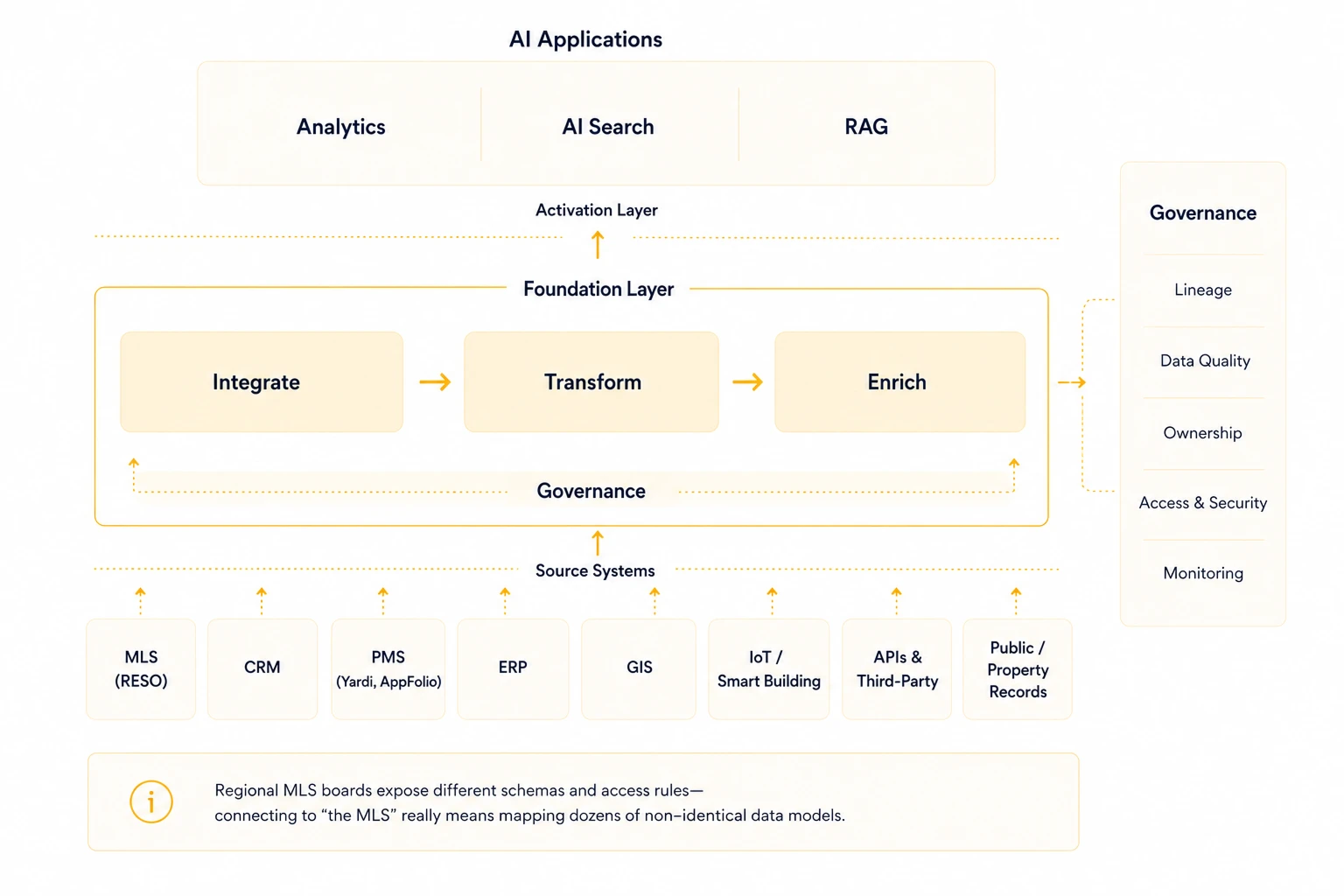
Where AI Gets Property Data: Mapping the Modern Real Estate Data Stack
Property data in a modern PropTech platform flows through layers.
At the base sit the inputs: MLS feeds (RESO-aligned), public and property records, CRM, PMS platforms such as Yardi and AppFolio, ERP systems, IoT and smart-building signals, third-party APIs, valuation providers, and geographic information systems (GIS).
Those feed an integration and transformation layer, then an enrichment layer, with governance running across all of it. Only at the top does AI sit, drawing on a single governed layer rather than the raw mess beneath.
One nuance makes this harder than it looks. MLS feeds vary by regional board in both schema and access terms, so “connect to the MLS” is really “map dozens of non-identical schemas, each with its own rules.” That variation, across real estate APIs with genuinely different data quality, is where a lot of integration effort actually goes.
Data Integration vs. Data Enrichment vs. Data Governance: Why All Three Matter
Integration, enrichment, and governance are sequential. Each depends on the one before it.
| Data Integration | Data Enrichment | Data Governance | |
| What it does | Brings sources together | Adds external context | Controls quality through validation, lineage, and access rules |
| Question it answers | Is the data connected? | Is the data deep enough to be useful? | Can we trust and defend it? |
| Business outcome | Unified pipeline | Predictive power | Reliability and compliance |
| When it happens | First | After integration and transformation | Continuously, across all stages |
Order is the part teams underestimate. Enrichment applied to unintegrated data appends tax and ownership records to duplicates and mismatched identities, so you pay to enrich the same property three times and still can’t trust the result. Basic pipelines pull records in. Data enrichment solutions add the tax, ownership, and demographic context a model needs to reason, but only once there’s one clean record per property to attach it to.
How to Assess Whether Your Property Data Is Ready for AI
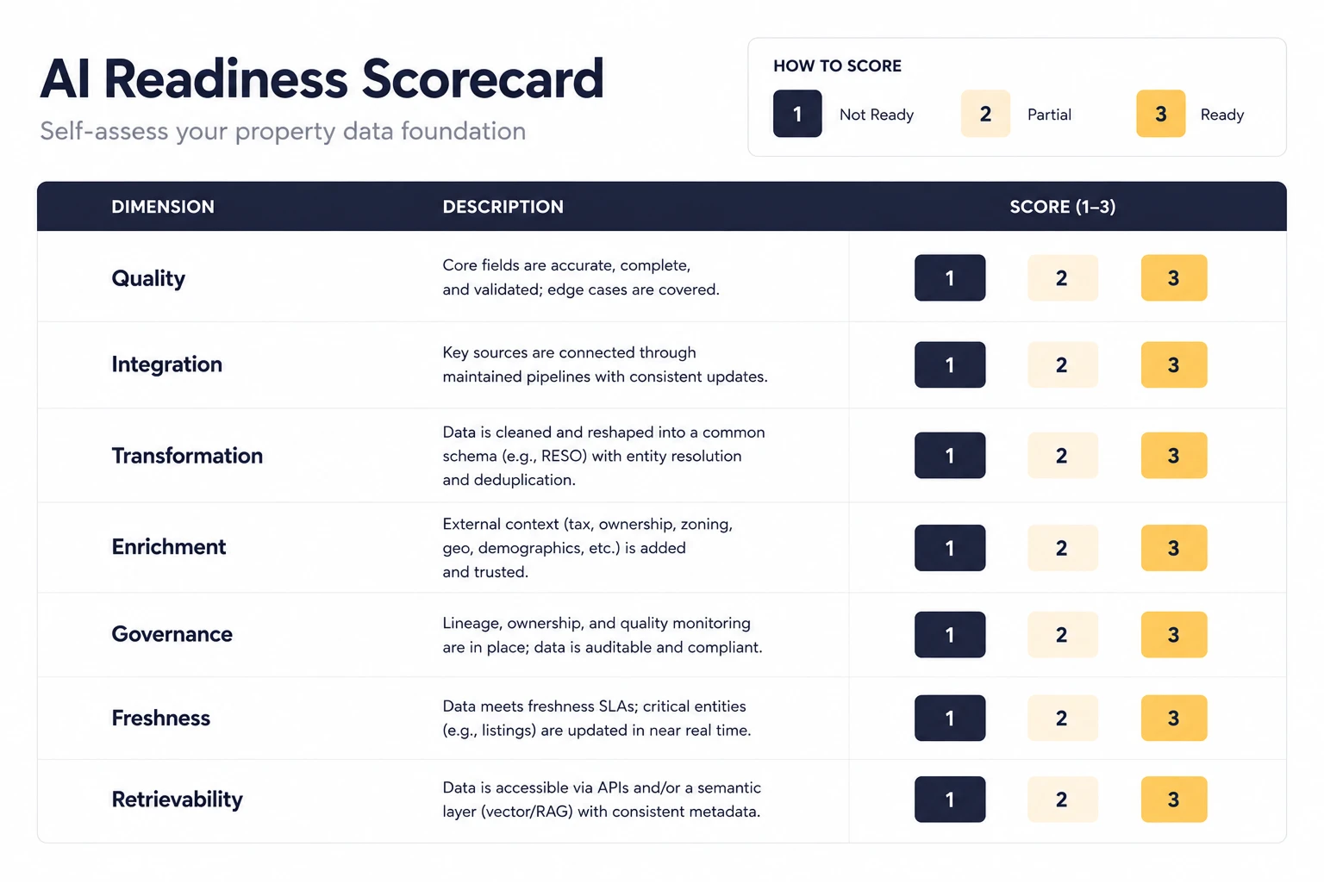
Score your data ecosystem across seven dimensions on a 1-to-3 scale: data quality, integration maturity, standardization, enrichment, governance, freshness, and retrievability.
A 3 is production-grade; a 1 means the dimension will block a model regardless of how good the model is. As a rough anchor:
- A 1 is unmanaged, with no standard and known gaps.
- A 2 works for reporting but may break under the volume or edge cases a model introduces.
- A 3 holds up in production today.
In PropTech specifically, the dimensions that most often score lowest are standardization and freshness. MLS and PMS feeds arrive in incompatible schemas, and listing status changes faster than most pipelines refresh.
The lowest score sets the priority. If any dimension scores a 1, that gap is the next project, not the AI feature it’s meant to support. Most teams have at least one. In an AWS survey, more than half of companies across industries judged their data not ready for AI use.
Self-scoring is directional. A structured application design audit exposes the database and pipeline risks a team tends to score too generously on its own, before any model training begins.
Common Mistakes Companies Make Before Investing in AI
The most costly mistakes here are decisions, not data defects. A few recur often enough to name.
- Funding the model before the foundation. Budget goes to an AI capability the data can’t support, so the pilot either stalls or ships on data that produces results the team can’t defend.
- Trusting an internal read on data quality. Self-assessments run optimistic. The duplicate rates, missing fields, and schema gaps that surface in an audit are consistently worse than the team estimated.
- Leaving data ownership unassigned. With no steward accountable for quality, definitions drift between teams. No one is responsible when a downstream model inherits the inconsistency.
- Deferring standardization to move faster. The cost doesn’t disappear; it moves to the model stage, where reconciling identities and schemas after the fact is more expensive than doing it upstream.
- Building on manual data entry. Hand-keyed records are where most duplicates and inconsistencies originate, and they scale with headcount rather than being fixed by it.
Two decisions compound these. The build-versus-buy call often gets made too early, with a team licensing a platform when a tailored pipeline is the real need. Weigh building custom software vs buying against who controls the data model at the end.
Search design is also frequently underestimated. When we built AI-powered property search, listings had to be normalized before natural-language queries returned anything reliable, because the query layer is only as consistent as the records beneath it.
Building an AI-Ready Property Data Foundation: A Practical Roadmap
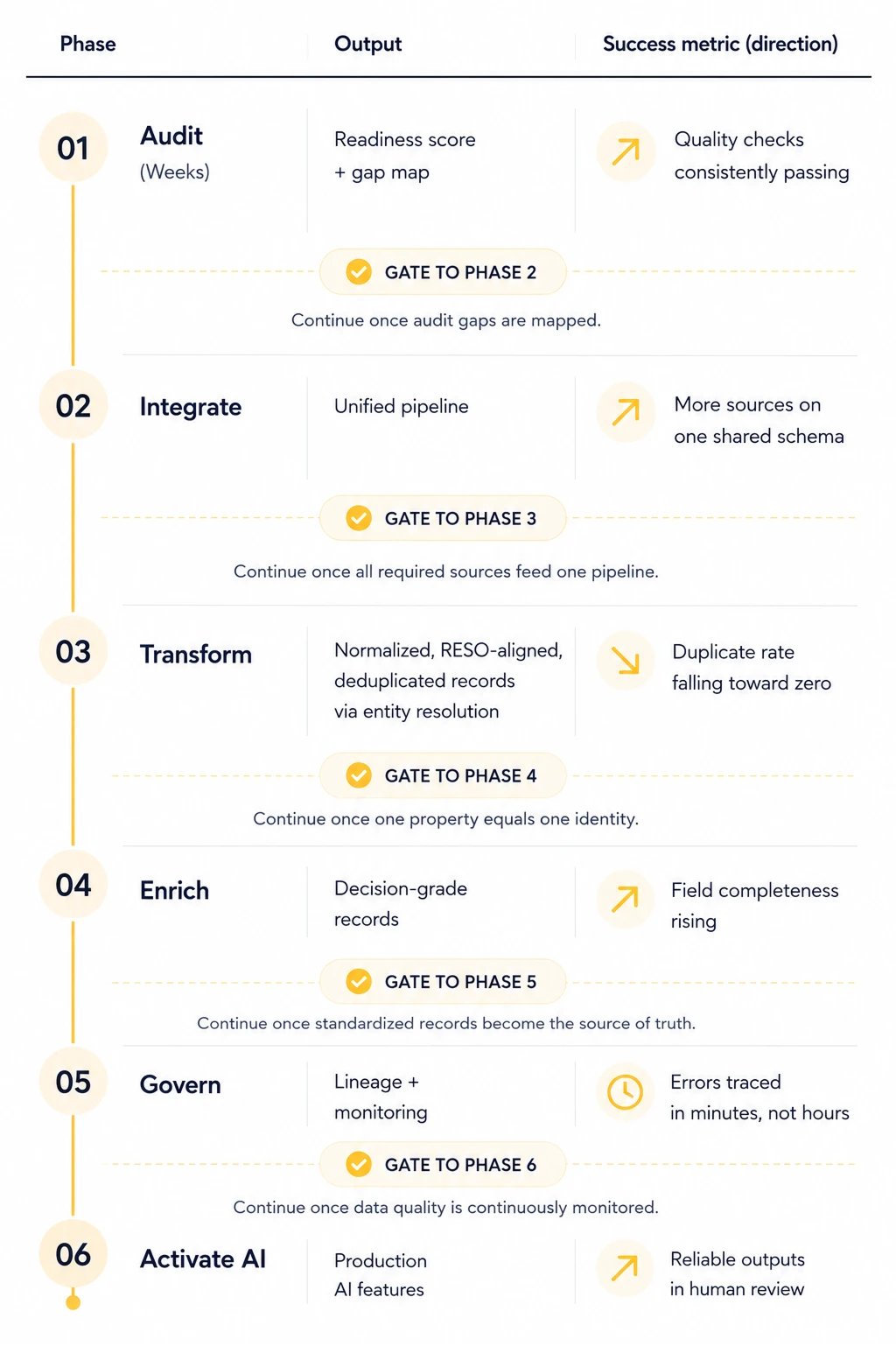
The framework describes the stages. The sequence below is how to execute them, with each phase gated on the one before it.
The gating is the point. A field-completeness problem discovered during enrichment is cheap to fix; the same problem discovered after a model is live means retracing every downstream output it touched.
Two phases carry more weight than their position suggests.
The audit determines everything after it. Before any integration work, the useful output is a data audit report and opportunity map: what sources exist, where the gaps and inconsistencies are, and what it would cost to acquire or enrich the data you’re missing. Most of that first phase is planning a move off legacy silos without losing record integrity, which is a controlled database migration, not a rebuild.
Integration is where naive plans break. Connecting sources is more than authentication and a data-lake write. It’s the work that decides whether the pipeline holds. Scenario planning for the cases that don’t fit the happy path: no match found, malformed records, a provider feed that changes without notice. A pipeline that drops those cases silently is worse than no pipeline, because the model inherits the gaps without anyone knowing.
From there, the order is fixed: you can’t resolve identities on data you haven’t integrated, can’t enrich records you haven’t resolved, and can’t govern a layer whose lineage you never captured. Treating it as a staged product build rather than one large project is what proven real estate product roadmaps get right: validate each phase before scaling to the next.
How ORIL Helps Build AI-Ready Property Data Platforms
A decade of PropTech focus means clients don’t have to explain to us the domain from scratch. That specialization is the core of our real estate software development work, and it’s why integration and transformation start faster with a team that already knows how MLS feeds and PMS data models behave.
The work usually starts before any model, with a data audit report and opportunity map: where the sources are, where the gaps and inconsistencies sit, and what it would cost to close them.
From there, we connect the systems a real estate platform actually runs on: property management systems such as Yardi, AppFolio, and RealPage, brokerage platforms like Dotloop and kvCORE, and CRMs including Salesforce and HubSpot. Then, enrich each record with ownership, mortgage, valuation, and rental-comp data drawn from providers such as Cotality, BatchService, and RealEstateAPI.
The proof is in the delivery rather than the pitch. The AI analytics assistant we built for property managers derived its value from the governed data underneath, not the model on top. Our work on AI-powered property search only functioned once listings were normalized ahead of natural-language querying.
That work spans the disciplines this article has covered: data integration, data enrichment, analytics platforms, and AI enablement. The difference from a generic development shop is that rather than executing an AI specification as written, ORIL questions the data first.
Key Takeaways
- In PropTech, most underperforming AI initiatives are held back by the data feeding the model, not the model itself.
- AI-ready property data is complete, consistent, standardized, enriched, governed, fresh, and retrievable.
- The Property Data Readiness Framework (Collect, Integrate, Transform, Enrich, Govern, Activate) is a dependency chain: each stage relies on the one before it.
- Assess before you invest. The lowest-scoring readiness dimension, not the AI model, is your first project.
- The organizations pulling ahead invest in the foundation as much as the model, and they treat data readiness as ongoing infrastructure.
Where an AI Strategy Should Actually Begin
The order of operations decides the outcome. A PropTech platform with clean, connected, and governed property data will get more from an off-the-shelf model than a competitor running a fine-tuned one on fragmented feeds.
AI does not create the advantage. The property data foundation underneath it does, and that is where an AI strategy should start.
So before you evaluate another model, evaluate your data. Score your ecosystem against the readiness dimensions above and find the weakest link, because that gap is your real first project.
If you want an outside read on whether your property data is AI-ready, ORIL’s dedicated development team can assess your current data maturity and map out a path to a modernized foundation for your specific stack.


