

Give a Document AI model a single commercial lease, and it will often find the base rent, the expiration date, and the renewal option. Give it the full file for an office tenant several years into its lease, and the answers multiply. The original lease states one rent, a 2024 amendment resets it, and an extension restates the first figure in its recitals.
Underwriting and portfolio systems need one answer per term, for a specific date, with the source behind it. Getting there means linking each document to the right lease, tracking what each one changed and when, and deciding which value applies. That work sits in the platform around the model, and it is what the sections below cover.
Quick Checklist: What Makes Lease Abstraction Production-Grade
Production-grade commercial real estate (CRE) lease abstraction turns extracted observations from related documents into a reconciled, traceable record of the contractual terms applicable on a given date.
- Documents are linked to the correct lease
- Effective dates and amendment scope are captured
- Extracted observations are reconciled into applicable lease terms
- Material values stay linked to their source evidence
- Unresolved conflicts are routed for review
Key Terms in Commercial Lease Abstraction
| Term | Definition |
| Lease abstraction | The conversion of lease documents into structured, queryable data |
| Lease intelligence | Structured lease data with reconciled, validated terms for a specified period, linked to the source evidence supporting each material value |
| Extracted observation | A value extracted from a document, linked to its source location |
| Lease term | A contractual provision in structured form, such as a rent schedule, renewal option, or rentable area |
| Extraction confidence | A signal of extraction certainty, which is not necessarily a probability that the value is correct |
| Lease data reconciliation | Determining which extracted terms apply, based on document relationships, scope, and effective dates |
| Reconciled lease state | The contractual terms applicable to a lease on a specified date |
| Provenance | The evidence linking a lease value to its source and reconciliation decision |
Why Lease Data Matters to Commercial Real Estate Platforms
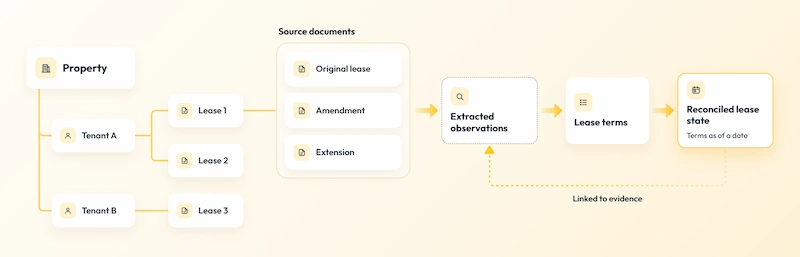
A CRE platform connects properties, tenants, leases, and the documents behind them. At a conceptual level, lease intelligence develops through the sequence below, although one tenant can hold several leases and one lease can cover several premises.
| Lease information | Downstream use |
| Rent, escalations, and concessions | Rent rolls and cash-flow projections |
| Commencement and expiration dates | Lease rollover and occupancy analysis |
| Premises and rentable area | Occupancy and rent-per-square-foot comparisons |
| Options and operating expense terms | Renewal scenarios and expense recovery |
| Tenant entity and guarantor | Tenant concentration and credit exposure |
Lease administration systems, cash-flow and valuation tools such as ARGUS Enterprise, and investment intelligence platforms all consume these inputs in different ways. Incorrect rent or expiration data can distort the rollover and cash-flow assumptions they rely on.
Why Commercial Real Estate Lease Abstraction Is Harder Than the Demo
The difference becomes clear when the unit of processing changes from a single document to a lease relationship that evolves over time. Across commercial real estate more broadly, Deloitte’s 2027 Commercial Real Estate Outlook found that 92% of surveyed respondents were in the piloting or research phase of AI adoption, while 8% had integrated AI solutions.
The survey covers AI adoption in general, but the gap between pilots and production is particularly relevant for document-heavy CRE workflows, where reliable outputs depend on more than extraction accuracy.
| Document AI demo | Production lease platform | |
| Input | One clean lease PDF | Leases, amendments, exhibits, notices, and uneven scans |
| Unit of work | A document | A property-tenant-lease relationship over time |
| Output | Extracted fields | Reconciled lease state for a given date |
| Conflicts | Out of view | Detected, reconciled, or routed to review |
| Evidence | May be absent | Linked to each material value |
| Quality measure | Selected-field extraction accuracy | Layer-specific evaluation, lease-state accuracy, and regression results |
Where Commercial Lease Documents Create Conflicting Observations
Each document type plays a different role in the lease record:
| Document | Role in the lease record |
| Original lease | Establishes the initial contractual terms |
| Commencement date memorandum | Confirms actual dates when the lease ties them to delivery of the premises |
| Amendment | Changes specified provisions, such as rent, premises, or term |
| Extension or renewal | Extends the lease and may set terms for the new period |
| Notices, exhibits, and confirmations | Provide supporting schedules or record events such as option exercises and assignments |
| Estoppel certificate | Records a tenant’s confirmation of specified lease terms, often during an acquisition or refinancing, and can serve as an additional source for checking the lease record |
Document Relationships, Scope, and Effective Dates
A later document does not automatically replace the original lease. The system needs to identify which lease the document belongs to, which provisions it changes, and when those changes take effect. Execution status, conditional provisions, and option exercises also matter: a signed amendment and an unexercised renewal option cannot be treated as equivalent evidence.
Example: When Multiple Lease Documents Contain Different Terms
Consider a hypothetical office lease for Suite 400, with all figures invented for illustration. The example assumes the extension is unconditional and fully executed. A conditional extension or an unexercised option would produce a different result.
| Document | Effective date | What it says | Extracted observations |
| Original lease | March 1, 2020 | Base rent $32.00/RSF/year, 3% annual increases, term ends February 28, 2030 | Rent $32.00, escalation 3%, expiration February 28, 2030 |
| First amendment | January 1, 2024 | Base rent resets to $30.50/RSF/year, increasing 2.5% each January 1 | Rent $30.50, escalation 2.5% |
| Extension amendment | Signed June 2026; extended period starts March 1, 2030 | Adds an extended period ending February 28, 2035, confirms that the existing rent schedule continues, and includes a recital referencing the original $32.00 rent | Final expiration February 28, 2035, rent $32.00 (from the recital) |
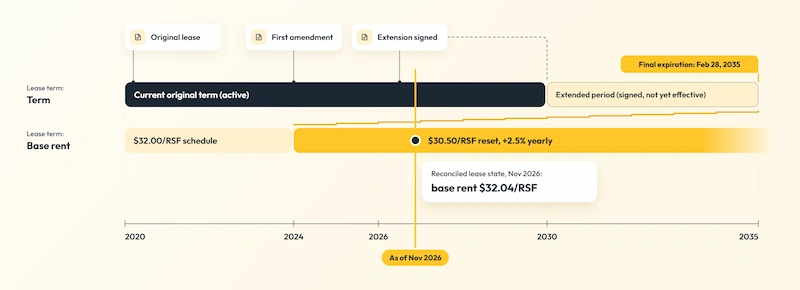
The extraction is textually correct: the extension amendment contains the figure of $32.00 per RSF in a recital. Identifying that figure does not establish that it is the operative rent for the relevant period.
Intentionally flawed output (illustrative): a “latest document wins” rule treats the extension as the current record and reports base rent of $32.00/RSF/year.
Reconciled lease state as of November 2026:
- Current rent: $32.04/RSF/year under the first amendment’s schedule, after the January 2025 and January 2026 increases.
- Current period: the lease is currently within its original term, which runs through February 28, 2030.
- Final expiration date: the executed extension has already established February 28, 2035 as the lease’s final expiration date. The extended period begins March 1, 2030.
- Recital figure ($32.00): retained as source evidence and not treated as a new rent-setting provision in this hypothetical.
The difference is small in 2026, but if the system treats the recital figure as the current base rent, the discrepancy grows as subsequent annual increases are applied. Correctly extracting a figure from a document does not guarantee that the platform has identified the rent applicable to the lease.
Why Reconciliation Is the Core Engineering Problem
Reconciliation determines how extracted observations combine into the terms that apply during a particular period. Before comparison, values are normalized to common units and rent periods, with the original value kept as evidence. The main factors are:
- Document relationship and scope
- Effective date and applicable period
- Type of contractual provision
- Source context: whether a value appears in an operative clause, an exhibit, or a recital
- Portfolio-specific business rules
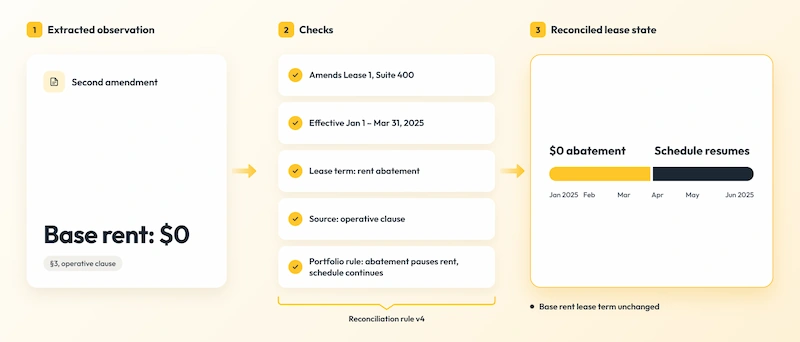
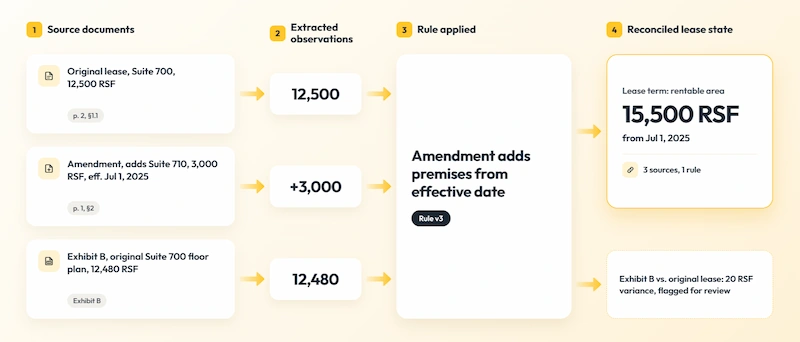
Reconciliation rules encode how the platform handles recurring lease patterns. For example, an executed amendment may supersede an earlier rent schedule from its effective date if it explicitly changes the relevant provision and premises. Rules should be versioned and tested against known lease scenarios:
- Record the rule version applied to each result
- Cover known patterns in test cases, including partial-premises amendments, rent abatements, fair market value extensions, and recitals that restate earlier terms
- Route cases with insufficient evidence to review instead of selecting a value arbitrarily
Build the Data Model Around Lease Documents and Terms
The important modeling decision is to keep extracted observations separate from the contractual terms the platform determines to be applicable. An observation records what a document says. A lease term represents a contractual provision. The reconciled lease state brings together the terms that apply for a specified period, and each derived value keeps its connection to the observations and rules behind it.
Lease attributes such as base rent, rentable area, and expiration date also need consistent definitions across the platform.
Engineer a Production-Grade Real Estate Lease Intelligence Pipeline
AI-assisted processing and platform engineering divide the work roughly like this:
| AI-assisted processing | Lease platform responsibilities |
| OCR and document classification | Document linkage and verification |
| Clause and field extraction | Structured lease observations |
| Detection of potential changes | Temporal reconciliation and validation |
| Confidence signals | Evidence, exceptions, and lease-state evaluation |
The two columns describe functional responsibilities and do not map to rigid product boundaries. Managed document-processing services may provide orchestration, classification, or extraction, while the platform’s engineering layer remains responsible for how those outputs are validated, reconciled, and used.
Extraction may use a managed service such as Amazon Textract, Google Document AI, or Azure AI Document Intelligence, a large language model (LLM) with a structured output schema, or a combination. The choice affects processing cost, latency, document handling, and extraction behavior.
The integration layer must map reconciled terms to the records and workflows used by existing lease administration, property management, and underwriting applications, so updates can reach the teams and models that depend on them.
Keep Extraction Separate From Contractual Interpretation
AI-assisted clause interpretation helps identify relevant provisions and potential changes. The platform should still store extracted language separately from the rules that determine applicable terms.
When contractual meaning is ambiguous or depends on legal context, the system should preserve the uncertainty and route the case for review instead of presenting an automated interpretation as definitive.
What “At Scale” Means for Lease Intelligence
Document volume is usually the easier part of scale.
Each acquisition adds leases with their own amendment histories, documents drafted by different landlords and counsel, and lease structures the reconciliation rules have not seen yet. Exception queues grow with them.
A lease intelligence system works at scale when a lease added this quarter gets the same treatment, and the same lease-state answer, as one processed two years ago.
Make Real Estate Lease Intelligence Traceable and Validated
Provenance
Each lease term in the reconciled lease state should link to its source document, extracted observation, and reconciliation decision. An analyst can then trace a rent figure or expiration date back to the evidence behind it.
Uncertainty
Three lease-specific cases need explicit handling:
| Condition | Example |
| Conflicting provisions | Two documents indicate different rents for the same period |
| Ambiguous provision | Renewal rent depends on a fair market value determination that is not yet available |
| Uncertain document relationship | An amendment cannot be confidently linked to a particular lease |
Two observations can conflict even when both carry high extraction confidence. Extraction confidence should be evaluated against reviewed examples, since a model-generated confidence score alone does not establish that a value is correct.
Validation
Four useful checks include:
- Temporal consistency: check rent periods, commencement dates, and expiration dates against the contractual timeline, flagging unexpected overlaps or gaps.
- Lease-level consistency: check whether rentable area, premises descriptions, and rent calculations agree with the applicable lease provisions.
- Business rules: apply portfolio-specific validation rules to escalations, concessions, operating expenses, and other material terms.
- Cross-source checks: compare reconciled terms with rent rolls and lease administration records, and investigate discrepancies instead of automatically favoring one source.
A lease history where every change links back to its source is also a long-term product asset. Read how a proprietary data moat forms around well-maintained real estate data.
How to Evaluate Commercial Real Estate Lease Abstraction
Field accuracy alone hides where errors come from. Measure each step through to the lease state:
| Dimension | What to measure |
| Field extraction | Precision and recall for important lease attributes |
| Entity resolution | Whether documents are linked to the correct lease |
| Reconciliation | Whether conflicting observations resolve to the correct terms |
| Lease-state accuracy | Whether the applicable terms match a reviewed answer for a given date |
| Exception and evidence coverage | Whether unresolved cases are flagged and material values retain source evidence |
For platforms that use lease data in underwriting and portfolio analytics, lease-state accuracy is a particularly important measure, because it reflects the terms downstream applications consume. The earlier example shows how a system can extract every figure correctly and still produce an incorrect lease state.
Regression Testing When Models, Prompts, Schemas, and Lease Rules Change
Lease processing results can change when a model, extraction schema, or reconciliation rule is updated. A revised rent-extraction schema may change how annual and monthly amounts are represented. A modified reconciliation rule may alter which amendment governs a particular lease period. Both changes can affect previously processed leases as well as newly ingested documents.
Re-run the reviewed lease dataset whenever extraction models, prompts, schemas, or reconciliation rules change, and compare the results with the previous version.
Human Review for Unresolved Lease Exceptions
Specialist review is still necessary when the system cannot establish a reliable lease state. Instead of sending every extracted field for manual checking, a production workflow can route material exceptions to specialists:
- Contractual ambiguity: for example, a fair market value renewal clause without a documented determination
- Unresolved conflicts: competing provisions that existing reconciliation rules cannot resolve
- Document-linkage uncertainty: amendments or notices that cannot be confidently associated with a lease
Reviewed decisions can become part of the evaluation dataset and help refine future reconciliation rules.
How Lease Data Errors Affect Downstream Applications
In the earlier example, the rent discrepancy is small in 2026 but grows with subsequent increases. Across multiple leases, similar errors can distort projected cash flows, while incorrect expiration dates can affect rollover assumptions. The impact depends on the terms involved and how downstream applications use them.
ORIL supports this work through AI enablement and product development: defining the right use case and engineering architecture, then building, testing, and integrating the capability into the wider platform. If you’re developing or modernizing an investment or portfolio platform, talk to our team about your lease data requirements and product roadmap.


