
A platform can connect a dozen systems and still behave as if it connects none of them.
The listings service reports one count of active properties, the analytics dashboard reports another, and finance keeps a third in a spreadsheet.
Each number is correct inside its own system. None of them agrees, because every system carries its own definition of a Listing, a Property, and an Agent.
This is usually diagnosed as an integration problem, so teams add another connector. The connector works, and the disagreement gets worse.
At ORIL, most of the real estate software development work that starts as “help us connect these systems” turns out to be an architecture question underneath: the platform was assembled around the tools it uses instead of the business it runs. This article is about that upstream decision, the one that determines whether backend services, APIs, reporting, and AI hold together as the platform grows.
The Root Cause: PropTech Platforms Are Built Around Systems Instead of Business Models
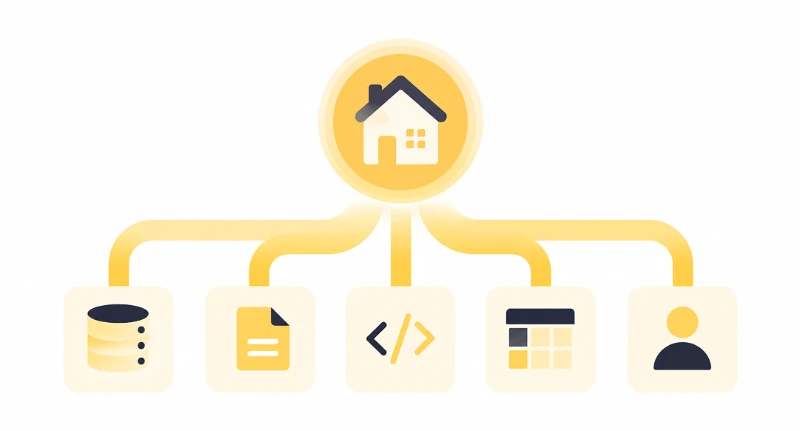
Fragmentation usually accumulates. A platform ships with an MLS (multiple listing service) feed, then adds a CRM (customer relationship management) system, then a transaction system, then a PMS (property management system), then a few internal tools. Each arrives with its own data model, and each becomes a small authority on the entities it touches:
- The MLS is the source of truth for listing data.
- The CRM holds the authoritative record for relationships and leads.
- The transaction system governs deal execution.
- The PMS runs property operations, leases, and units.
- Internal tools cover whatever the others leave out.
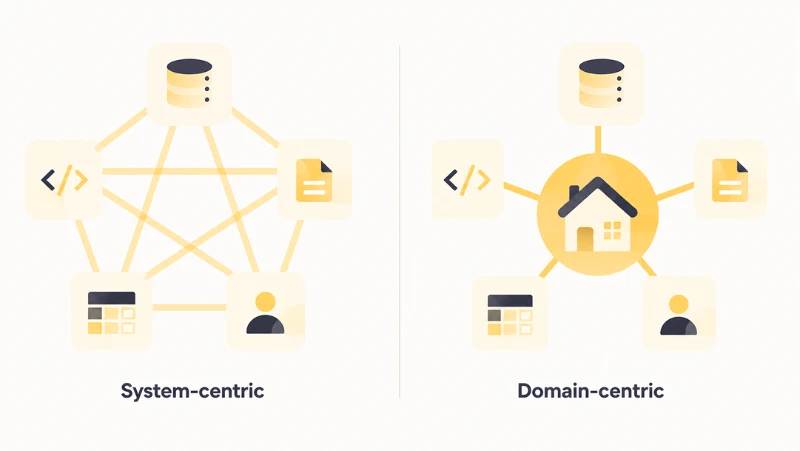
No layer owns the business itself. A system-centric platform models the software it bought. A domain-centric platform models Property, Listing, Agent, Customer, and Transaction directly, then treats every vendor as a source that feeds those definitions. The difference is invisible at first and expensive later, which is why digital transformation services engagements so often start with untangling entity ownership before anything gets rebuilt.
The distinction matters more in real estate than in most verticals, because so much of the stack is external and standardized on its own terms rather than yours. We’ve written before on why a data platform beats a CRM as the system of record for exactly this reason: wrapping the business around a CRM’s schema can lock transactional records away from property data.
Why Fragmented Data Models Stall Engineering Velocity
When entities are defined per system, engineering spends its time reconciling versions of the same thing instead of building. A single business object fractures into several:
- Multiple Property definitions, each with different fields and identifiers.
- Different Listing structures depending on which feed produced them.
- Duplicate Agent and Customer records with no shared key.
- Conflicting IDs that require a mapping table to resolve.
- Mapping and translation logic that grows with every new source.
Each of these is a small tax. Together they compound into slower feature delivery and rising maintenance costs, because business logic gets copied into each system’s dialect and has to be maintained in all of them.
The clearest way to see it is a new feature. Adding a consumer marketplace to a fragmented platform means touching the MLS ingestion code, the CRM’s contact model, the transaction system’s deal records, and the reporting layer separately, since none of them shares a definition of a Listing or a Customer.
The same feature on a unified platform extends existing entities instead of reconciling four copies of them. That gap is what real estate data integration work is meant to close, by insulating the product from each source’s schema rather than propagating it upward.
Fragmented Entities Weaken the Numbers Leadership Relies On
Inconsistent reporting reads like a business intelligence problem, so it gets sent to the BI team. They usually can’t fix it, because the fault is one layer down. A dashboard can only aggregate the entities it is given. If revenue is defined three ways across three systems, the dashboard will faithfully produce three revenue numbers.
Fragmented entities surface as:
- Different revenue figures across departments.
- Agent performance metrics that don’t reconcile.
- Property analytics that shift depending on the source.
- Poor visibility into the customer lifecycle across systems.
- Forecasting built on inputs that were never comparable.
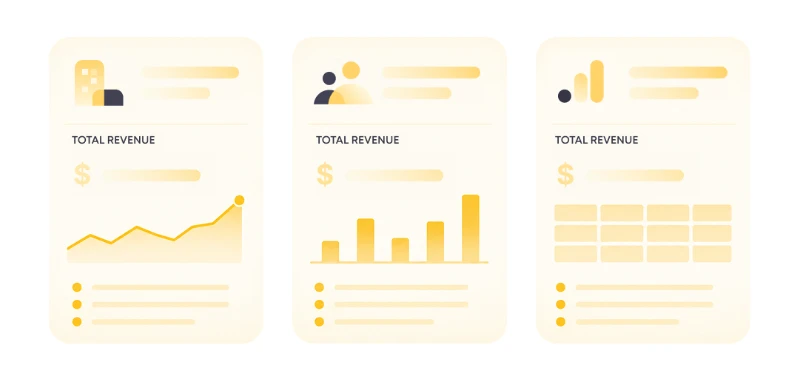
No visualization layer can resolve this on its own. Trustworthy executive reporting requires a single authoritative definition of each entity underneath it, which is the argument for building data-native real estate platforms where entity relationships are standardized before analytics is ever attached.
Why Integrations Alone Cannot Create a Scalable Real Estate Platform
An integration moves records between two systems. A platform architecture defines the business model those records are mapped into. The two are often confused because both involve connecting things, but they solve different problems, and one does not scale into the other.
As of July 2026, RESO tracks 489 MLS systems in the United States, each independently operated with its own schema and access terms. Integration alone may not resolve that fragmentation. Point-to-point integrations often introduce another source-specific representation of the same entities and another mapping to maintain. Past a certain number of sources, integration count becomes a liability rather than coverage.
The alternative is to make integrations adapters into a shared model, so a source can change without disrupting products built on top. That decision is a build-vs-buy question worth taking seriously; our build vs buy guide for real estate software walks through when a custom data layer earns its cost.
It also has a security dimension, since point-to-point sprawl widens the attack surface, which is part of why securing third-party API integrations through a managed layer matters as the source count grows.
What a Unified Domain Model Actually Contains
A unified data model is a single, authoritative definition of each business entity that the whole platform shares, independent of any vendor’s structure.
The industry term is a canonical model: one representation that every system maps into and reads from, rather than several parallel ones. These entities are platform assets. They exist whether or not a given MLS, CRM, or PMS is connected today.
For a PropTech platform, the core domains are consistent:
- Property: the physical asset, independent of which feed described it.
- Listing: a marketing state of a property, with its own lifecycle.
- Agent: a single record across CRM, MLS, and transaction systems.
- Customer: buyer, seller, or tenant, resolved to one identity.
- Transaction: the deal, from offer through close.
- Lease: the tenancy relationship and its terms.
- Organization: brokerages, teams, and partners.
- Documents, Financial Operations, and Market Intelligence: supporting domains every product reuses.
New capabilities extend these entities instead of introducing parallel ones. This is where property management software development tends to go wrong: lease and financial records get modeled around whichever PMS was integrated first, so the tenant-property relationship never becomes a reusable platform entity.
How ORIL Designs a Unified PropTech Data Architecture
When we design a unified PropTech platform, we typically organize it across six layers, though how each one takes shape varies by platform.
| Layer | What it owns | Why it exists |
| 1. Business Domains | The real workflows and entities the company runs on | Defines the platform in business terms before any tool is chosen |
| 2. Canonical Domain Model | One authoritative definition of each entity | Removes duplicate, conflicting versions of the same object |
| 3. Platform Services | Backend services that own business capabilities | Business logic lives in the platform, not inside vendor connectors |
| 4. API Layer | Stable contracts expressed in the platform’s own model | Products and partners build against business entities, not vendor schemas |
| 5. Integration Layer | Adapters that map external systems into the canonical model | MLS, CRM, and PMS become replaceable data sources |
| 6. Intelligence Layer | Analytics, automation, and AI on the canonical model | Every downstream capability reads one trustworthy definition |
In practice the build follows five steps:
- Business domain discovery. Identify the core entities, workflows, and system dependencies before modeling anything.
- Data model architecture. Define canonical entities and their relationships, independent of vendor structures.
- API and integration architecture. Design the interfaces between external systems and the core platform.
- Backend platform development. Build services around business capabilities, not around the systems they draw from.
- Analytics and AI foundation. Establish a trusted data layer that reporting, automation, and AI can rely on.
Two decisions inside this approach carry most of the weight.
The Integration Layer is where MLS, CRM, transaction management, and PMS get demoted from architecture to source. Each becomes an adapter that normalizes its data into the canonical model before anything downstream sees it.
The MLS supplies market and listing data, the CRM supplies relationships, the transaction system supplies deal execution, and the PMS supplies operations, but none of them defines the platform.
Designing that layer well starts with understanding each source on its own terms, which is why the MLS integration overview is a useful foundation before building the adapter around it.
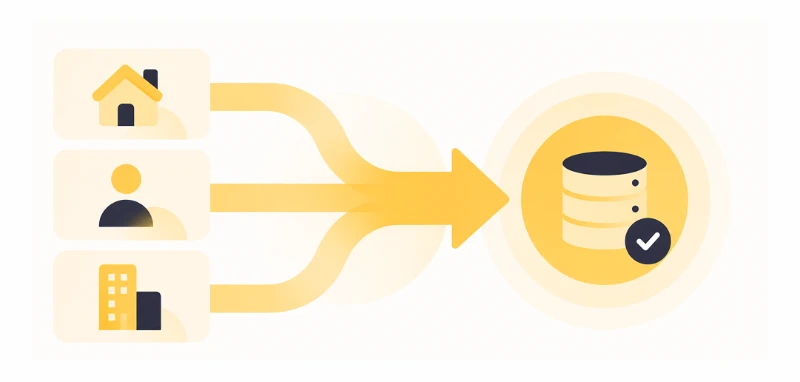
The API Layer must express the platform’s business model rather than mirror vendor structures.
When an API exposes a specific MLS’s fields, every product built on it inherits a dependency on that vendor. When the API exposes Property, Listing, and Transaction as the platform defines them, integrations can change underneath without touching the products above.
This is the broader shift we described in the real estate API transformation: API design should follow the business model, not the source.
Refactoring core schemas while a product keeps shipping is the hard part operationally. Teams handling this without stalling their roadmap usually run it through a dedicated development team working alongside the in-house group rather than pausing feature work.
How Unified Architecture Enables Analytics, Automation, and AI
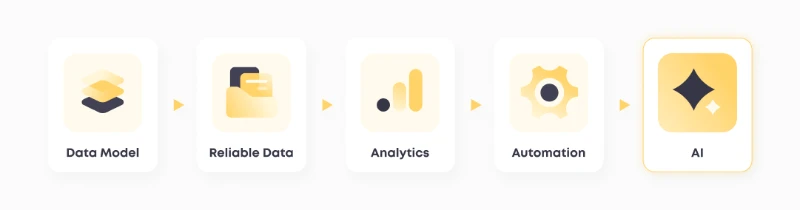
Every advanced capability sits on top of a dependency chain that a fragmented platform cannot support. Each stage depends on the one before it:
- A unified data model
- produces reliable data
- which supports trustworthy analytics
- which supports scalable automation
- which is what makes AI viable
Automation is the clearest example. Workflow automation only scales when every application references identical entities. Otherwise, automation accelerates inconsistent processes and multiplies the reconciliation work instead of removing it.
AI sits at the far end of the chain, which is why pilots may stall on data cleanup. MIT’s State of AI in Business 2025 report found that 95% of generative AI pilots fail to deliver measurable business impact.
The failures cluster not around model quality but around integration and data fundamentals: pilots collide with fragmented data and rigid processes long before model performance matters. Recommendation engines, intelligent search, pricing models, forecasting, and copilots all depend on entities that mean the same thing across the platform.
Two examples make the dependency concrete:
- An AI property search that answers natural-language queries is only as good as the schema behind it.
- An AI assistant for property managers can only reason over a customer lifecycle if that lifecycle is defined once.
AI is an architectural outcome, not a bolt-on. The same pattern shows up across the 2026 PropTech trends worth planning around.
One foundation is what makes future expansion cheaper. New marketplaces, mobile apps, customer portals, partner ecosystems, and additional SaaS products reuse the existing entities instead of rebuilding them, which is why architecture decisions set the pace of every later product. Planning that evolution deliberately is the through-line in our real estate product roadmap guide for scaling from MVP to platform.
Signs Your PropTech Platform Needs Data Architecture Modernization
A few signals separate an integration issue from a structural one. If several of these are true, the constraint is architectural:
- Different teams maintain their own version of the same entity.
- Reporting numbers differ depending on which system produced them.
- Every new feature requires changes across multiple integrations.
- Data cleanup keeps blocking AI or analytics initiatives.
- Engineering velocity drops as the platform grows rather than improving.
- Routine changes feel risky because their blast radius is unclear.
- Vendor dependencies keep deepening, and swapping a source feels impossible.
These patterns usually mean the underlying model, not the connectors, needs work. When they appear alongside a legacy codebase, our guide to revamping legacy applications covers how to sequence that modernization, and the case for it is easier to make to stakeholders once you’re measuring real estate integration ROI across the operational touchpoints it affects.
You Don’t Need to Rewrite the Platform at Once
The target architecture in the last few sections can read like a rebuild, and for a team shipping features every sprint, a rebuild is a non-starter. It doesn’t have to be one. A canonical model can be introduced incrementally, with the live product running throughout the transition
The path usually looks like this:
- Wrap existing sources in adapters first. Each MLS, CRM, or PMS keeps feeding the platform as it does today, but through an adapter that maps its data toward the canonical model. Nothing downstream changes yet.
- Put an anti-corruption layer between old and new. This is the boundary that stops a vendor’s schema from leaking into the canonical model while both coexist, so the new model stays clean even though the old structures are still in play.
- Migrate one domain at a time. Start with a single entity, Property or Listing, prove the canonical version in production, then move to the next. The blast radius of each step stays small.
- Use dual-read or dual-write only where it earns its cost. For a domain being migrated, the platform can read from or write to both the old and new models during the transition. It adds complexity, so it’s worth doing where correctness during cutover matters and skipping where a clean switch is safe.
- Move consumers to the canonical APIs gradually. Products, reports, and services point at the old schema until the canonical API is ready for their domain, then switch one at a time rather than all at once.
Architecture Is the Decision Everything Else Inherits
The failure mode runs in one direction.
- Disconnected systems produce fragmented entities.
- Fragmented entities produce duplicated logic and slower delivery.
- Slower delivery produces reporting that won’t reconcile, automation that spreads inconsistency, and an AI layer with nothing stable to stand on.
Each stage inherits the flaw from the one before it, and no downstream fix reaches back up the chain to correct it.
That is why domain modeling belongs at the front of the build, not on a cleanup backlog reached once the platform is already hard to change. A platform designed around stable business entities keeps the cost of every future product bounded, because each new capability extends what already exists. A platform designed around its vendors pays that cost again with every integration it adds.
This is the layer ORIL is built to own: we design the canonical model, backend services, and API contracts that a platform’s future marketplaces, portals, and AI features. get built on, while the MLS, CRM, and PMS feeding them stay replaceable underneath.


