

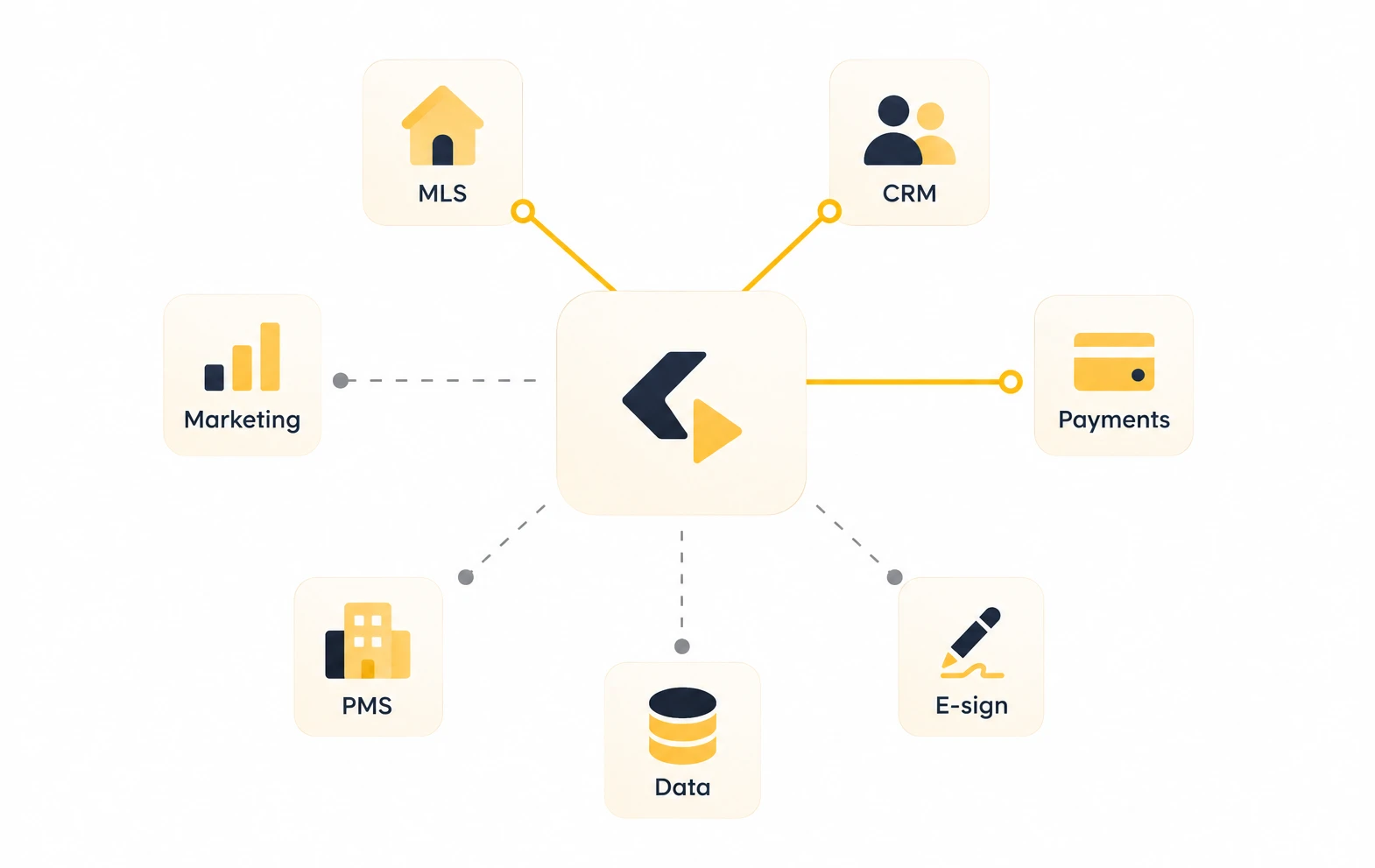
Ask a PropTech team how many systems their platform connects to and you’ll usually get a number they’re a little proud of. A typical platform ties into an MLS feed, a couple of CRMs, a payments provider, an e-signature vendor, and a scatter of data sources, yet it still converts and retains about the way it did a year ago. So the question worth asking about real estate platform integrations isn’t how many you can support. It’s which ones earn their keep, and which ones just quietly bill you in maintenance for the rest of their life.
The answer starts with what an integration actually is: infrastructure. The business outcome shows up a step later, in the product capabilities that infrastructure unlocks, and only when those capabilities remove friction from something a customer already pays for. A CRM connection does not make money on its own; the money comes from reaching a lead while they still care. An MLS feed works the same way. What customers pay for is a search that returns accurate, current, complete inventory.
Capabilities like those rarely come from integrations alone. In enterprise PropTech products, they run on a dedicated data platform that unifies, normalizes, and governs information before it reaches customer-facing features. That is engineering work, not a connector you switch on.
This article holds each integration to the same questions: what business goal it serves, what capability it unlocks, which KPI should move, and whether you should build it, buy it, or leave it alone. Answering them well is where real estate software development services earn their value.
Impact Comes From Better Workflows, Not More Integrations
Think of your integration layer as revenue infrastructure. It earns its cost only when it improves one of five things:
- Acquisition
- Conversion
- Transaction completion
- Retention
- Operational efficiency
If a proposed integration doesn’t map to one of those, it’s a utility at best and technical debt at worst.
Which integrations even belong on your roadmap depends on what kind of platform you’re running, and “real estate platform” covers far more than listings and brokerage. Each subdomain leans on a different set of systems:
| Platform type | The integrations that carry it | What they’re there to move |
| Listing marketplace | MLS and listing databases (Zillow, Trulia, Redfin), mapping and location services, media pipelines | Search relevance and contact requests |
| Brokerage platform | CRM (HubSpot, Salesforce, Follow Up Boss), communication and analytics services, e-signature and payment gateways | Lead response time and conversion |
| Property management | PMS (Yardi, AppFolio, RealPage, Buildium), accounting, maintenance and vendor systems, payment processing | Operational cost per unit |
| Smart building and energy | IoT devices and HVAC (Siemens, Schneider Electric, Honeywell), energy platforms (Energy Star, utility meters), climate-risk tools | Energy cost and building performance |
| Investment and portfolio | Market and property data (CoStar, CoreLogic, ATTOM, HouseCanary), financial platforms (Plaid, Stripe), risk and geospatial tools | Decision speed and portfolio return |
| Construction | Construction platforms (Procore, Buildertrend), ERP and project management, predictive-maintenance and security systems | On-time, on-budget delivery |
The systems differ by subdomain, but the decision underneath is identical everywhere: an integration earns a place on the roadmap only when it moves one of those KPIs. That shared logic is what the rest of this article lays out, and it applies whether you’re wiring an MLS feed into a marketplace or an HVAC telemetry stream into a smart-building platform.
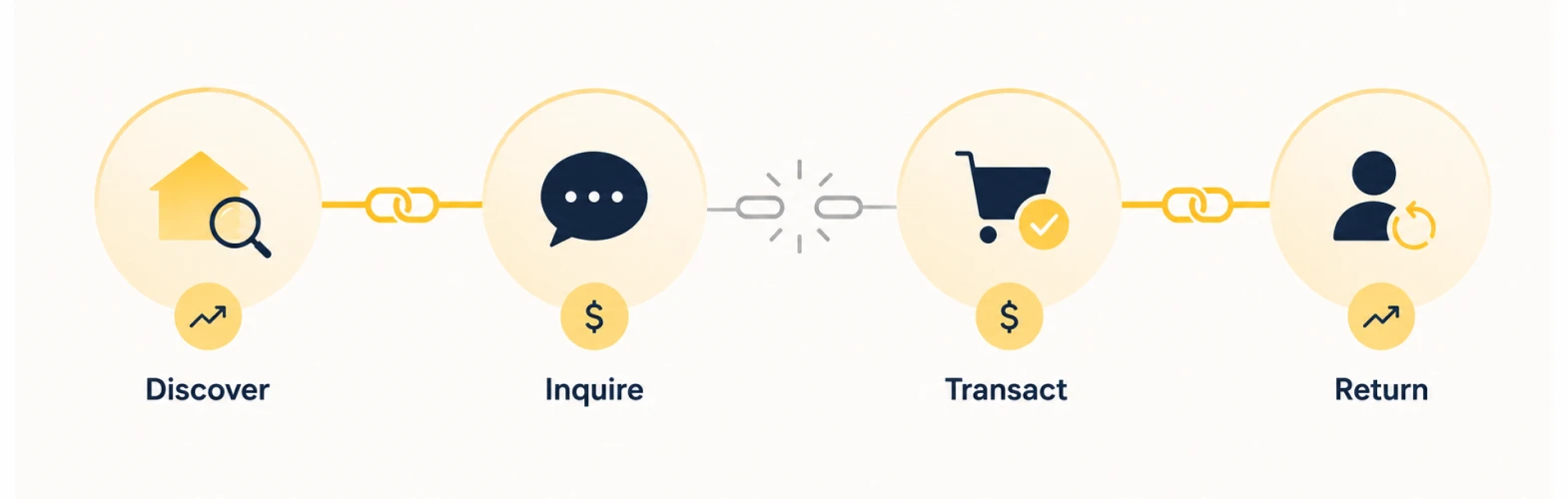
Disconnected systems create friction at every step a customer touches:
- A lead fills out a website form, but the record never reaches the agent’s CRM, so no one follows up for a day.
- A buyer inquires on a listing that’s already under contract, because the feed only syncs overnight.
- A tenant submits a maintenance request that lands in an inbox no one monitors.
None of these are integration failures in the technical sense. Every system works. They’re workflow failures, and each one has a business number attached.
The more durable fix is to re-engineer the workflow first, then integrate only where the workflow demands it. That’s the difference between a one-off system audit and digital transformation services that treat the product as the thing being redesigned.
A Framework for Deciding Which Integrations to Build
There’s no single right way to prioritize, but the teams that do it well tend to hold every candidate to the same set of questions. Here is one framework you can use. Together these seven questions turn “should we build this?” from a gut call into something you can defend in a roadmap review.
| Dimension | The question it forces |
| Business problem | What friction does this remove? |
| Product capability | What can the product do afterward that it couldn’t before? |
| Customer journey impact | Where does it land: acquisition, discovery, transaction, or retention? |
| KPI influenced | Which number should move, and by when? |
| Engineering complexity | How hard is it to build, and what does it cost to keep running? |
| Build vs. buy | Commodity connector, existing API with custom logic, or proprietary build? |
| Long-term value | Does it become a defensible capability or stay a replaceable utility? |
The last question does the most work. An integration that can’t name the number it moves doesn’t get prioritized, no matter how many customers ask for it. A request tells you where to look; whether to build is a separate call the KPI has to justify.
Increase Customer Acquisition: Integrations That Generate More Qualified Leads
The top of the funnel is where fragmented systems cost the most while drawing the least attention. Leads come in from a website form, a portal, a paid campaign, and a phone call, and each channel drops them somewhere different. The same person ends up as three records. Marketing spend loses its trail back to a source. And the clock on every lead keeps running because no single queue shows the whole picture.
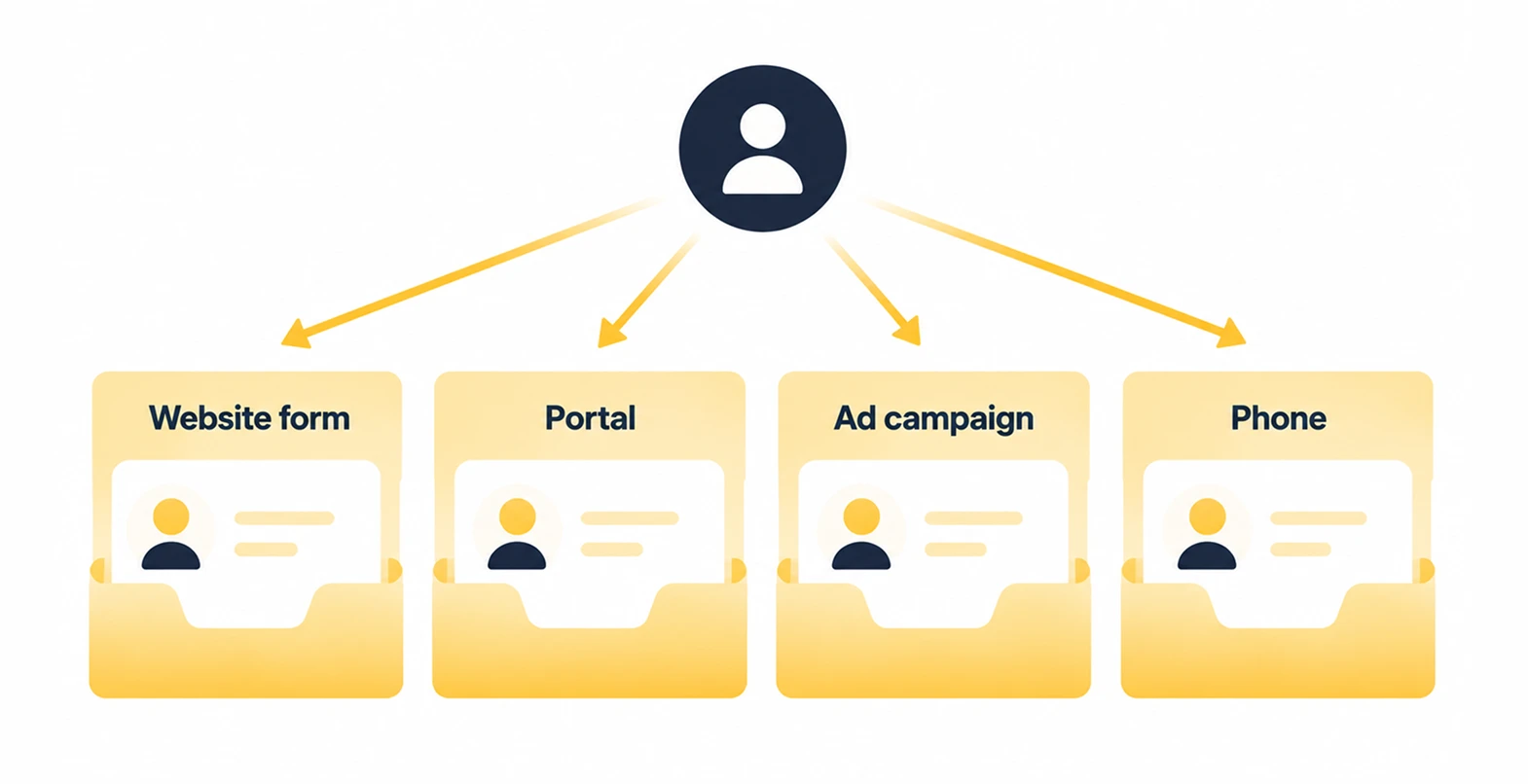
The integrations that matter here pull lead capture, the CRM, marketing automation, and communication tools into one pipeline with a single source of truth. What that buys you is a lead record that assembles itself from every channel and reaches the right person while the lead is still warm.
Speed is the mechanism, and buyers give you very little of it. NAR’s 2025 Profile of Home Buyers and Sellers found that 88% of buyers still purchase through an agent, who they rate as their most useful information source, ahead of the online listings that first brought them in. That makes the handoff from inquiry to agent the pivotal moment in the funnel, and the platform’s job is to make it before the lead cools.
Product Capability Created
The integration produces capabilities the funnel didn’t have before:
- Unified profiles that hold together across every channel a lead touches
- Automated routing by source, geography, or intent, so the right person gets the lead first
- Campaign attribution that connects spend to closed revenue instead of clicks
- Full customer history in front of whoever picks up the next conversation
Engineering Considerations
The connectors are the easy part. The work that decides whether this holds up lives underneath them:
- Identity resolution. Is this new lead the same person as an existing contact, or a net-new record?
- Webhook reliability. Bursts of inbound leads can’t silently drop when a campaign spikes.
- Bidirectional sync. Three systems can each believe they own the record, and the sync logic has to settle that without overwriting the truth.
Pulling external lead streams in at volume also widens your attack surface, which is why securing third-party API integrations belongs in the original build rather than a hardening pass bolted on once something leaks.
Build vs. Buy
A stock connector handles the ordinary case of moving a contact from one system to another. It runs out of room the moment your routing has to encode something only your business does, like a lead-scoring model or a territory rule. That proprietary logic is the piece worth building yourself. Everything around it can usually be bought, and deciding where that line falls for a lead-capture engine is exactly the calculation the real estate software build vs. buy guide walks through.
Increase Property Discovery: Integrations That Improve Search and Listing Quality
A marketplace lives or dies on what a buyer finds when they search. Stale listings, missing photos, and the same property showing up three times all cost inquiries, no matter how good the ranking underneath is. Property discovery integrations exist to make the catalog complete, current, and searchable: MLS feeds and listing syndication supply the inventory, enrichment providers fill in the attributes buyers filter on, and media services carry the photos and tours that decide whether a listing earns a click.
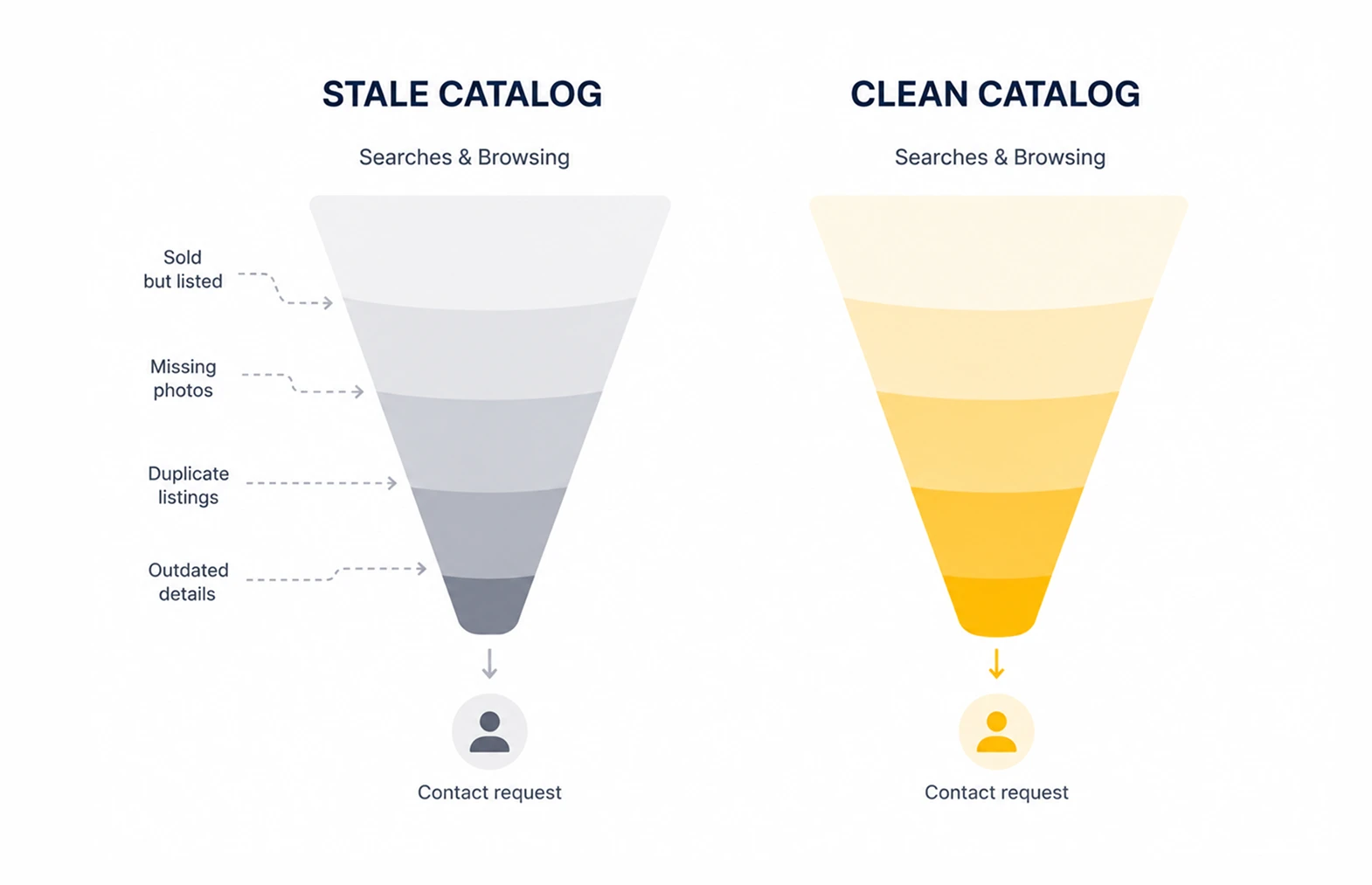
That quality feeds straight into the numbers a marketplace lives by. A complete, trustworthy catalog lifts search success rate, because buyers find matches instead of dead ends. It lifts listing engagement and property views, because enriched listings give people more reason to look. And it lifts contact requests, because a buyer who trusts what they see is a buyer willing to reach out.
Product Capability Created
The integrations turn a pile of overlapping feeds into a product a buyer can rely on:
- Unified property catalog that reconciles the same listing arriving from several sources into one clean record
- Enriched listings carrying the attributes and media that move engagement
- Near-real-time inventory so buyers stop inquiring on homes already under contract
- Search worth using, good enough to be a reason people pick your platform
Regional variation is the part teams underestimate. MLS access terms, refresh cadence, and schema differ from one region to the next, and that shapes everything downstream, which is worth grasping through an MLS integration overview before you build against a feed. For teams that want search to be a differentiator rather than a checkbox, that capability is the case for property listing software development built for interactive mapping and advanced search UX.
Engineering Considerations
The connectors are trivial, the data underneath them is the work:
- Normalization across feeds that disagree on how to define the same field
- Duplicate resolution when one property appears in three sources under three IDs
- Synchronization frequency tuned to each feed’s own terms and refresh limits
- Image pipelines that resize, dedupe, and cache media at volume
- Search indexing that stays fast as inventory grows
- Availability management so listing status never lags reality
Handling that volume without dragging response time down depends on real estate data integration services that normalize incoming feeds before they reach the product.
Build vs. Buy
A standard listing feed is a buy. Every marketplace pulling the same regional feed starts from identical raw data, so wiring one in earns you parity and little else.
The property-intelligence layer on top is the build: your own deduplication, your own enrichment, and your own definition of what “quality inventory” means for your users. That layer is the part a competitor working from the identical feed cannot replicate, which makes it worth owning outright.
The practical sequence is to buy the feeds early to get inventory live, then invest in the intelligence layer once search success rate and listing engagement start to plateau on raw data alone.
Increase Transaction Velocity: Integrations That Remove Buying Friction
Once a customer decides to act, every screen, redirect, and manual handoff between them and a signed agreement is a chance for the deal to stall. Payments, e-signature, financing, identity verification, scheduling, and document handling each either compress that path or add a step to it. The only question that matters for an integration here is how much friction it removes from the moment someone is finally ready to transact.
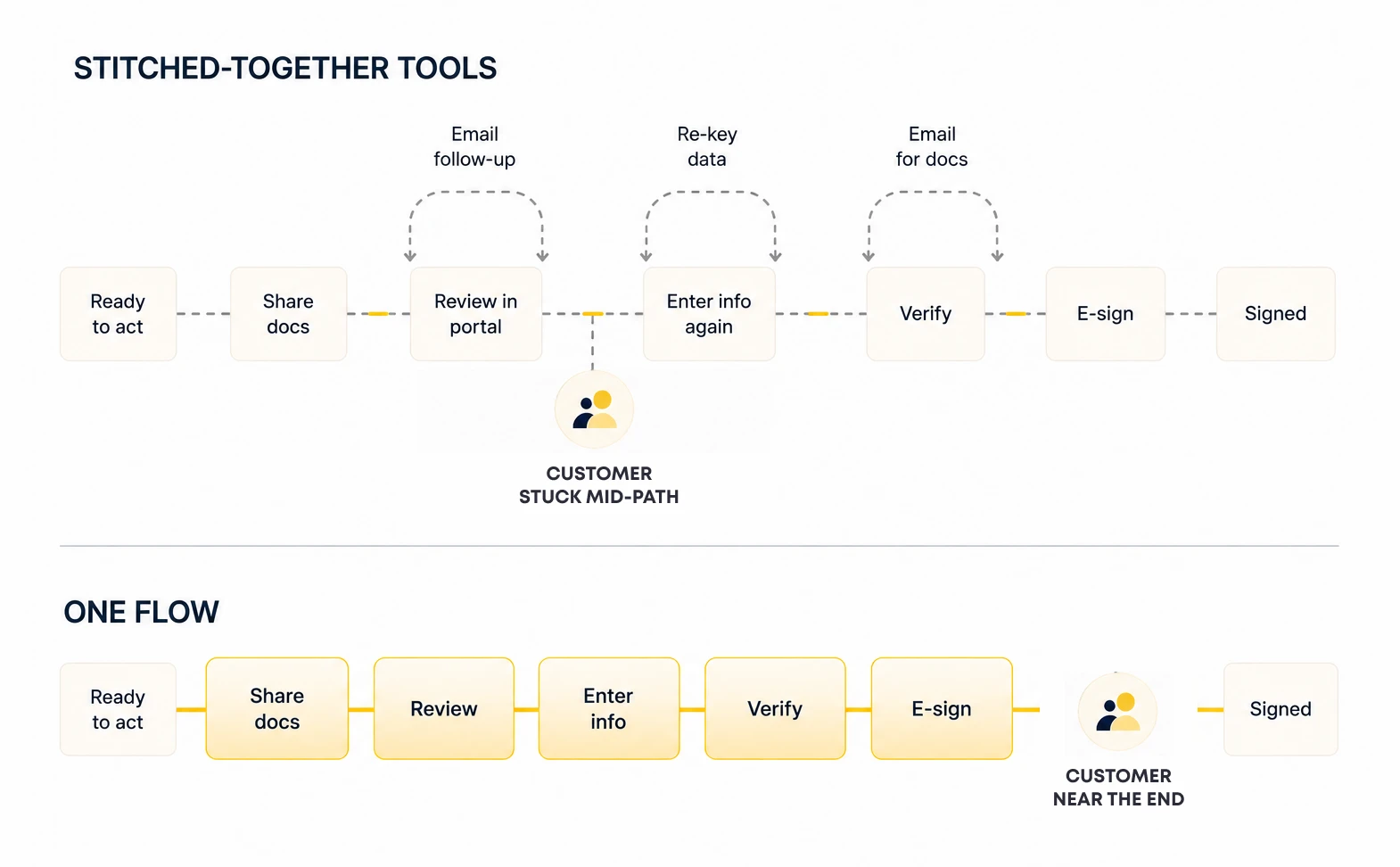
The ICP has usually been burned on this already. A team wires in a payments provider and an e-signature vendor as separate point solutions, and a single transaction now bounces the customer through three tools and two email threads. The result is predictable:
- Completion rate drops as customers abandon mid-flow
- Time-to-close stretches across tools that don’t talk
- Drop-off stays invisible, so no one can see where buyers are quitting
Product Capability Created
The capability worth building is a transaction that stays inside the product:
- Verification clears in minutes instead of days
- Documents move a deal forward with no one re-keying the same data into a second system
- Drop-off becomes a visible number you can attack rather than a mystery
For platforms carrying leases and deal execution, that depends on property management software development shaped around the real lease and payment workflow, which is where completion rate and revenue per transaction actually move.
Transaction speed also rides on how fast the underlying data becomes an answer a user can act on. For Rentometer, which delivers more than 20,000 rental reports a day, ORIL built a batch-processing tool that lets users submit up to 500 properties at once and get rent analyses back quickly, instead of running them one lookup at a time.
Engineering Considerations
Compliance and security set the outer boundary of what you can ship, and getting them wrong costs more here than a broken CRM sync ever could. Payment handling, identity verification, and audit trails all carry regulatory weight. On top of that, third-party APIs in this layer fail in ways you can’t retry blindly, so the orchestration around them has to be idempotent. A dropped connection cannot be allowed to double-charge a buyer or double-sign a contract.
That reliability engineering is the real work, and it happens well before UX. Routing contract execution, for example, is a security and compliance decision first, which is what a clear-eyed comparison of top eSignature APIs is for.
Increase Customer Retention: Integrations That Keep Users Coming Back
Acquisition gets the attention, but retention is where the compounding revenue lives, and it depends almost entirely on whether your customer data is connected well enough to act on. Analytics platforms, communication systems, personalization engines, and customer-success tools can each turn one-time users into recurring ones.
Leave the data between them disconnected and every outreach comes out generic, which is the quiet mechanism behind most churn. Users drift because nothing the product sent them was timed to what they were actually doing.
Connected retention data changes what the product can do:
- Know what a user did across every touchpoint
- Anticipate what they need next from that behavior
- Reach them on the right channel before they slip away
Done well, that lifts retention rate, repeat visits, and customer lifetime value together, because each one feeds the next. For teams building the resident- or owner-facing surface where that engagement happens, the guide to building a property management app covers designing features people come back to instead of ones that ship and sit unused.
Scale Operations: Integrations That Reduce Operational Costs
Some of the most valuable integrations never touch a customer. Operational connectors protect margin by removing manual work that would otherwise grow with every new unit or account. A platform that has to add an ops person for every hundred units it onboards is carrying an integration gap that eats its unit economics as it scales.
Where these integrations pay back:
| System | Manual work it removes | KPI it moves |
| PMS | Re-entering lease, tenant, and unit data across tools | Operational cost per unit |
| ERP / accounting | Hand-reconciling payments, splits, and invoices | Manual task volume |
| Maintenance systems | Routing and tracking requests out of an inbox | SLA performance |
| Reporting | Assembling numbers by hand from every source | Staff productivity |
The common thread is operational leverage: back-office workflows that run without a human copying data from one system into another. Trustworthy automated reporting only becomes possible once the raw records underneath it are cleaned and standardized, which is the unglamorous work behind real estate data enrichment services. Get that layer right and the manual task volume that used to gate growth simply goes away.
Not Every Integration Deserves to Be Built
The highest-leverage prioritization move is often deciding to skip an integration entirely. A few patterns account for most wasted engineering capacity:
- Integration-first thinking. Building a connector because a partner exposes an API, before confirming a customer workflow actually needs it.
- Duplicate systems. Adding a second tool that overlaps one you already run, then paying forever to keep two versions of the same truth in sync.
- Low-adoption connectors. Shipping something a handful of accounts requested that carries full maintenance cost regardless of how few people use it.
- Ungoverned sprawl. Adding integrations faster than you retire them, until no one on the team can say which feeds are load-bearing.
The discipline is simple to state and hard to hold. An integration that can’t name the KPI it moves does not get built, however reasonable the request behind it sounds.
Build vs. Buy: Where Custom Integration Creates Competitive Advantage
Every candidate integration sorts into one of three buckets, and which bucket it lands in decides whether engineering time on it earns a return.
| Bucket | What it covers | Example integrations | Where the value lives |
| Buy | Commodity connectors identical in value for you and every competitor | Standard e-signature, payments provider, calendar sync | The vendor’s. Custom work here earns nothing. |
| Integrate | Existing third-party APIs wrapped in workflow logic that’s yours | CRM sync with custom routing, MLS feed with your enrichment | The orchestration you build around a bought API |
| Build | Proprietary orchestration and data platforms that encode how your business works | Unified customer data platform, marketplace logic, workflow automation | Fully yours, and the only bucket a competitor can’t copy |
Most PropTech work lives in the Integrate row, and it’s the row that gets mis-scoped most often. How far to take the custom logic around a bought API is a return-on-investment question, which is why it pays to be measuring real estate integration ROI across the MLS, PMS, and CRM stack before committing sprints to it.
The Build row is where a specialist engineering partner earns its keep, because the risk sits in the domain-specific logic rather than the wiring. Legacy systems often force the decision here: when existing connectors cap performance or block a capability you need, modernization becomes the realistic path, and the guide to revamping legacy applications covers how to reach it without a ground-up rebuild.
Successful platforms typically combine commercial connectors with proprietary orchestration, business rules, and data intelligence rather than choosing between buying and building outright.
The Architecture Behind Revenue-Generating Integration Ecosystems
Whether an integration strategy survives contact with scale is an architecture question. A platform can ship ten integrations that each work in isolation and still buckle under their combined maintenance load, because every ungoverned connector is a dependency that can break the product when a vendor changes something upstream.
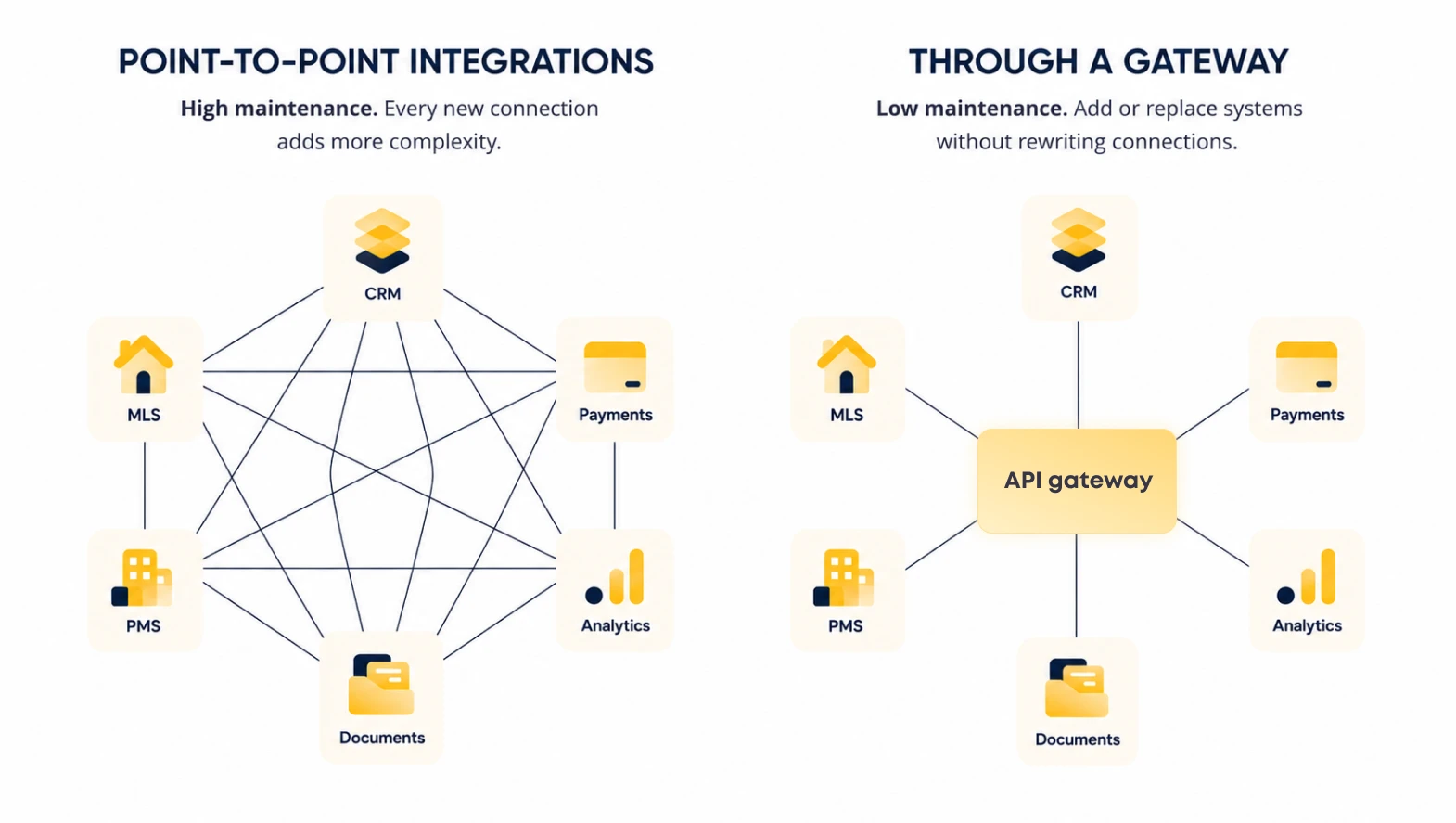
A few patterns keep an ecosystem sustainable as it grows:
- API gateway. A single, governed entry point rather than a tangle of direct calls.
- Middleware isolation. Each third-party dependency wrapped so a vendor’s change stays contained instead of rippling through the product.
- Event-driven where it counts. Near-real-time sync for state that has to be current, batch sync for everything that can wait, so you aren’t paying real-time cost for data that doesn’t need it.
- Monitoring and observability. A silently failing feed surfaces on your dashboard before it surfaces in a customer complaint.
- Versioning and governance. The ecosystem stays legible enough that the next engineer can tell which integrations are load-bearing.
The economics sit underneath all of it. Architecture decides long-term ROI, because it decides how much of every future integration is fresh work versus rework on something already brittle. Designing the data layer for insight at the outset is the thinking behind building data-native real estate applications, where analytics live in the foundation instead of getting retrofitted once the platform is already load-bearing.
How to Prioritize Your Integration Roadmap
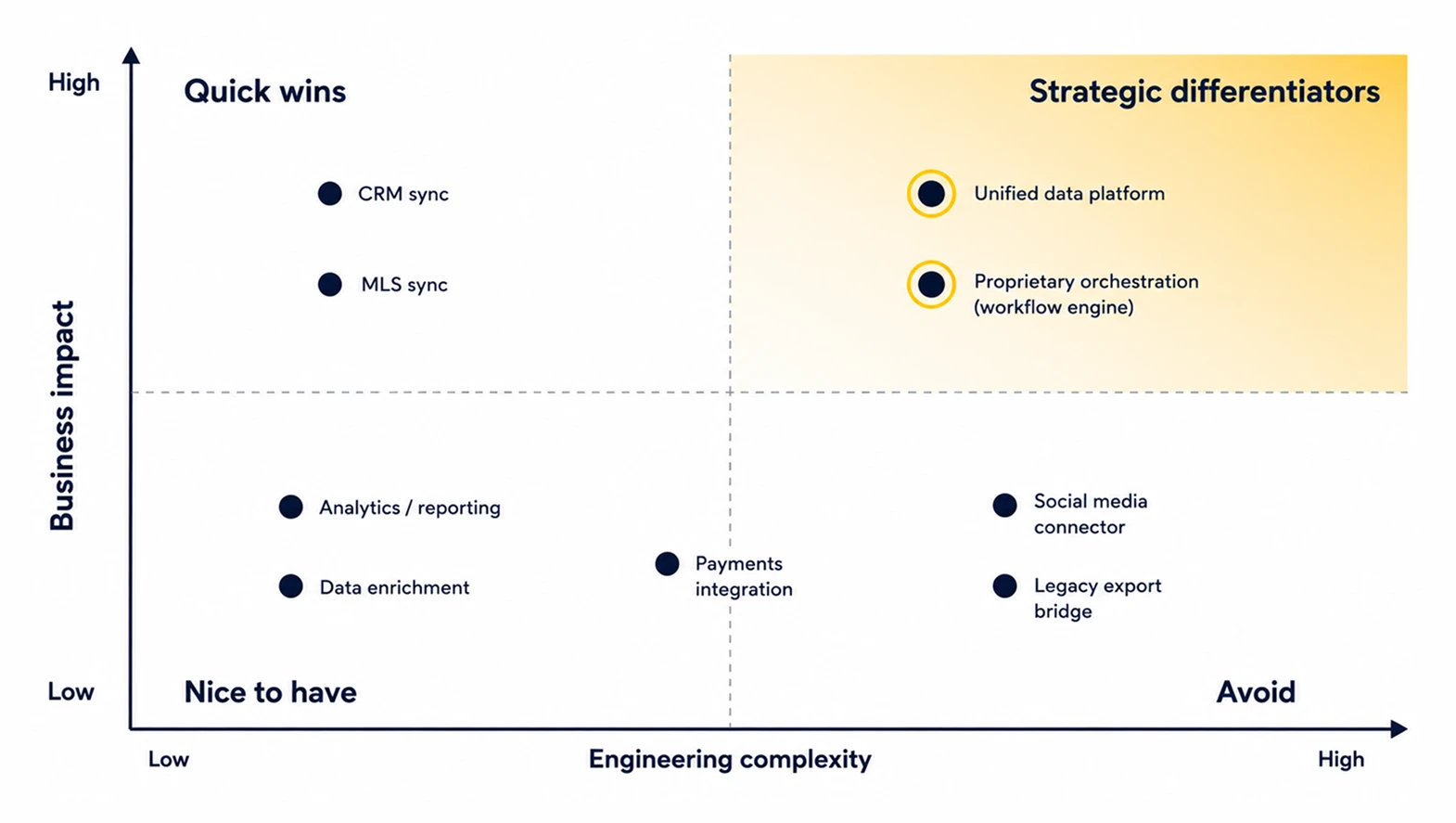
Score each candidate on two axes, business impact and engineering complexity, and the roadmap organizes itself.
| Low complexity | High complexity | |
| High business impact | Quick wins: CRM sync, communication tools, MLS synchronization | Strategic differentiators: proprietary orchestration, unified customer data platform |
| Low business impact | Fill-in work; do it if it’s cheap | Avoid: high cost, low return |
Quick wins ship first, because they move a KPI fast and cheaply. Growth investments like analytics, enrichment, and payments come next, funded as the business justifies them. The long strategic builds, the ones that make a product genuinely hard to replace, are worth starting only once the fundamentals underneath them are solid. Sequencing that arc from MVP to a mature platform is the whole subject of the real estate product roadmap guide.
Real-World Product Scenarios: How Revenue-Generating Integration Ecosystems Are Built
The same framework runs across four platform types. Each moves from the business problem through capability, integrations, KPI, engineering challenge, and a build-or-buy verdict.
Marketplace
Buyers abandon a search that returns stale or incomplete inventory, and every abandoned search is a lost inquiry.
- Get discovery right and the platform earns a catalog buyers trust, current and relevant, standing on MLS feeds, enrichment, and search.
- Watch search success rate and contact requests; both move the moment inventory quality does.
- Most of the difficulty is deduplication and normalization, because the feeds rarely agree about the same property.
Buy the feeds, then build the intelligence layer on top. Turning raw listing records into ranked, relevant results is exactly the problem behind this AI property search case study.
Brokerage platform
Leads arrive faster than agents can work them, and manual routing lets the warm ones go cold.
- What the platform gains is instant, rule-based routing that hands an agent the full context, drawn from the CRM, marketing automation, and communication tools.
- Two numbers tell you whether it worked: lead response time and lead-to-opportunity conversion.
- Identity resolution across channels is where the engineering time goes, since the same person arrives looking like three leads.
Integrate the CRM’s API, but build the routing logic yourself, because it has to encode how your desks actually assign and chase a lead.
Property management platform
Every hundred new units used to mean another ops hire; this is how you break that link.
- The payoff is back-office automation spanning leasing, accounting, and maintenance, wired through PMS, accounting, and maintenance-system integrations.
- Operational cost per unit and manual task volume are the figures that should fall.
- Reliable sync and clean audit trails are the hard requirements, and both are unforgiving when money and compliance are involved.
Integrate the systems already in place, and build the orchestration that moves work between them without a person in the middle.
Investment platform
Portfolio decisions wait on data scattered across half a dozen sources, and every delay is a slower call.
- The platform’s edge becomes unified analytics that make a decision faster and better supported, fed by market data, enrichment, and analytics integrations.
- Progress shows up as shorter decision cycle time and stronger portfolio performance.
- The work concentrates in data modeling and pipeline reliability, where a single bad feed quietly poisons the output.
Buy the data sources, then build the analytics layer that turns them into something decision-grade.
How ORIL Designs Integration Ecosystems That Scale With the Business
Across brokerage platforms, listing marketplaces, property management systems, and real estate data products, we’ve repeatedly seen that scalable integration ecosystems depend as much on architecture as on the integrations themselves. Because every platform has different business goals, workflows, and existing systems, the integration landscape is designed around the product rather than applied from a fixed template.
What stays constant is the engineering approach underneath.
The work runs in a set order, and the order is the point:
- Learn the goal: the KPI the platform is accountable for.
- Data assessment and architecture review: map existing sources, current architecture, and the gaps.
- Data provider integration: connect the feeds and providers the product needs.
- Data enrichment and normalization: turn raw records into a clean, trusted source of truth.
- System integration: wire the layer into the CRMs, PMS platforms, and internal tools that run the business.
- QA, monitoring, and continuous optimization: keep the ecosystem working as the business grows.
Where a team needs to move quickly without pulling its own engineers off the roadmap, that work runs through dedicated development team services staffed for PropTech, so an integration push doesn’t stall everything else in the backlog.
Key Takeaways
- Integrations are infrastructure. The payoff comes from the product capabilities they enable, and only once those capabilities move a KPI.
- Prioritize by business impact against engineering complexity, before you consider what happens to be technically available.
- Architecture decides long-term ROI, because it decides how much of every future integration is rework on something already brittle.
- Buy commodities, integrate existing APIs behind your own logic, and build only where the capability becomes defensible.
- An integration that can’t name the number it moves doesn’t get built.
- Where the ecosystem is heading, from API economies to deeper interoperability to AI features that depend on unified data, is the subject of this PropTech trends analysis.
What Separates a Platform From a Pile of Connectors
The platforms that pull ahead treat every connection as an engineering decision with a number attached. They connect systems where a connection moves conversion, time-to-close, retention, or cost per unit, and they leave the rest alone.
The difference between those platforms and the ones drowning in maintenance comes down to the engineering applied at each step: what to normalize, where to make sync idempotent, which logic to own outright, and which connector to buy and forget.
That engineering is the actual product. A feed anyone can license; the deduplication and ranking that make it trustworthy is build work. A CRM anyone can connect; the routing logic that gets a warm lead to the right desk in seconds is build work. The revenue lives in that second half every time, which is why the integration layer rewards a team that has built these systems before over one wiring endpoints together for the first time.
So the most useful move before adding the next integration is to audit the ones already running and ask which are load-bearing and which are quietly billing you in maintenance. ORIL specializes in exactly that kind of work: complex integrations, integration architecture, and the PropTech products built on top of them.
If you’re adding to your stack or untangling what’s already there, ORIL’s custom software development services can build the integrations and data layer that improve how your platform runs and move the numbers you’re accountable for.


