

The MLS (Multiple Listing Service) is designed to manage and exchange listing information within a defined real estate market. It standardizes how a property for sale is described and distributed, and it updates on a regular cadence. Within its market, an MLS is the system of record for the listing data it governs.
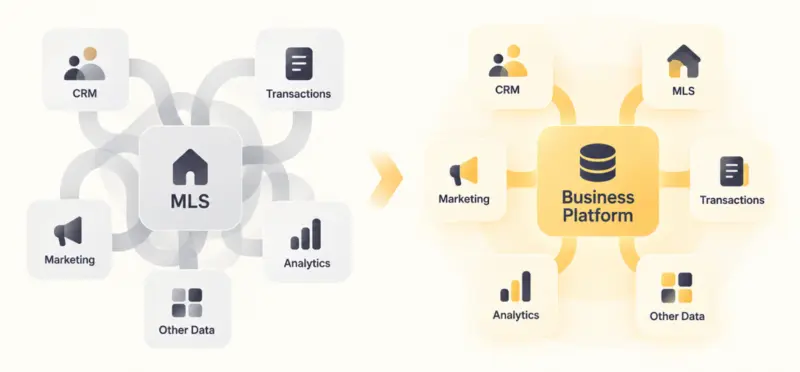
It was not designed to be the central operational data platform for an individual brokerage’s customers, transactions, financials, or product analytics. Because it holds the largest and most consistently maintained dataset a real estate business touches, other systems tend to gather around it. Step by step, a system built to move listings between brokers becomes the layer business logic depends on.
That dependency is where the cost starts. Customer relationships, transactions, commissions, and analytics sit outside the MLS’s design, so every product decision built directly on it inherits the schema, access terms, and release schedule of a platform the business does not control.
We build real estate data platforms at ORIL where the MLS stays the system of record for listings and one input among many, while the business owns the data platform connecting it to everything else. This article covers the architectural distinction that makes that possible and how to design for it.
Why MLS Was Never Designed to Be Your Business Platform
The MLS exists to share listing inventory among cooperating brokers within a regional market. It standardizes how a property for sale is described and distributed so agents can find and show each other’s listings.
When functions grow up around the MLS because it is the biggest available dataset, business logic ends up depending on a source system for its operational truth, complete with a schema, access terms, and release schedule the business does not control.
Designing an architecture where MLS feeds act as inputs rather than the application database calls for real estate software development services that keep core business logic separate from external schemas.
Data Source vs. System of Record: Why the Difference Matters
A source system produces data about one slice of the business and stays authoritative for that slice. The MLS is a source system for listing publication. A payment processor is a source system for card transactions. Each is authoritative for what it does and nothing more.
A system of record is the system the business designates as authoritative for a given entity, such as a customer or a transaction. It defines the entity, governs how it changes, and holds its full history. A system of record does not have to be software the business built or owns. A CRM like Salesforce can be the system of record for customer data even though the organization does not own it.
A data platform is the architectural layer that integrates, normalizes, stores, governs, and exposes data from across those systems. It is where the canonical model lives.
The distinction that matters for architecture: for data that drives core business logic, keeping the canonical model under the business’s own architectural and governance control reduces dependency on any single external provider. The MLS can stay the system of record for listings while the business-owned data platform becomes the authoritative operational context for the entities and relationships its products depend on.
Keeping the canonical model independent from any external provider’s schema follows the same logic as the data platform vs CRM approach: the business defines its entities once and governs them itself.
| Dimension | Source system (e.g., MLS) | Business-owned data platform |
| Primary job | Publish and exchange listing data | Integrate, normalize, govern, and expose business data |
| Owns | Listing content and access terms | Canonical entities: customers, transactions, agents, analytics history |
| Governance | Set by the MLS and RESO standards | Set by the business |
| Change control | External, outside your roadmap | Internal, on your schedule |
| Role in AI | One input among many | The unified context models read from |
The Hidden Costs of Building Your Business Around MLS
When a source system is treated as the data platform, the effects reach past integration code and into the numbers executives rely on. Five costs tend to compound as an organization grows:
- Vendor dependency: roadmap decisions wait on an external platform’s schema and access terms.
- Fragmented business data: customer, transaction, and marketing data sit in separate systems with no shared model.
- Slower product development: every new feature has to reconcile identifiers across disconnected sources.
- Unreliable reporting: departments report different numbers because each joins MLS data to different systems.
- Limited AI capability: models see listing records without the customer and transaction context around them.
Building core application logic directly on regional MLS schemas is a known driver of structural data debt in PropTech, and the maintenance cost climbs as more systems connect.
Your Business Data Lives Outside MLS
A brokerage’s real operating picture is spread across systems the MLS never touches:
- Customer conversations in the CRM
- Transaction milestones in a transaction management system
- Commissions and accounting in finance tools
- Marketing engagement, documents, support tickets, website behavior, and valuation outputs, each in its own system
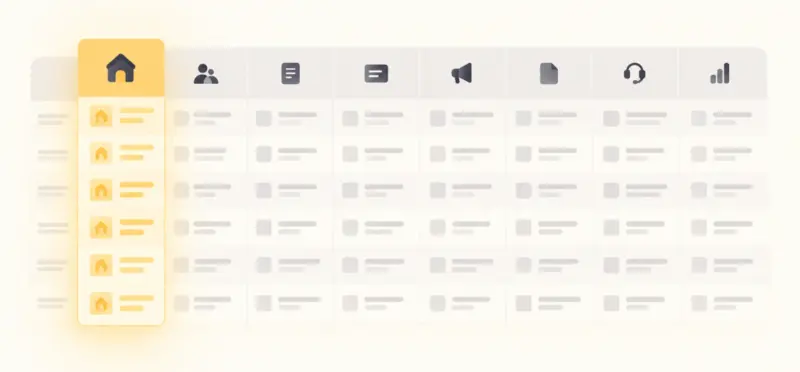
The MLS holds listing data, which is one column in a much wider table. A platform that treats it as the center can describe properties in detail while knowing little about the people and deals around them.
Owning the layer where all of that data meets is what makes a complete business view possible.
Why Every New Integration Becomes More Expensive
The deeper cost of an MLS-centric design is not the number of connectors. It is that business logic becomes coupled to an external schema and external identifiers. When core application logic reads and writes in the shape the MLS defines, every other system has to be reconciled against that shape, and the business inherits changes it does not control.
That coupling shows up as:
- Business rules written against fields and identifiers owned by an external system
- Property and customer records that don’t line up cleanly across sources
- Application logic that breaks when a feed’s schema or values change
The U.S. has hundreds of MLS organizations, 489 as of RESO’s July 2026 count, each operating within its own market, governance structure, and business rules. RESO standards reduce unnecessary variation in how listing data is named and transported, but they do not remove the architectural work of integrating external MLS data into a business’s own model. Placing a stable platform between those feeds and the core application is the job of real estate data integration services.
Choosing those feeds is its own engineering decision. Benchmarking real estate APIs on throughput, rate limits, and latency before you build keeps early choices from becoming long-term constraints.
Why Reporting Rarely Matches Across Departments
Departments answer the same question with different systems. Each starts from the MLS but joins it to a different source, using different identifiers:
| Department | MLS combined with | Metric it owns |
| Sales | CRM | Pipeline, activity |
| Finance | Accounting | Closings, revenue |
| Marketing | Web analytics | Campaign attribution |
The result is dashboards that disagree. A property carries one identifier in the MLS, another in the transaction system, and a single customer shows up as three separate records across tools.
Without a shared model, executive numbers depend on which department produced them. Consistent cross-department reporting depends on standardizing metrics at the data layer, a common trait of data-native real estate platforms, where business entities are defined once.
Why an MLS-Centric Architecture Holds AI Back
AI features read from whatever context the platform can assemble.
A recommendation engine, a forecasting model, a valuation model, or an agent copilot needs several things in one place: unified customer profiles, transaction history, behavioral events, marketing engagement, and property data.
The MLS supplies listing attributes. It does not carry who viewed a property, which lead converted, or how a deal progressed. A model grounded on listing records alone misses the business context around them, which surfaces as weak recommendations and unreliable predictions.

The data foundation is where AI programs tend to stall. Gartner has predicted that through 2026, organizations will abandon 60% of AI projects that lack AI-ready data. An MLS-centric setup is one way data stays un-ready: the customer and transaction context a model needs never sits in one place.
Running semantic search or predictive models over clean, canonical property data is where AI in real estate development starts, well before model selection.
The data foundation matters more than the model choice. Our AI property search architecture case study shows how a sanitized, unified database supports conversational search grounded in the actual source data.
The Architecture Modern Property Platforms Use Instead
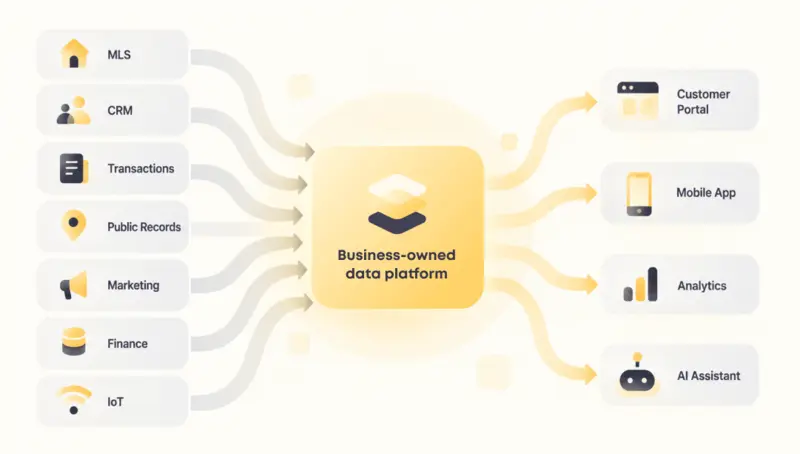
A durable design puts a business-owned data platform at the center. The MLS becomes one trusted input flowing into it, alongside the CRM, transaction systems, public records, marketing platforms, financial systems, IoT feeds, and customer applications.
Data flows into the platform, and every product reads from the platform rather than from any single source. This inverts the common pattern: instead of systems connecting through the MLS, they connect through a layer the business owns and controls.
Three engineering practices make it work.
Build a Canonical Business Data Model
Enterprise ownership starts with defining your own business entities. A canonical data model describes each one once, in your terms, so every external system maps into it. The goal is not to reproduce the MLS schema inside your platform. It is to define the business entities your applications actually need, then map external systems into those entities.
Core entities a real estate data platform typically owns:
- Property
- Listing
- Unit
- Customer
- Agent
- Brokerage
- Transaction
- Offer
- Campaign
- Lead
- Document
- Financial Record
One distinction matters more than it first appears: a property and a listing are not the same entity. A property persists across multiple listings, transactions, agents, and lifecycle events over time. A listing is one market-facing record of that property at one point in time, and the same property may appear across different feeds and markets. Collapsing the two is a common source of downstream identity problems.
Under this model, the MLS maps into your Listing and Property entities rather than defining them. Turning heterogeneous regional feeds into that shared structure is the work of normalizing MLS data at scale, where varied field names and value sets resolve into one schema.
Use Integration Services Instead of Direct System Dependencies
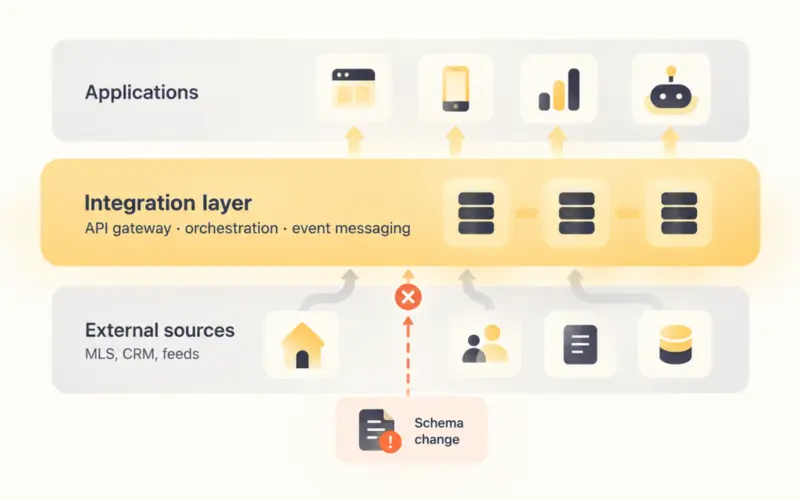
Systems should communicate through the platform rather than point-to-point with one another or with the MLS. Depending on scale and latency requirements, an integration layer may combine API management, orchestration, event-driven messaging, and synchronization services:
- API management as a controlled entry point
- Orchestration to route and coordinate calls
- Event-driven messaging to keep sources decoupled from consumers
Incremental synchronization, webhooks, CDC where supported, and scheduled reconciliation can keep the platform current as sources change. Transformation pipelines, versioning, and retry handling absorb feed changes before they reach application code.
Isolating each provider behind the discipline of managing third-party API dependencies in dedicated ingestion services keeps a single upstream change from breaking the core.
Make the Data Platform Authoritative Through Governance
A data platform becomes the authoritative record for an entity only when governance makes it trustworthy. A few mechanisms carry most of the weight:
- Master data management (MDM), entity resolution, and identity mapping collapse duplicate records into single, trusted entities.
- Audit history, validation services, and observability keep that truth measurable and business-controlled rather than feed-controlled.
This is the layer that holds records the MLS never will, such as leases, financial telemetry, and physical asset data that property management software development is built to house.
Treating source systems as raw input, then resolving them into a governed canonical model, mirrors current real estate data aggregation models where the platform layer, not any single source, becomes the authoritative record.
How Centralized Data Architecture Accelerates Product Development
Once entities and integrations live in one platform, new products stop starting from scratch. A client portal, a mobile app, an AI assistant, or an analytics dashboard reads from the same canonical APIs instead of re-integrating every source. Engineering time shifts from plumbing to features.
That shift has a cost side worth quantifying. Framing a platform investment in terms of reduced engineering cycles is how teams approach measuring real estate integration ROI for the stakeholders who fund it.
It also changes the roadmap. Moving off vendor schema lock-in is a common milestone in data-driven product roadmaps, where each release builds on a stable data layer rather than reworking it.
How ORIL Designs Enterprise Data Platforms for Real Estate
We approach these platforms as a sequence of engineering decisions rather than a fixed template. The exact path varies by engagement, but it often moves through phases like these:
1.Business capability discovery: map the entities and workflows the platform must own.
2.Data assessment: inventory current sources, identifiers, and quality gaps.
3.Canonical model design: define shared business entities.
4.Integration and API architecture: design gateways, orchestration, and contracts.
5.Synchronization services: build CDC and event pipelines to keep data current.
6.Governance framework: set entity resolution, ownership, and validation rules.
7.Analytics and AI-ready foundation: structure data for reporting and models.
8.Incremental modernization: sequence the rollout so operations keep running.
Each phase produces a decision the business can see and own, rather than a black-box deliverable.
Change the Role of MLS Without Replacing It
None of this means leaving the MLS. It stays an authoritative source for listing inventory, and the integrations you already run keep working. What changes is its position in the architecture: one input into a platform you own, instead of the base layer other systems depend on.
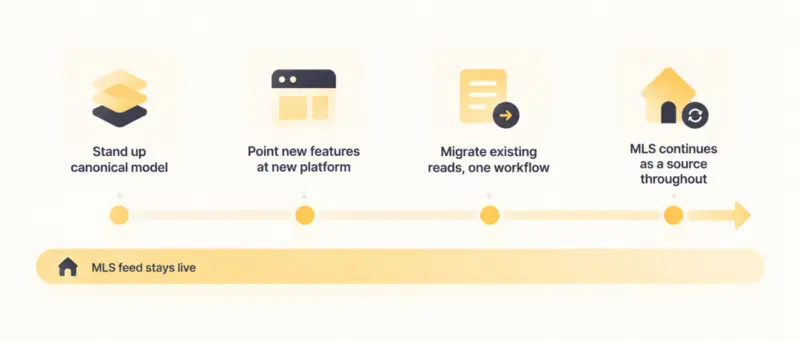
The common transition sequence is to stand up the canonical model and integration layer alongside the current setup, point new features at the new platform first, then migrate existing reads onto it one workflow at a time. The MLS feed keeps running as a source throughout, so nothing goes dark during the shift.
Decoupling live business logic from external schemas without interrupting operations is a specific engineering problem, one we cover in our guide to refactoring legacy database architectures.
What Owning the Data Layer Actually Changes
Raw listing data is rarely the durable differentiator by itself. Many competitors can access overlapping MLS feeds and RESO-standardized data. The differentiation increasingly comes from what a company can build around that data: its customer, transaction, behavioral, operational, and proprietary data.
That layer is where the compounding happens. When a new source maps into a canonical model that already holds your customers and transactions, the work is one mapping and the data joins everything already there. When a new source connects through the MLS structure instead, it inherits that structure’s identifiers and constraints, and each addition adds another set of transformations to maintain. The first approach tends to get cheaper per integration over time; the second tends to accumulate maintenance.
The MLS stays the system of record for the listings it governs. The distinction worth carrying into an architecture decision is between the source systems that supply your data and the data platform that holds the authoritative model your products run on.
Teams that draw that line early keep their options open for analytics, AI, and new products. Drawing it later is still workable; it usually means doing the separation as a modernization project rather than up front.
The point is not to remove the MLS from the architecture. It is to prevent an external listing system from becoming the architecture. That distinction, and where a given platform actually sits on it, is the kind of assessment we work through with real estate and PropTech teams before any code is written.


