

A real estate product can look simple on a roadmap: search properties, analyze rents, manage listings, track deals, or automate a manual process. The complexity usually appears underneath, in the data, integrations, user roles, and workflows that make the feature usable.
That is why a real estate MVP is not simply the smallest set of features. It is the smallest production-capable product that can test a defined hypothesis using the data and workflow the real product depends on.
One of the main purposes of an MVP is to reduce the amount of product and engineering work committed before a core assumption has been tested. CB Insights’ analysis of startup post-mortems found that lack of market need was the most frequently cited reason startups fail. An MVP does not remove that risk, but it gives a team a way to test a specific assumption before committing to a larger product.
This guide keeps the original path (idea, discovery, product strategy, design, development, launch, and validation) and shows what changes at each stage when the product is built for real estate. The through-line at every stage is the same: hypothesis, then the workflow that tests it, then the data and integrations that workflow needs, then scope, then validation.
What Is a Real Estate MVP?
A real estate MVP runs in a live environment rather than as a staged demo. It helps to separate four things that are often blurred together:
- An idea is a belief about a problem and a possible solution. It has not been tested.
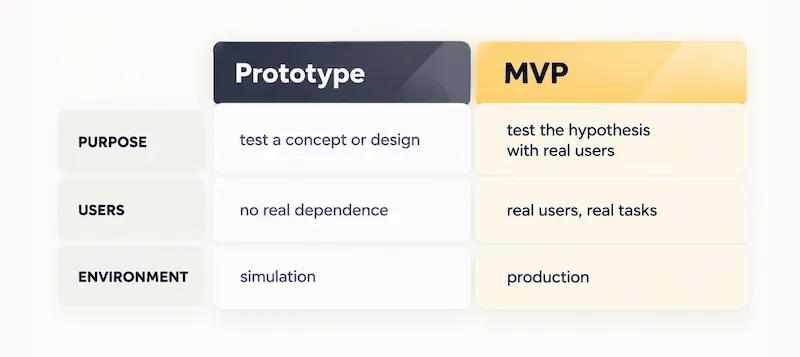
- A prototype simulates the experience, used to check a concept or a design before building it.
- An MVP is a working product that real users can use to complete the workflow being tested.
- A later-stage product is what you build as evidence from the MVP informs which capabilities to expand, change, or remove.
The scope of an MVP follows from the hypothesis.
A property listing product, a rental-analysis tool, and an investment dashboard each test a different assumption, so each has a different minimum.
A clearly named assumption is what keeps an MVP small enough to estimate, build, and validate within a defined scope. For PropTech startup solutions, that discipline shapes how quickly a first version can reach real users.
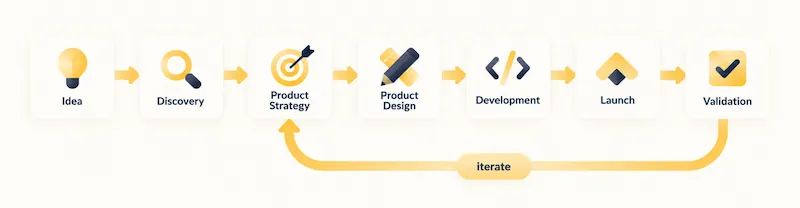
1. Discovery: Define the Problem Before Defining the MVP
Discovery turns a rough idea into a defined product concept. The goal is to understand the problem well enough that later scope decisions are grounded in defined requirements and assumptions.
For a real estate product, discovery gives particular weight to a few areas:
- What the business needs to achieve. Whether the MVP is meant to validate willingness to pay, reduce a manual process, improve a user workflow, or test a new revenue stream changes what has to be built.
- Who the users are and which roles matter first. An agent, a landlord, a tenant, an asset manager, and an underwriter each want something different from the same property data.
- The real workflow the product fits into, including the parts that still happen in spreadsheets, email, or a legacy system.
- The property and market data the product needs, and where it comes from.
- The external systems the product must read from or write to, such as a CRM, a property management platform, or a listing feed.
These are product questions as much as technical ones, because they shape what the MVP can realistically prove. Structured discovery and early product strategy and design keep the later build from being reworked once these constraints surface.
What Should Be Defined During Discovery?
By the end of discovery, a real estate MVP should have clear answers to:
1.Problem: the specific pain the product removes.
2.Target users: the primary role for the first version, and secondary roles deferred.
3.Core workflow: the sequence the MVP must support end to end.
4.Data requirements: the property, listing, or market data involved.
5.Integration dependencies: the external systems in scope.
6.Constraints: compliance, data access terms, and operational limits.
7.MVP objective: the hypothesis the release will test.
8.Success criteria: the signals that will count as validation.
The earlier these decisions are made explicitly, the easier it is to identify scope and delivery risks before development expands around them, which is why disciplined business analysis for PropTech treats them as decisions to document rather than assumptions to carry forward.
Once discovery has defined the scope, a realistic estimate can account for the work, dependencies, timeline, and budget rather than relying on a preliminary guess. Sound project estimation practices turn that defined scope into the estimate.
2. Product Strategy: Decide What the MVP Needs to Prove
Product strategy decides what the MVP will and will not include. The organizing idea is the hypothesis: the one thing you most need to learn from real users.
A feature list does not define an MVP. Scope should follow the workflow and the hypothesis being tested. Anything that does not contribute to that test can usually be deferred, even when it is part of the longer-term product vision.
For a real estate product, strategy also weighs where to build and where to rely on existing systems. Most capabilities fall into one of three decisions, and naming which is which is what keeps the first version focused on the part that sets the product apart:
| Decision | Typical example |
| Buy | Authentication, payments, maps |
| Integrate | PMS, CRM, MLS or data provider |
| Build | Proprietary workflow, scoring, analytics logic |
Working through that build vs buy real estate decision for each capability is where a real estate MVP earns its focus.
How Do You Define the Scope of a Real Estate MVP?
Scope follows a short chain of decisions:
1.Start with the product or business hypothesis.
2.Identify the core real estate workflow that tests it.
3.Define the minimum functionality needed to run that workflow end to end.
4.Include only the data and integrations that workflow requires.
5.Defer secondary workflows and nice-to-have features.
6.Keep later scale in mind without building for it yet.
A rental-analysis tool that tests whether users will pay for bulk rent estimates needs reliable data intake, an analysis engine, and a clear way to return results. It can usually launch without portfolio management, messaging, or billing tiers on day one.
Keeping secondary features out of the first release reduces the work required before the core workflow can be tested.
What Should a Real Estate MVP Include?
There is no universal feature list for a real estate MVP, because the required features depend on the hypothesis. Most MVPs share a set of components to decide on:
| MVP component | Real estate question to answer |
| Core workflow | What property, deal, or management task must users complete? |
| Business logic | What matching, pricing, valuation, or approval rules are required? |
| Data | Which property, listing, market, financial, or user data is essential? |
| Integrations | Which MLS, PMS, CRM, map, or data provider must connect? |
| Roles | Who acts as owner, agent, tenant, investor, or manager? |
| Measurement | What behavior proves or challenges the hypothesis? |
| Production essentials | What security, QA, monitoring, and compliance requirements apply? |
The judgment is in choosing which SaaS features for PropTech belong in the first version and which are safe to add once the core idea is validated. A feature that does not help test the hypothesis usually belongs in a later release.
3. Product Design: Turn the MVP Concept Into a Testable Experience
Design turns the defined scope into a concrete user experience, showing how users move through the core workflow and where key decisions happen. For an MVP, the effort concentrates on that core workflow rather than the entire future product.
The typical progression is user flows, then wireframes, then a clickable prototype, then the interface itself.
Role-specific journeys matter in real estate products, since a landlord listing a unit and a renter comparing options need different paths through the same system. UX/UI design services at this stage help surface usability problems while the underlying flows are still relatively inexpensive to change.
Real estate interfaces often have to hold dense property data inside workflows that need to stay simple. Search and map views, financial metrics, documents, listings, communications, and role-specific actions can all sit around a single property record, and the design work is deciding which of those the MVP’s core workflow actually needs.
A prototype also gives the engineering team a shared reference to build against. When those decisions are recorded as product design documentation, engineers have a clearer reference during implementation and less ambiguity about the intended interface and interactions.
Prototype vs. MVP: What’s the Difference?
A prototype tests a concept or an experience. An MVP is a working product released to real users who use it to accomplish something.
4. MVP Development: Build the Smallest Production-Capable Product
Development translates the approved scope into a production-capable system. Here “minimum” refers to scope. The product still needs to be secure, tested, and stable enough for real use.
Architecture should match the MVP’s actual requirements and risk profile, while avoiding decisions that unnecessarily constrain later development. Depending on the product, the engineering work may include:
- architecture and technical foundations
- frontend and backend development
- APIs and third-party integrations
- data flows and storage
- authentication and permissions
- security and QA
- deployment and monitoring
How AI Can Support MVP Development
AI can help accelerate different stages of MVP development, starting with discovery. It can support requirements gathering by analyzing existing documentation, user feedback, business processes, and other inputs to help teams identify patterns, clarify requirements, and surface questions that need further validation.
During design and development, AI can also assist with prototyping, code generation and review, test case creation, documentation, and working with structured or unstructured data. These capabilities can help teams move faster without expanding the initial scope.
But AI does not replace product and engineering decisions. For a real estate MVP, the core questions remain the same:
- Which workflow needs to work first?
- What data does it depend on? Which systems need to connect?
- What business rules and permissions must be supported?
Used well, AI can accelerate how an MVP is defined, designed, and built. All while keeping the focus on what the first release actually needs to prove.
Integrations can be a significant source of risk in real estate products, particularly when property or listing data comes from external systems with their own formats, availability, and access terms. When real estate data integration is planned early, the core workflow stays reliable once real data flows through it.
A concrete example: the Batch Processor we built for Rentometer started as an MVP for internal use, built to push a batch of property addresses through Rentometer’s existing rent-analysis API and return rate estimates in one pass. After the MVP, the project expanded, with MongoDB added for data management and scaling and further tools built on top, including a rent-comparison tool and a gross potential rent calculator. The Batch Processor handles up to 500 addresses in a single batch. That path, a focused MVP first and broader capability afterward, is documented in the Rentometer platform case study.
What Makes Real Estate MVP Development Different?
A real estate MVP carries a few engineering considerations that a generic software MVP usually does not:
- Property and listing data. Listing feeds, public records, and market data are large, change often, and vary in quality, so intake and validation need real attention.
- MLS and data standards. When a product uses MLS listing data, RESO standards may shape how that data is accessed and modeled. RESO Web API is the modern standard for accessing MLS data, while RETS is a deprecated legacy transport. RESO’s Data Dictionary provides standardized real estate data fields and terminology, although individual MLS implementations and data agreements can still introduce differences. Available fields, access rules, and implementation details still vary by MLS and data agreement.
- Internal systems. Products often need to read from or write to a CRM or a property management platform.
- Maps and geospatial data. Location, boundaries, and distance are core to many real estate workflows.
- Multiple roles. Agents, owners, tenants, and managers frequently share one product with different permissions.
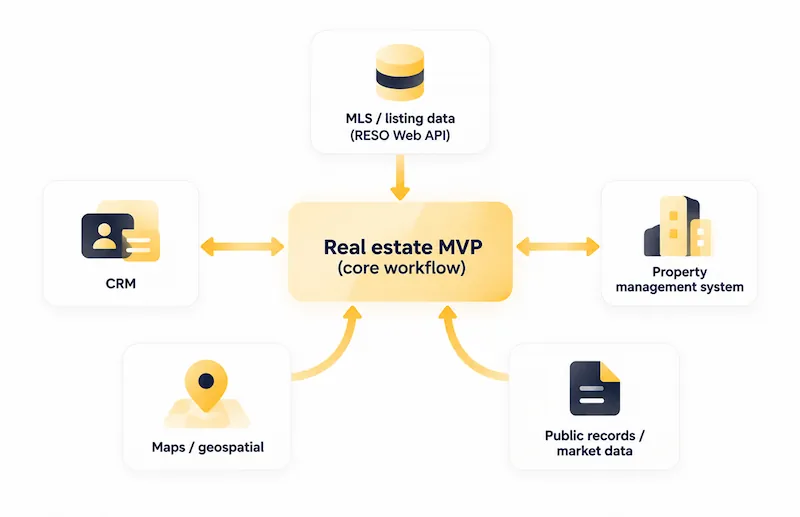
The workflow also has an operational context. Listing, leasing, underwriting, property management, transaction, and investment workflows involve different users, decisions, and system dependencies, and that context shapes what the MVP has to handle.
These details can materially affect the scope, reliability, and delivery risk of a real estate MVP, so they belong in scope discussions early. Where a hypothesis depends on it, this is also where AI enablement for PropTech fits, tied to a specific workflow such as property search or automated analysis, rather than introduced simply because AI is part of the product vision.
5. Launch and Validate the MVP With Real Users
Launch puts the MVP in front of its intended users and provides the first opportunity to compare actual usage with the assumptions defined during discovery.
In practice, that involves watching whether people finish the core workflow, where they drop off, and what they say when they get stuck. The product needs the right analytics and feedback mechanisms to capture that, so the team can see where users complete, abandon, or struggle with the core workflow. Qualitative feedback from early users often explains the numbers.
The outcome of this stage is a decision: the hypothesis is supported, needs adjustment, or should be reconsidered. Any of these outcomes can be useful when the evidence is strong enough to inform the next product decision.
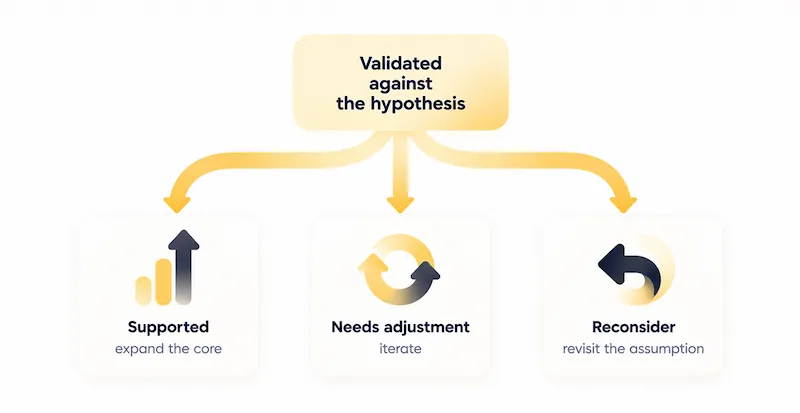
How Do You Know If a Real Estate MVP Is Working?
Validation is measured against the hypothesis, so the right signals depend on the product. Common ones include:
- Whether users complete the core workflow without help.
- Whether users return to the product and continue using the core workflow.
- Whether the intended business outcome appears, such as a conversion, a booking, or a paid report.
- What qualitative feedback reveals about value and friction.
- Whether technical or usability issues are blocking adoption.
There is no universal benchmark that declares an MVP successful, which is why the metrics are defined during discovery rather than borrowed from another product. The point is not to collect every possible metric, but to connect the signals that answer the original product question.
How Long Does It Take to Build a Real Estate MVP?
Timelines vary because scope varies. A reliable estimate depends on:
1.The size of the MVP scope and the number of core workflows.
2.The availability and quality of the required data, which in real estate is often the largest variable.
3.The complexity of the integrations the workflow depends on.
4.How many user roles the product supports.
5.Custom business logic, such as valuation or matching rules.
6.The depth of UX and design work required.
7.QA requirements and production-readiness standards.
8.Team composition.
Because these differ so much, a dependable estimate follows discovery and scope definition rather than preceding them. A simple workflow built on existing data and mature third-party services can be delivered materially faster than a product that needs new data pipelines, MLS integrations, complex permissions, or custom valuation logic. The biggest variables are usually data access, integration complexity, the number of workflows, and production requirements, not the number of screens.
A real estate bidding platform we built, for instance, started from an idea and reached an interactive MVP. Owners could list properties, buyers could place offers, and offer agreements could be signed electronically through an integrated e-signature service. Broader document storage and sharing came afterward. The scope of that first release, more than any generic average, set its timeline, as the real estate bidding platform case study shows.
What Comes After a Validated Real Estate MVP
A validated MVP provides evidence about whether the core use case is working for the intended users and whether the original hypothesis still holds. It does not settle what the product should become, and it is not the same as product-market fit.
Once the core is proven, the questions change. They move toward broader functionality, deeper integrations, scalability, and the data-driven capabilities a maturing platform needs. That next stage has its own decisions, mapped out in our guide to real estate product roadmap strategy, which picks up where MVP validation ends.
Have a Real Estate Software Idea? Let’s Turn It Into an MVP.
When a team builds broadly before testing the core assumption, a real estate product becomes more expensive to change before anyone knows whether the underlying idea holds.
A tightly scoped MVP tests that assumption without committing to the broader product scope upfront. Much of that discipline comes from decisions made before development begins: what to prove now, and what to defer.
If you have a real estate software idea, the useful next step is a conversation about the hypothesis and the workflow rather than a finished feature list. ORIL works as a technology partner for real estate across discovery and the full product lifecycle, so the plan and the build stay connected.


