

MLS data describes a listing. A real estate product often needs to understand the property behind that listing, not just the terms it is being marketed on. That gap tends to show once a team moves past the basics of how MLS data works.
MLS data enrichment connects external sources to a persistent property identity, creating a richer record that can support search, valuation, investment analysis, and other workflows. A listing carries price, status, property details, and location; the property behind it also has ownership, tax history, prior transactions, valuations, and neighborhood context held in other systems.
Those sources use different schemas, identifiers, and update cycles. The engineering problem is not collecting more data. It is connecting each source to the right property, preserving meaning and provenance, and making the resulting record reusable across the product.
Key Takeaways
- MLS data is listing-centric. Property data answers a different question. An MLS record describes what is on the market; a product often needs ownership, tax, transaction, valuation, geographic, and market context the listing was never meant to hold.
- Ten categories of context can enrich an MLS record: ownership, property characteristics, tax, mortgage/financing, AVM/valuation, neighborhood, demographics, geospatial, historical transactions, and market data. The right set depends on the product workflow, source availability, licensing, and required freshness, so enrichment should follow product decisions rather than data volume.
- Resolve the property before enriching it. Entity resolution is probabilistic, so matching needs multiple signals, confidence thresholds, and a review path. Attaching data before the match is reliable can associate one property’s data with another.
- Distinguish source facts from estimates, and keep dates. Preserve each value’s source, retrieval date, and effective date, and treat a recorded sale price differently from an AVM estimate.
- A shared property model reduces duplicated work. When features read from one unified property record, a new feature can reproduce less source-specific integration.
Why MLS Data Is Not the Whole Property Record
An MLS record is built around a listing and the workflow of marketing it: price, status, media, agent remarks, and the fields the local MLS requires.
Some feeds carry more than the current listing depending on the implementation and access, but a product often needs context the listing was never meant to hold.
The same property can appear in multiple listings over time, change ownership, be reassessed, accumulate transaction history, and sit within a changing local market. Much of that information lives outside the MLS, in public records and third-party sources.
Different product features need different slices of that context. A consumer search experience leans on location and amenities. An investment tool leans on tax, ownership, and transaction history. The listing rarely carries all of it, and that outside context is what a product can use to build a broader property-level view beyond the listing itself.
What Data Can Enrich an MLS Record?
External providers, public records, and other datasets can add attributes that are missing, incomplete, differently structured, or less suitable for a specific use case in the MLS feed. Many of these arrive through real estate APIs. The categories below cover roughly ten kinds of context, and each should support a specific product capability.
| Enrichment category | What it adds to the record | What it enables |
| Ownership | Current owner or holding entity, ownership context and history | Ownership analysis, portfolio research, prospecting |
| Property characteristics | Year built, size, lot, unit count, construction detail | Search filters, comparables, underwriting |
| Tax | Assessed value, tax amount, assessment history | Investment screening, valuation context |
| Mortgage/financing | Financing and lien-related signals where available | Ownership and financing analysis, where data supports it |
| AVM / valuation | Automated valuation model (AVM) estimates, with date and method | Pricing tools, portfolio valuation |
| Neighborhood | Amenities, schools, points of interest | Location-based search and ranking |
| Demographics | Population and household context by geography | Market segmentation, site selection |
| Geospatial | Coordinates, parcels, boundaries, proximity | Map search, spatial analytics |
| Historical transactions | Prior sales, dates, prices, status changes | Trend analysis, comparables, valuation inputs |
| Market | Local pricing, inventory, comparable-sale context | Market analytics, timing signals |
No product needs all ten categories, and no source provides complete coverage for every property. The right set depends on the product workflow, geography, source availability, licensing, and required freshness.
Where Does MLS Enrichment Data Come From?
Enrichment data is pulled from several source types:
- MLS feeds
- County and public records
- Property data providers
- AVM providers
- Geospatial data sources
- Demographic datasets
- Market and transaction data
- Internal CRM or property systems
The right source depends on coverage, licensing, freshness, identifiers, and the product workflow.
Physical and Ownership Data
Ownership data identifies the current owner or holding entity and, where available, ownership context or history. Property characteristics describe the physical asset, including:
- Year built
- Property type
- Building size and lot dimensions
- Unit count
- Construction detail
Keep persistent attributes separate from listing-specific ones. List price, status, and agent remarks belong to a single listing.
Attributes such as year built, building area, lot size, and unit count are generally treated as property-level, but their values can still differ across sources or change after construction or redevelopment. Keep the source and effective date with each value rather than assuming one version is permanently correct.
Financial Data
Tax, mortgage, and valuation data add financial context that the current list price alone does not represent. Assessed value and tax history come from county records, and this kind of AVM and property valuation context supports pricing and underwriting workflows.
Mortgage and lien-related data can add financing context. In some workflows, it can contribute to equity estimates when combined with sufficiently current ownership, loan, and valuation data. Availability and coverage vary by source.
An automated valuation model (AVM) produces an estimate rather than a transaction price or an assessed value. Its accuracy depends on the model, the available data, property characteristics, and market conditions. For each estimate, an enriched record should preserve:
- The valuation provider
- The estimate date
- The methodology or model version, where available
- Any confidence or error indicators the provider supplies
Geographic and Demographic Context
Neighborhood attributes cover amenities, schools, and points of interest. Geospatial data adds coordinates, parcel boundaries, and proximity relationships that support map search and spatial analytics.
Demographic and neighborhood figures describe a geography around the property, not the property itself. The data model should retain the geography a value came from, such as a census tract, ZIP code, or municipality, instead of flattening an area-level statistic into a property attribute.
Historical and Market Context
Historical transactions add the property’s timeline. Market data adds context around how the property sits within its local market.
Prior sales can include dates, recorded prices, transaction types, and other available details. Depending on the source, market datasets can add:
- Inventory levels
- Pricing trends
- Comparable-sale context
- Other local market indicators
Together they support investment analysis and underwriting, where a single current price says little without the trend behind it.
Example: A 12-Unit Building
Consider a listing for a 12-unit building priced at $2.4M. Following one property through the pipeline shows what each stage adds.
Listing (from the MLS): asking price, property type, unit count, location, and listing status.
Resolve the property: match the listing to a parcel, a property identity, and the owning entity.
Enrich: attach the previous sale, tax history, mortgage-related data, comparable transactions, and neighborhood market context.
Product outcome: the resolved, enriched record can feed investment analysis, valuation, and prospecting.
That does not put every dataset into every product. The pipeline connects these sources to one property identity and exposes only the context each workflow needs.
The Architecture Behind MLS Data Enrichment
At production scale, enrichment is easier to maintain when source integration, normalization, matching, enrichment, and validation are handled as repeatable pipeline steps rather than one-off joins. A real estate data integration layer connects MLS feeds to external providers and internal systems.
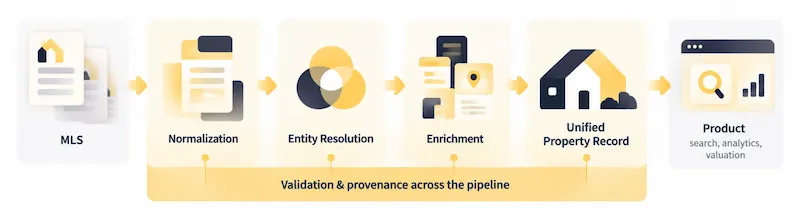
The stages map to a distinct problem and output:
| Stage | Main problem it solves | Output |
| Normalization | Sources use different formats | Comparable records |
| Entity resolution | Records may refer to the same property | A property identity |
| Enrichment | Useful context lives outside the MLS | Additional attributes on the property |
| Unified property record | Data is otherwise fragmented | A reusable property model |
| Product layer | Features need different views | Search, analytics, valuation, and other features |
Normalize the Sources
Addresses, property types, lookup values, date formats, and identifiers differ by provider, and MLS feeds can differ in schemas, local fields, and implementation details even when they follow common industry standards.
Normalization standardizes those representations so records can be compared and combined, while preserving source distinctions where they carry meaning.
Resolve the Property Identity
Matching comes before enrichment. The pipeline first decides which records from the MLS, public records, and third-party sources describe the same real-world property.
Entity resolution is probabilistic in many implementations, so matching should use several signals together rather than a single field:
- Normalized address
- Parcel and property identifiers
- Source-specific IDs
- Geographic attributes
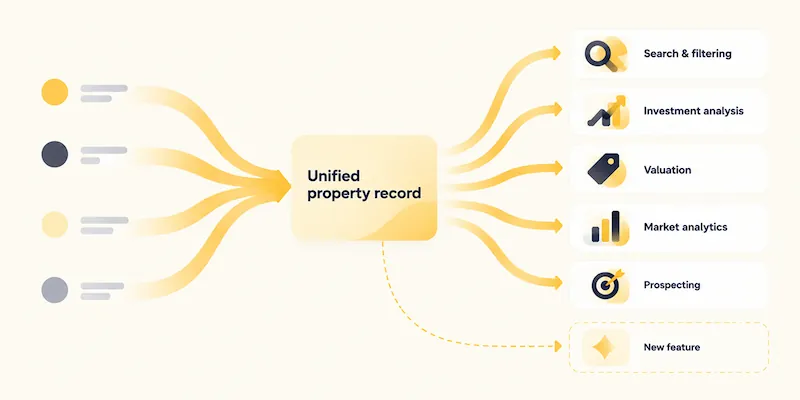
Because matching produces likely matches rather than certainties, it needs confidence thresholds, conflict-resolution rules for competing values, and a review path for ambiguous records.
The output of reliable matching is a unified property identity: a common reference that source records attach to when the match clears the required threshold.
If enrichment is attached before identity resolution is reliable, data from one property can end up associated with another.
Enrich the Property
Enrichment attaches the categories covered earlier to the resolved property. Each attribute attaches to the property identity rather than to a single listing, so the context persists across listings.
Build the Unified Property Record
The result is a property model that gives downstream systems one consistent way to reference the property while preserving the source-specific records behind it.
“Unified” does not mean one flat table. A workable model:
- Relates the property to its listings, transactions, owners, valuations, and geographic entities
- Preserves each source’s individual history and provenance
- Keeps historical attributes time-aware, so it can show previous owners, assessments, transactions, and valuations rather than overwriting every value with the latest one
- Represents relationships between properties, buildings, units, or portfolios when the product requires them
Preserve Provenance, Freshness, and History
Enriched values come from many systems, so provenance and freshness rules are needed to keep the resulting record trustworthy. That governance should stay light enough not to add unnecessary operational complexity.
Keep enough metadata with each value to know what it is and where it came from:
| Keep with each value | Why it matters |
| Source | Where the value came from, such as county records, an AVM provider, or a market feed |
| Retrieval date | When the pipeline fetched the value |
| Effective date | When the value was true, which can differ from the retrieval date; a tax assessment’s effective date is not the date an API returned it |
| Fact or derived | A recorded sale price is a source fact, while an AVM figure is a derived estimate; the two should not be presented as equivalent |
Freshness requirements should follow the use case. A prospecting workflow may tolerate older ownership data, while a pricing workflow may require much more frequent updates. The goal is a property record where each value has a defined meaning, a known source, a date, and, where relevant, a method or confidence indicator.
What the Unified Property Record Enables
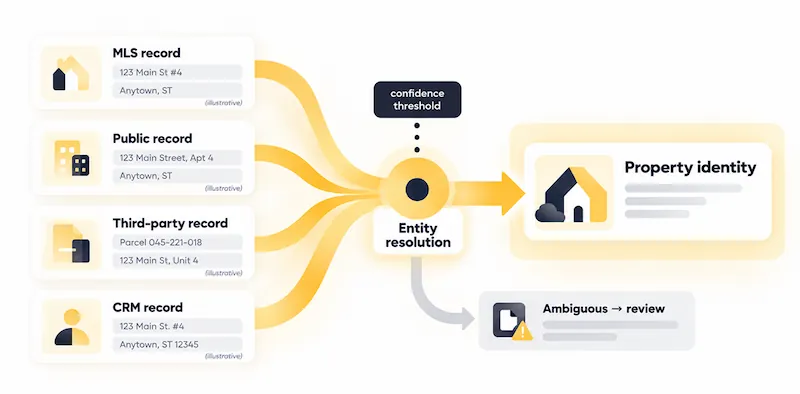
When multiple features read from the same property model, each one uses the slice of context it needs. Search and discovery features, the core of most property listing platforms, can read physical, geospatial, and neighborhood attributes from that record.
Common workflows and the data they draw on:
- Search: property characteristics, geospatial, neighborhood
- Investment analysis: ownership, tax, transactions, valuation
- Valuation: transactions, property characteristics, market data
- Market analytics: transactions, inventory, pricing, geography
- Prospecting: ownership, property characteristics, location
The same property model can also feed dashboards, maps, reporting, and real estate data visualization without each interface reconstructing the underlying data connections.
A well-structured record also gives AI features cleaner, traceable inputs, though the same foundation serves conventional search, analytics, valuation, and reporting. Because features share one model, a new feature can reduce the amount of source-specific integration it has to reproduce.
How to Prioritize Enrichment
More data does not automatically make a better product. A workable order of operations keeps enrichment tied to product decisions:
1.Define the product decision. What should the user be able to search, compare, estimate, or analyze?
2.Identify the missing property attributes. Which information is absent or incomplete in the MLS feed?
3.Evaluate sources. Compare coverage, accuracy, freshness, licensing, identifiers, and integration requirements.
4.Add the data to the property model. Resolve identity, validate the values, preserve provenance, and expose only what the product needs.
Enrichment is one option among several. Process changes, better governance, off-the-shelf data tooling, and a warehouse can each be the right call depending on the gap.
Building the Enrichment Layer as an Architecture Problem
MLS enrichment is more useful when it is treated as reusable data infrastructure rather than a one-time integration. How far to take it depends on the product, source coverage, update requirements, and existing data stack.


