

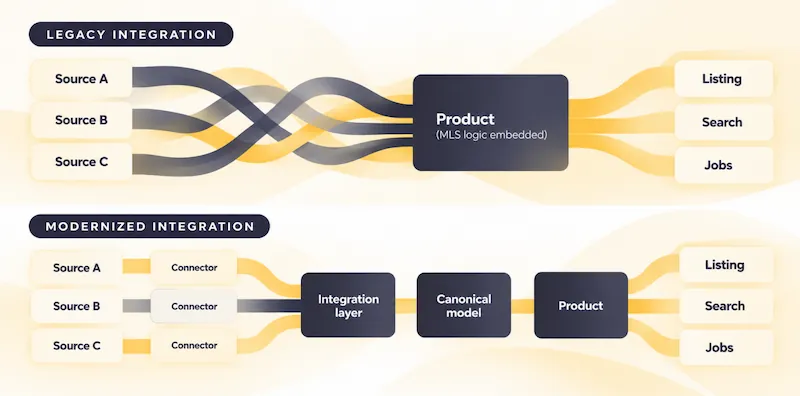
An MLS integration becomes difficult to change when source-specific API handling, mappings, status rules, and exceptions become embedded in product logic. Changes to one source can then affect listing services, search, background jobs, and other downstream components.
The business impact is visible in slower source onboarding, more engineering work for routine changes, and less reliable listing data. Modernization can address these problems by establishing a stable internal contract and moving source-specific logic behind it, without requiring a full-system rewrite.
Some legacy integrations use RETS-based access, while others use RESO Web API connections or a combination of both. RESO has deprecated RETS in favor of its Web API standard, but the access method alone does not determine the quality of the integration architecture. A Web API connection can still be tightly coupled to product logic, while a RETS-based integration can have well-defined internal boundaries. Modernization should focus on how source-specific behavior is handled, regardless of the access method.
When a Legacy MLS Integration Becomes a Product Problem
A legacy integration is worth modernizing when its implementation starts to slow product development or undermine data reliability.
Common signals include:
- Every MLS change requires engineering work. A source renames a field or adjusts an endpoint, and product code has to change to keep listings flowing.
- Adding another MLS can take weeks when each source requires a near-custom implementation rather than following a repeatable integration pattern.
- MLS-specific logic is scattered across product code. Source handling lives inside listing services, search, and background jobs instead of in a defined integration boundary.
- The integration has become fragile. Small changes carry regression risk, so the team becomes reluctant to modify it.
- Listing data is becoming less reliable. Updates arrive late, records go missing or duplicate, or status changes lag behind the source.
Why Legacy MLS Integrations Become Difficult to Change
These business symptoms often have several technical causes. The most important is where source-specific responsibilities live and how they interact with the rest of the application.
A legacy MLS integration may show several of these patterns:
- Source-specific retrieval logic. Pagination, rate limits, authentication, and retry behavior are implemented differently for each source.
- Inconsistent field and status mapping. Similar fields or status values have different meanings across MLSs, but the product handles those differences in multiple places.
- Unreliable record synchronization. Updates, withdrawals, and deletions are not consistently reflected in downstream records.
- Inconsistent record identity. The integration relies on source-specific identifiers without a reliable way to match records across updates or prevent duplicates.
- Fragmented media handling. Image references, media updates, or listing-to-media relationships are processed separately from the associated listing data.
- Limited feed-level diagnostics. When a listing is missing, stale, or incorrectly mapped, the team cannot easily trace the problem to source retrieval, transformation, or downstream processing.
Industry standards such as RESO can improve consistency in field definitions and data structures, but they do not eliminate differences in source behavior, update patterns, or market-specific requirements. Those differences still need to be handled by the integration architecture.
The Architecture Shift: Introduce an Abstraction Layer
For many legacy MLS integrations, modernization starts with an abstraction layer: an internal interface that separates source-specific logic from the product services that consume MLS data.
| Dimension | Legacy Integration | Modernized Integration |
| Data path | MLS-specific handling is mixed into product logic | Source-specific handling is separated from the product through defined internal interfaces |
| MLS logic | Distributed across product services | Contained within defined integration responsibilities |
| Data representation | Product services may consume source-shaped data directly | A shared internal data model provides consistent representations where needed |
| Source changes | May require changes across multiple product components | Can often be handled within the relevant connector or mapping logic |
| Adding a source | May require source-specific implementation across the application | Can follow a reusable connector contract, with source-specific mapping and validation |
The integration layer and canonical data model are logical responsibilities, not necessarily separate services. They can exist within one application or span multiple components. The key is to maintain a consistent product-facing data contract while preserving source attribution, licensing requirements, and other information needed by the product.
Establish a Canonical Data Model
A canonical data model defines how the product represents MLS data internally, including listings, properties, agents, media, and listing statuses. It provides a consistent structure for shared concepts while allowing different sources to use their own field names, formats, and market-specific attributes.
Two principles guide its design:
- Normalize shared fields. Define the internal representation of core listing attributes, then map each MLS into it.
- Preserve meaningful differences. The RESO Data Dictionary defines standardized resources, fields, and lookup values for interoperability, but it does not dictate the product’s database schema. Use it as a reference while designing a model that meets the product’s business requirements and accommodates relevant source-specific fields.
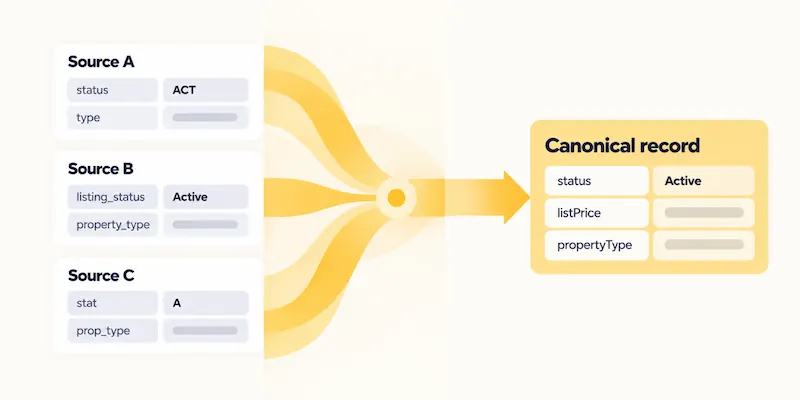
Field names alone do not guarantee consistent meaning across MLS sources. Status values and other source-specific fields must be interpreted and mapped according to their business meaning.
Handling Status Changes and Unknown Values
For example, an MLS may change how it represents a listing status. If the new source value has the same business meaning as an existing canonical status, the connector can map it to that representation, allowing downstream product services to continue using the same contract.
Unknown values should not be silently mapped to an existing status. Instead, the integration should apply an explicit fallback or exception policy, retain the original source value for diagnosis, and record a validation failure or trigger an alert when appropriate.
If the new value represents a different business meaning, the canonical model and downstream handling may need to be extended. Mapping rules should be validated against known values and tested whenever source schemas or lookup values change.
Build Reusable MLS Connectors
A reusable connector is a source-specific adapter that implements a common integration contract. Each connector handles the requirements of its MLS while exposing data through a consistent interface for downstream processing.
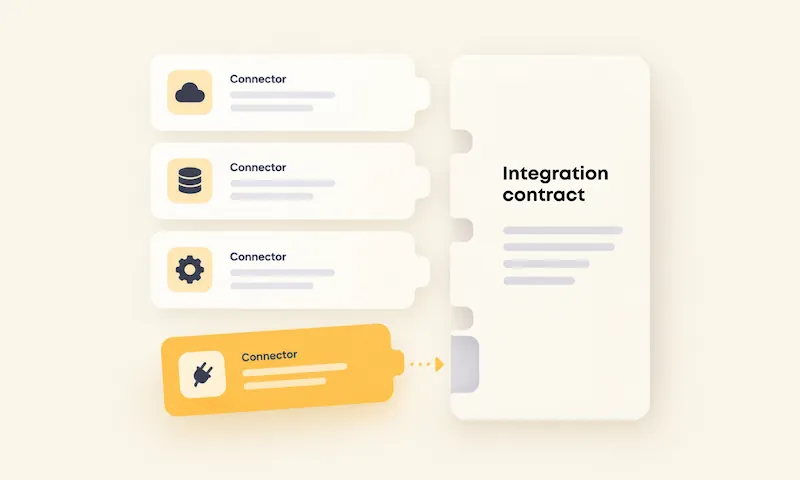
What a Reusable MLS Connector Should Handle
Typical responsibilities include:
- Source communication: API requests, authentication, and credential handling.
- Data retrieval: Pagination, rate limits, and incremental retrieval of changed records where supported.
- Field mapping: Translating source-specific fields and values into the canonical data model.
- Error handling: Managing source-specific failures and making them available for diagnosis.
Add Observability Before Migrating Production Traffic
Before changing production traffic, establish how the existing integration behaves under normal conditions. Track the signals that help identify failures and regressions:
- Connector availability and API failure rates
- Ingestion latency and processing failures
- Unexpected changes in record or update volumes
- Source schema changes and mapping errors
- Data freshness and delayed updates
Use these metrics to distinguish normal source variation from integration failures and compare the legacy and modernized paths. Set alert thresholds according to the product’s update requirements and the behavior of each source.
How to Compare the Legacy and Modern Integration Paths
Where appropriate, run the new integration path in shadow mode alongside the existing production path. Both paths process the same source changes, but the new path’s outputs are compared with the legacy results without independently writing to production records or triggering business operations. This allows the team to validate behavior before routing production traffic through the new implementation.
Define which path is authoritative for production writes at each migration stage. If both paths must write during a controlled transition, use explicit ownership and idempotency or deduplication controls to prevent duplicate updates and business actions. Establish rollback criteria before cutover, including how production traffic and writes will return to the legacy path if material discrepancies appear.
Compare the paths across these areas:
- Record completeness and identity: Compare record counts, identifiers, matching, duplicates, and unexplained missing or additional records.
- Field and status accuracy: Check critical fields, normalized values, and status transitions.
- Updates and deletions: Verify that changed records are updated correctly and withdrawn or deleted records are handled according to source behavior.
- Timing and freshness: Compare update latency, processing delays, and when changes become visible in the product.
- Media integrity: Where applicable, validate media references, availability, and associations with the correct listing.
- Critical product workflows: Test listing display, search, status updates, and other affected workflows.
- Error recovery: Test retries, interrupted processing, and recovery from failed or partially completed ingestion.
Document the results and compare them against agreed acceptance criteria. Resolve material discrepancies, or obtain explicit stakeholder acceptance of them, before moving production traffic to the new path.
Migrate Gradually Instead of Replacing Everything at Once
Migrate one MLS at a time to limit the scope of each change and make discrepancies easier to isolate. It also lets the team validate the new integration approach before applying it to additional sources.
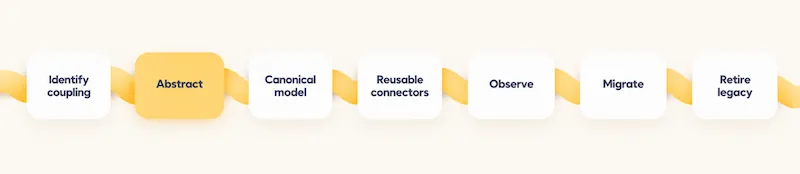
A Practical Legacy-to-Modern Migration Sequence
1.Map dependencies. Find where MLS-specific logic currently lives.
2.Define the internal contract. Decide what the product-facing interface should expose.
3.Introduce the abstraction layer. Put the boundary in place.
4.Establish the canonical model. Define the shared representation for core entities.
5.Build a connector. Implement one source against the shared contract.
6.Run in parallel. Operate old and new paths together where appropriate.
7.Compare outputs. Validate records, fields, and timing.
8.Review cutover criteria. Confirm validation results and rollback readiness.
9.Cut over and monitor. Shift traffic gradually and watch for issues.
10.Retire the legacy path. Remove old components after a successful observation period.
How to Choose the First MLS to Migrate
Choose a source that exercises meaningful integration differences without introducing unnecessary business risk.
Consider:
- Technical complexity: Enough variation to test source-specific mapping and processing, but manageable for an initial migration.
- Business criticality: Avoid making the first migration dependent on the most critical source unless there is a clear reason.
- Traffic volume: Moderate volume can provide meaningful comparison without maximizing exposure.
- Source stability: A stable source reduces variables during the first migration.
- Dependency count: Fewer downstream dependencies can make the initial cutover easier to control.
What Successful MLS Integration Modernization Looks Like
The value of modernization should be visible in day-to-day integration performance. Evaluate the results against a baseline using four measures:
- Source onboarding time: How long it takes to bring a new MLS into production.
- Incident resolution time: How quickly the team diagnoses and resolves integration failures.
- Regression frequency: How often integration changes cause defects in existing workflows.
- Data freshness: How long source updates take to become available in the product.
Compare these measures before and after migration, using similar sources and workloads where possible. The results help establish whether the changes are reducing engineering effort and improving reliability.
How ORIL Modernizes Legacy MLS Integrations
ORIL begins by assessing how the existing MLS integration behaves, where its dependencies lie, and which source-specific changes create the greatest engineering or operational burden. This assessment provides the basis for a modernization plan tailored to the current system, whether it uses a monolith, separate ingestion services, or vendor-managed feeds.
ORIL can support the full modernization lifecycle, from architecture assessment and target-state design through connector implementation, data validation, controlled cutover, and ongoing product development. The scope depends on the system and engagement, with progress evaluated against agreed validation criteria and operational measures.
As a technology partner for real estate businesses, ORIL combines technical implementation with a migration plan that accounts for the product’s existing architecture, dependencies, and operational constraints.
Is Your Legacy MLS Integration Holding Back Product Development?
If MLS changes are slowing product development, new-source onboarding is taking too long, or listing data reliability is declining, an architectural assessment can help identify the underlying constraints and prioritize the next steps.
Talk to ORIL about modernizing your real estate data integration or contact the technical team to discuss your current architecture and migration options.


