
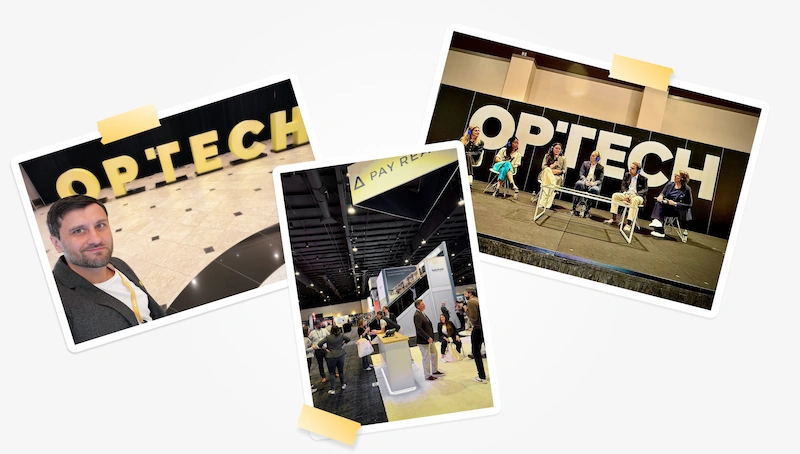
The clearest signal from OPTECH 2026 is that multifamily operators are not short of software. They are short of software that connects, shares clean data, and earns its place in an already crowded stack.
ORIL CEO Roman Havrylyuk spent November 16–18 in Las Vegas for OPTECH 2026, the rental housing industry’s flagship event for operations, technology, marketing and data. The conference is run by RETTC with the National Multifamily Housing Council (NMHC), and its agenda leaned heavily into AI strategy, data and integrations, and cybersecurity.
Below are the themes that stood out to us at OPTECH and what they mean for PropTech companies and tech-driven real estate businesses planning their next product or platform investments.
Key takeaways
- Operators are counting their systems. Consolidation is becoming a near-universal second priority.
- AI is arriving on top of fragmented stacks. Data and integration now take the largest share of new tech budgets.
- Autonomy needs to be earned. Panelists warned against trusting AI models without knowing where their answers come from.
- Security before efficiency. Protecting resident data and controlling how AI tools are used came before speed.
- Integration was the pitch. On the expo floor, vendors led with connecting systems, not with new features.
- AI strategy is going enterprise-wide. The conference closed with a lab on building an enterprise AI roadmap.
1. Operators are counting their systems
Tech stack consolidation is moving from a nice-to-have to a standing priority for multifamily operators. In RETTC’s latest biennial technology survey, consolidation won few first-place votes but took 27% of second-place votes, the strongest second-choice showing of any trend.
The numbers behind that shift are concrete. An IT leader at one of the larger U.S. multifamily operators has said publicly that the company runs roughly 70 applications across its properties and is in the second year of reducing that count. The argument is financial: spend concentrated in one solution buys more than the same budget split across several tools, and the difference reaches property NOI.
Third-party managers face an extra layer: owners often bring their own systems. For them, the practical approach is to fix a small set of non-negotiable core tools and choose everything else for how well it connects to the PMS underneath.
What this means for PropTech companies: every new product now competes with the operator’s wish to have fewer products. To get adopted, a platform has to cover a core workflow end to end, or plug so cleanly into existing systems that it does not feel like one more login. For operators and other real estate businesses, the first step is mapping which tools overlap and which system owns each piece of data before adding the next one.
2. AI is arriving on fragmented stacks, and integration is the bottleneck
AI adoption in multifamily has moved fast, but most stacks were assembled one point solution at a time. According to the same RETTC survey, the share of respondents with no AI anywhere in their operations dropped from 92% to 6% in two years. Yet only 14% call AI transformative today, while 85% expect it to be within one to two years.
Where is the money going to close that gap? When respondents split a hypothetical $100 across 2026–2027 priorities, the largest share, $14, went to data science, warehousing and integration. RETTC’s earlier OPTECH Leadership Circle findings point the same way: fragmented software ecosystems were named the biggest barrier to scaling AI.
The mechanism is simple. An AI assistant that answers a resident question, flags a maintenance risk or drafts a portfolio report needs consistent records behind it: the same unit, lease, vendor and property identifiers across PMS, CRM, accounting and building systems. When those records disagree, the model either produces unreliable answers or someone reconciles data by hand before every run.
What this means: For most real estate businesses and PropTech platforms, “add AI” is rarely the right first step. The first step is usually making operational data accessible, mapped and trustworthy, and then putting the intelligence layer on top. The same concern ran through OPTECH’s sessions on AI, as the next section shows.
3. Autonomy needs to be earned
The first day of OPTECH 2026 was about discipline and restraint in AI use, and that set the tone for the rest of the conference.
The clearest version came from one of the sessions, where panelists warned that the worst mistake owners, operators and PropTech vendors can make is to blindly trust a GPT or agentic model without knowing where it gets its information. A solutions architecture leader at one of the major property management software providers summed it up: autonomy needs to be earned.
Panelists also stressed that teams should understand how a model reached its conclusion, not only what it concluded. For a leasing recommendation, a maintenance priority or a rent decision, that explanation is what lets a human approve, correct or defend the outcome.
What this means for PropTech companies: agentic features will be judged on transparency as much as capability. Products that show their data sources, log their reasoning and let operators set the level of autonomy step by step will be easier to adopt.
What this means for real estate businesses: before giving an AI tool more autonomy, check that its answers can be traced back to systems you trust, such as your PMS, CRM or accounting data, and that someone owns reviewing its decisions.
4. Security before efficiency
Day two of OPTECH 2026 centered on security and resilience. The conference’s keynote lineup included a former senior U.S. federal cybersecurity official, and the program covered security for smart access, sensors and connected building systems.
For owners, operators, developers and PropTech vendors, panelists framed security in practical terms: knowing exactly what information an AI tool uses, and how employees use the tool.
Safeguards for personally identifiable information deserve as much attention as model evaluation, because unchecked models have exposed personal data or reached company data without authorization. Attackers use the same AI tools everyone else does.
This builds on RETTC’s AI Governance Framework, first released at OPTECH 2025, and its Leadership Circle findings that AI adoption risks becoming fragmented without shared governance.
What this means for PropTech and real estate leaders: access control, data permissions, audit logs and human review of AI outputs should be designed in from the start. They are now part of how operators evaluate vendors, and retrofitting them after a security review usually costs more and delays deals.
5. Integration has become the main selling point
Across OPTECH 2026, PropTech vendors were answering the same operator concern: too many disconnected systems. The common message was less about new features and more about connecting what operators already run, through deeper PMS integrations, consolidated platforms and AI that removes manual work between tools. Research shared ahead of the event supports that shift: integration problems, more than ROI concerns or training gaps, are what slow AI adoption most in multifamily property management.
What this means for PropTech companies: “integrates with your PMS” is no longer a differentiator; it is the entry ticket. Operators judge a product by what it replaces and how deeply it connects, not by how many features it has.
What this means for real estate businesses: as vendors converge toward platforms, the decisions that matter most are which system is the source of truth for each type of data and how everything else connects to it.
6. From AI pilots to an enterprise roadmap
OPTECH’s agenda made it clear that the industry is moving past one-off AI experiments.
The timing fits the data. Only 14% of RETTC survey respondents call AI transformative in their organization today, while 85% expect it to be within one to two years. Closing that gap takes more than buying another tool.
An enterprise AI roadmap usually has to answer a few concrete questions:
- Which workflows come first? Pick the ones with clear volume and measurable outcomes, such as leasing inquiries, invoice processing or maintenance triage.
- Which data do they depend on? Map the systems, identifiers and owners behind each workflow before choosing a model or vendor.
- What level of autonomy is acceptable? Decide where AI recommends, where it acts with review, and where it acts alone.
- Who governs it? Assign responsibility for data access, model oversight and fair housing compliance.
- Build, buy or extend? Buy where a proven product covers the workflow; build or extend where your data, process or customer experience is the differentiator.
What this means: for operators, the roadmap turns AI from a series of vendor demos into a sequence of decisions. For PropTech companies, it is the document your product needs to fit into, so knowing your customers’ priorities and data constraints is now part of product strategy.
How ORIL approaches these challenges
Most of what operators described at OPTECH is engineering work that happens before and beneath the visible product: mapping data across systems, building reliable integrations, and designing AI features around governed data rather than around a demo.
That is the work ORIL has focused on since 2015. Our team has delivered 100+ products across Real Estate, PropTech, ConstructionTech and GreenTech, including third-party integrations with PMS, CRM, ERP and data providers, MLS/IDX/RESO integrations, and data platforms that make operational data usable for analytics and AI.
We attend events like OPTECH to hear directly from operators and product teams about where real friction sits, and we share what we learn so it is useful beyond the conference floor.
If integration or data readiness is slowing your roadmap, start with an honest picture of where you are. Our experts can help you see which data, integration and governance gaps to close before scaling AI.


