
Building a real estate product and maintaining one are different engineering challenges. Getting to market rewards speed. Growing successfully depends on decisions made much earlier: how real estate data sources and third-party feeds are integrated, how domain workflows like listing, valuation, or leasing are modeled, and whether the architecture can absorb new integrations and data volume without a rewrite.
Our team helps PropTech companies design, build, scale, and maintain digital products across the full product lifecycle. We can own the complete development process or join at the stage where you need additional product or engineering expertise.
Whether you are validating a new idea, building an MVP, scaling a live platform, modernizing a legacy product, or strengthening an existing engineering team, we start where your product is today.
Start Where Your Product Is Today
Have an idea?
Start with product design to validate the concept before committing to a build, testing assumptions against the data and systems the product will rely on and turning them into a development-ready direction.
Already have validated designs?
Move directly into MVP development, building on the decisions already made instead of re-running discovery you have already paid for.
Already have a product in production?
Add features and handle growth without destabilizing what already works, whether that means new functionality, architecture improvements, scaling, integrations, ongoing maintenance, or AI enablement.
Working with a legacy platform?
Modernize or run a targeted architecture upgrade to move the product forward without a full rebuild you cannot afford.
Already have an engineering team?
Close a capability or capacity gap faster than hiring allows by adding the engineers, QA, designers, or other roles you need, while keeping your team and product ownership in place.
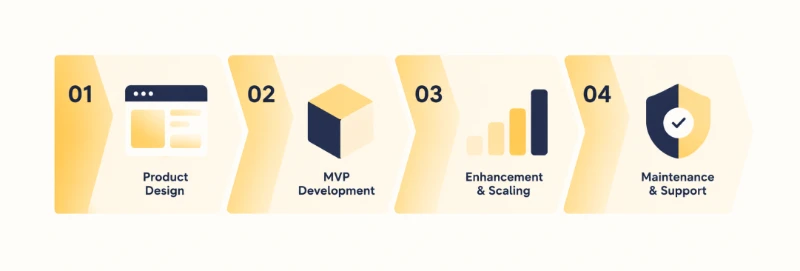
01. Product Design: Idea to Market-Ready UX
Validate the product direction before engineering begins.
PropTech product design depends on facts that sit outside the interface. Which data is available and at what quality, which third-party systems the product reads from and writes to, how the underlying real estate workflows behave, and what those systems allow. These constrain what the interface can do, so we establish them during design rather than discovering them during the build.
The rest of the work is standard: identifying what users need, where current tools fall short, and which capabilities differentiate the product.
Design happens on screens before it happens in code.
Testing assumptions through user flows, wireframes, and prototypes makes changes significantly easier to address. Finding a workflow gap during design is very different from discovering the same issue after an external integration or core backend process has already been built around it.
Product Design Deliverables:
- Competitive analysis
- Value proposition
- Job stories
- User flow diagrams
- Wireframes
- UI design
- Clickable prototype
A typical team includes a Project Manager, UX/UI Designer, and Business Analyst, with client consultations every two weeks.
A standard design scope takes approximately five to seven weeks, depending on product complexity and feature scope.
Outcome: A validated, development-ready product direction with the core user experience defined before major engineering investment begins.
02. MVP Development: Launch the Core Product
Put the essential product into real users’ hands without engineering yourself into a corner.
The MVP is the smallest version of the product that validates the core workflow and the assumptions behind it, while setting up a foundation for later development. The foundation part carries weight in PropTech. An MVP built quickly can still commit the product to a data model or integration approach that limits scaling later. How much to build against real estate data sources and third-party systems at MVP stage, versus deferring it, is a decision the team makes deliberately.
Work runs in sprints with regular deliverables and checkpoints. Progress stays visible throughout the build, and each cycle can incorporate what the previous release taught the team.
A typical MVP team can include: a project manager, engineers, QAs, DevOps, a designer, and a business analyst.
Weekly demos, planning sessions, and retrospectives keep the work transparent throughout.
Outcome: A working product that can be put into use, tested against real requirements, and extended as the business learns what users actually need.
Different PropTech Products Create Different Engineering Challenges
There is no single architecture or development approach that fits every real estate product.
| Product | Typical engineering challenges |
| Listing Platforms & Marketplaces | Listing and inventory sync, search, external feed integration, transaction workflows |
| Property Management | Lease lifecycle, rent and payment processing, maintenance and tenant workflows |
| Data & Analytics | Ingestion, normalization, enrichment, high-volume processing |
| Transaction & Bidding | Workflow state, permissions, real-time updates, document and payment flows |
| Investment & Valuation | Data accuracy, valuation models, portfolio and performance reporting |
| Smart Building | IoT device connectivity, telemetry ingestion, real-time monitoring |
| Construction | Scheduling, document control, budget tracking, field-to-office sync |
| Energy & Sustainability | Metering data, monitoring, compliance and ESG reporting |
| AI-Enabled Products | Data quality, retrieval, security, monitoring |
Understanding those differences early helps avoid treating domain-specific engineering problems as generic software requirements.
03. Enhancement & Scaling: Grow With User Demand
Scale the product without sacrificing performance or slowing future development.
Once a product has real users, engineering work runs on two tracks: keeping the system reliable as usage grows, and adding features that usage and business needs justify.
Adding server capacity handles some of this, but not the parts that matter most. Higher volume tends to surface limits set earlier: a data model that no longer matches how the data is queried, an integration layer that cannot take another feed, APIs that slow under concurrent load, infrastructure not built to grow. These are architectural, and resolving them is most of what scaling work actually involves.
Enhancement and scaling work can include:
- Architecture improvements
- Performance optimization
- Infrastructure scaling
- Security upgrades
- Data-layer improvements
- New features and integrations
- UI/UX refinement
- Continuous testing
Outcome: A product that can support increasing usage, data volume, integrations, and feature complexity without allowing technical limitations to dictate the roadmap.
04. Maintenance & Support: Keep the Product Reliable After Launch
Keep the systems behind your product working as technologies and dependencies change.
Launching a product does not freeze its technical environment.
Standard maintenance includes:
- Bug fixes
- Performance monitoring
- Security patches
- Dependency updates
- Version upgrades
- Database maintenance
- Infrastructure checks
A PropTech platform integrates with external systems that are maintained by other companies and change on their own schedule. Those changes are the main source of post-launch integration work. A platform may depend on:
- MLS feeds
- PMS APIs
- AVM and valuation data
- IoT and smart-building feeds
- Payment gateways
- CRM APIs
- Listing-syndication services
Any of them can break an integration that worked at launch by changing its schema, API version, authentication requirements, rate limits, or behavior, even when nothing changed in your own code. Ongoing maintenance helps identify and address those changes before they become user-facing problems.
Security maintenance can also include dependency vulnerability management, access-control reviews, infrastructure configuration checks, and remediation of issues identified through monitoring or security testing.
Outcome: A product that stays secure, compatible, performant, and reliable as its surrounding technology ecosystem evolves.
AI Across the Product Lifecycle
Use AI where it solves a product problem
AI does not need to be a separate phase of development. When it can be introduced depends on data readiness and product maturity: some products are ready for it at MVP, others only once the data foundation is in place. Common applications include:
- Document and lease analysis, extracting structured data from unstructured records.
- Recommendations, surfacing relevant listings, matches, or actions from user and property data.
- Automation, handling repetitive workflow steps that would otherwise be manual.
- Decision support, turning operational and market data into insight a user can act on.
Each of these depends on the same foundations as the rest of the product: reliable data, integrations, architecture, security, and monitoring. We assess an AI feature against the product problem and the systems needed to support it, rather than adding it to the roadmap on its own.
Proof Across the Lifecycle
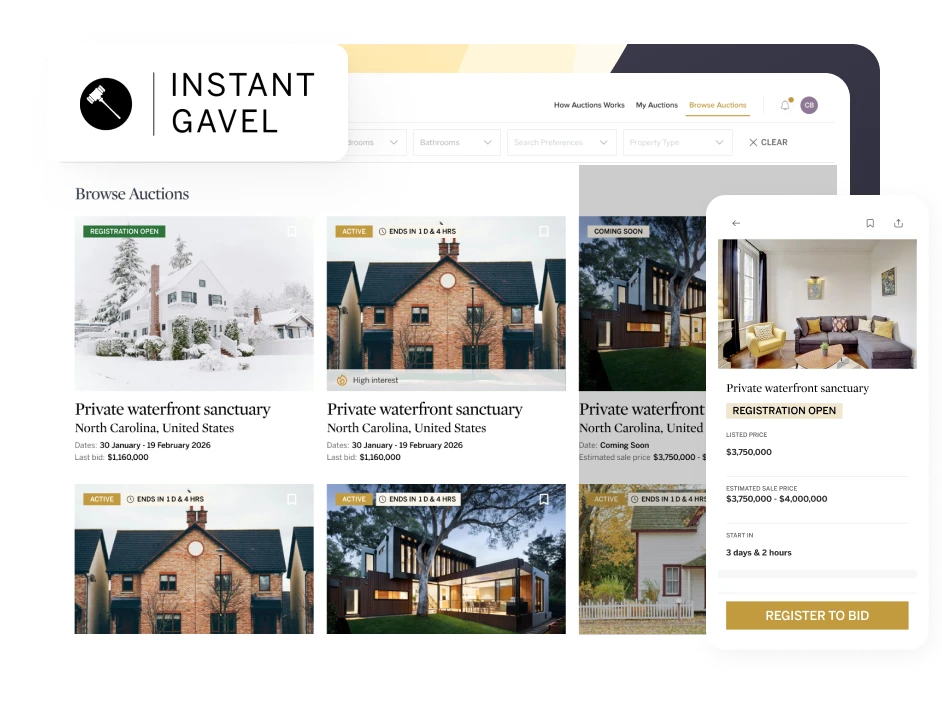
Product Development: Concierge Auctions (Instant Gavel)
For Concierge Auctions, ORIL built Instant Gavel, a fully digital, self-service auction platform for $1M–$3M luxury properties. The platform unified the full auction lifecycle — from verification and registration to bidding and agreements — reducing manual operations and accelerating agreements from hours to as little as 30 minutes. From product concept to live platform in seven months, enabling seamless digital transactions at scale.
Scaling: Rentometer
or Rentometer, a U.S. rental price data platform, ORIL expanded the product with a comprehensive suite of tools, including Yield Tracker, Deal Worksheet, Batch Processor, and a Mobile App — extending the platform without requiring a full rebuild.
Built on a scalable data layer supporting 400,000+ records, the platform now processes 20,000+ reports daily, enabling Rentometer to scale its product capabilities and data operations efficiently.

Modernization & Ongoing Engineering: Parity
For Parity, ORIL took over an HVAC optimization platform already in production and focused on stabilizing, modernizing, and scaling the existing product — without disrupting its ongoing operations. We strengthened the platform architecture, rebuilt data pipelines, integrated weather data, implemented anomaly detection, and migrated the infrastructure to support more reliable, scalable performance. Today, the platform supports nearly 100 million sq. ft. of real estate, delivering 15–30% reductions in HVAC energy consumption and $50K–$80K in annual savings per building.

Work With a Team That Already Understands PropTech
By this point, the lifecycle stages should map onto your own situation: an idea to validate, an MVP to build, a live product to extend, a scaling problem, or a legacy system to modernize. ORIL can start at any of them.
You can bring us in to:
- Turn a new product idea into a validated design
- Build and launch an MVP
- Add features to an existing product
- Improve architecture and performance
- Scale a growing platform
- Modernize a legacy system
- Build or maintain external integrations
- Add engineering capacity to your existing team
- Take over enhancement or maintenance of an existing product
We start with where the product is today and what needs to happen next.


