

A real estate acquisition often brings another data environment with it. That can mean a second CRM, a second PMS or ERP instance with its own chart of accounts, and a second set of property and client IDs that were never built to reference each other. Add in a spreadsheet or two, built to keep the two businesses reporting the same numbers in the meantime, and the picture gets messier still.
That reconciliation runs deeper than moving records into a shared database. The work is to give the combined business one reliable way to represent its properties, clients, transactions, and financial data. That means mapping the two organizations’ systems, identifiers, and business definitions to a common structure. For a CTO or CFO, the practical result is a number they can trace back to its source and explain when it reaches the board.
An Acquisition Creates a Data Problem Before It Creates a Reporting Problem
By the time a combined portfolio report is requested, the data or finance team may already be reconciling two versions of the same business by hand.
The acquired company may use different systems, IDs, or business definitions from the acquirer. A single deal can bring in:
- A different CRM, with its own contact and pipeline structure
- A separate PMS or ERP, with its own chart of accounts and lease data
- Property and client records with no shared identifier
- MLS feeds mapped to different fields and statuses
- Spreadsheets built to bridge systems that were never designed to connect
Spreadsheets are often used as a temporary bridge when reporting has to continue before the systems are fully integrated.
Reports can still go out, but manual extraction and reconciliation make stale data, inconsistent logic, and transcription errors more likely.
Deloitte’s 2026 GenAI in M&A Pulse Survey of 500 corporate and private equity M&A leaders found that buyer diligence across fragmented data sources was the single most cited source of transaction friction, named by 57% of respondents. Closing the deal does not resolve that fragmentation. The same gaps can reappear during integration, reconciliation, and reporting.
Why More Connected Systems Do Not Automatically Create a Single Source of Truth
Connecting the systems, or moving their data into one database, does not by itself create a single source of truth. The systems can still use different definitions and rules for the same business concepts.
Two systems can be integrated and still disagree on:
- What counts as an “active” listing versus “available” inventory
- How occupancy or revenue is calculated
- Which record wins when the same property exists under two different IDs
- What date a transaction is considered closed
A PRODA survey of 62 senior real estate professionals conducted in December 2025 found that only 31% were very or completely confident in the accuracy of their core real estate data, even though the same group reported using multiple integrated systems day to day.
A reliable reporting layer needs more than a common database. The underlying architecture needs clear ownership for core entities, controlled data flows, and shared definitions for the metrics used in reporting. The canonical model and the systems of record both play a role. The canonical model defines how data is represented across the business; the system of record identifies where a particular piece of data is owned.
9 Steps to Post-M&A Data Consolidation
Consolidating two real estate companies’ data involves several connected stages, each addressing a different class of integration or data-quality problem. Problems missed early in the process often surface later in reporting, where they are harder to trace to the original source.
| Stage | What it solves |
| 1. Inventory | Nobody knows what data exists or who owns it |
| 2. Data mapping | Same concept, different field names and meanings |
| 3. Canonical data model | No shared representation of the business |
| 4. Entity resolution | Same property, client, or asset under different IDs |
| 5. Normalization | Inconsistent formats and values across systems |
| 6. Validation & quality rules | No way to know if the combined data can be trusted |
| 7. Integration layer | Data flows are one-off scripts instead of an architecture |
| 8. Analytics layer | Metrics are recalculated differently by every team |
| 9. Executive dashboards | Leadership waits on manual reports for basic questions |
These stages inform each other more than they run in strict order. Entity resolution often surfaces mapping gaps that send a team back to step 2, and the integration layer usually gets built alongside the canonical model. The table below is best read as a set of dependencies, not a fixed timeline.
That non-linearity also applies to the source systems themselves. Migrating the acquired company’s CRM, PMS, or ERP onto the parent’s stack within the first quarter is rarely realistic, and forcing it may create more risk than it removes.
A practical alternative is to let both systems coexist temporarily while an integration layer connects them, a canonical model gives them a shared representation, and unified analytics run on top while the underlying systems are still separate. Retiring the acquired company’s legacy systems becomes a gradual rationalization once that data layer is already trustworthy.
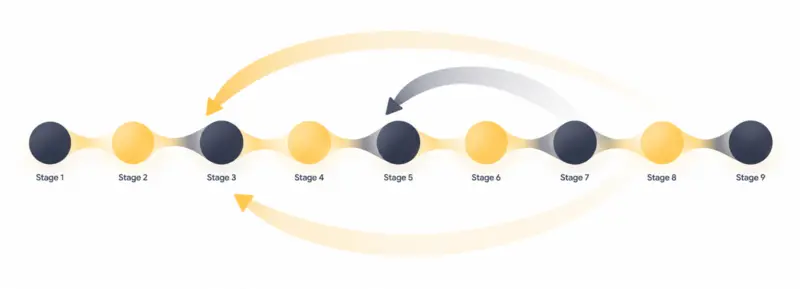
1. Inventory the Data Landscape Before Moving Anything
Before any database migration strategies get chosen, the combined organization needs a full map of what data exists: every CRM, PMS, ERP or accounting system, MLS feed, transaction system, acquired-company database, spreadsheet, API, and third-party data source across both businesses.
For each source, the inventory should capture ownership, format, refresh frequency, historical depth, dependencies, and which decisions rely on it. A structured integration ROI framework at this stage helps prioritize which sources to consolidate first, based on where fragmentation creates the most cost or risk.
2. Map Business Meaning, Not Just Database Fields
Field-to-field mapping is the easy part. The harder work is mapping meaning: does “active listing” in one CRM mean the same thing as “available” in the other? Does “property_id” in the acquired company’s PMS refer to the same concept as “asset_id” in the parent’s ERP?
Real examples that show up constantly in real estate M&A:
- Different transaction status taxonomies (pending, under contract, in escrow)
- Revenue recognized on different dates or under different rules
- Property type classifications that don’t line up one-to-one
- Client and organization records that mean “household” in one system and “account” in another
Documenting the business rule behind each field makes the mapping more useful later for entity resolution and validation. Teams working on consolidating real estate software stacks often find that a CRM and a PMS were never built around the same definitions to begin with, even before an acquisition adds a second set of each.
3. Build a Canonical Data Model for the Combined Business
A canonical data model defines how the combined business will represent the entities and relationships used across integrations and analytics:
- Property
- Asset
- Client
- Organization
- Agent
- Listing
- Transaction
- Lease
- Portfolio
The operational systems do not have to use the same schema. A CRM and PMS can keep their existing structures while both map into the canonical model used for integration and analytics.
Forcing every source system into one schema can also disrupt day-to-day operations without adding much value to the integration layer.
4. Resolve the Same Property, Client, or Asset Across Systems
Entity resolution is often one of the more technically challenging parts of consolidation. The same property may appear under different IDs in the acquiring company’s PMS, the acquired company’s PMS, and an MLS feed. Address formats and spellings may differ as well.
A working entity resolution approach typically includes:
- Matching logic based on multiple attributes (address, parcel number, name, geography), not a single field
- Deduplication rules for likely duplicates that aren’t identical matches
- Survivorship rules to decide which system’s data wins when records conflict
- A persistent enterprise identifier and cross-reference table
Without this step, a portfolio report can double-count a property that exists in both systems, or fail to recognize that a “new” client is actually an existing one who worked with the acquired company under a different name.

5. Normalize Data Without Losing Source-System Context
Normalization standardizes formats and values (addresses, currencies, property types, status values, dates) so they can be compared and aggregated consistently. If done carelessly, normalization can also erase useful context that a source system carried.
The better pattern is a controlled transformation: normalize the values used for reporting, but preserve a reference back to the original source record. This mirrors the approach used in enterprise data normalization patterns built for MLS feeds at scale, where incompatible listing structures from multiple regions need to resolve into one schema without losing detail a specific market relies on.
6. Validate the Combined Data Before Leadership Relies on It
Validation turns “the data is in one place” into “the data can be trusted.” Automated quality rules should check for completeness, uniqueness, validity, consistency, referential integrity, and freshness, and should flag exceptions.
Common rules include:
- Every property record is either linked to a resolved master ID or explicitly flagged as unresolved for review
- Every transaction references a valid client and asset
- Revenue figures reconcile to the relevant source-system totals within a defined tolerance, where the underlying business definitions and reporting periods are aligned
- No record has gone unrefreshed past its expected cadence
This kind of engineering-grade quality control, similar to what’s described in an analytics platform case study built for high-reliability reporting, gives an executive a number they don’t have to second-guess.
The Architecture That Turns Fragmented Sources into Trusted Business Data
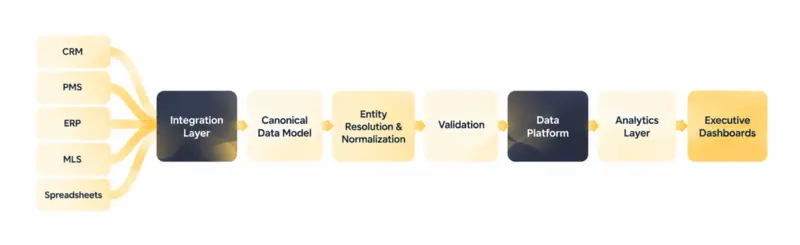
The nine stages describe the work itself. The architecture shows how those pieces fit together in a production environment.
1.Source systems
2.Integration layer
3.Canonical data model
4.Entity resolution & normalization
5.Validation
6.Data platform
7.Analytics layer
8.Executive dashboards
A well-designed integration layer helps make the process repeatable. It handles APIs, scheduled ingestion, transformations, orchestration, monitoring, and errors. Each source should also have a clear owner and an expected refresh cadence.
Whether it’s built as point-to-point connections, an event-driven pipeline, or a decoupled service architecture is itself an engineering decision, worth making deliberately as part of post-merger architecture integration rather than defaulting to whatever pattern the acquired company happened to use.
| Before | After |
| CRM, PMS, ERP, MLS, and spreadsheets held separately | Sources connected through a controlled integration layer |
| Same property or client under multiple IDs | Cross-system entities linked through a consistent identifier strategy |
| Every team calculates KPIs its own way | Metrics defined once in a governed analytics layer |
| Analysts reconcile numbers before many reports | Routine reporting draws from validated, refreshed data |
| Acquired and existing portfolios reported separately | Both visible through the same analytical model |
| Leadership waits days for some combined answers | Leadership can access standardized portfolio metrics through dashboards |
From Consolidated Data to Executive Analytics
Once KPIs are defined centrally, with consistent calculation logic and clear ownership, leadership stops waiting on manual reconciliation to get an answer. Comparisons that usually weren’t reliable before start to become routine.
Post-Acquisition Performance Attribution
A unified data model makes it possible to separate the performance of the acquired business from the legacy portfolio. From there, it’s just as easy to track how the combined organization performs as integration progresses.
Teams can compare revenue, occupancy, NOI, leasing activity, or operating costs across pre- and post-acquisition periods, regions, or entities. Real estate data visualization keeps those comparisons consistent as more acquisitions get added.
An investment team, for example, could compare the acquired portfolio’s performance before and after integration. That makes it possible to separate acquisition-driven growth from organic performance, and to check whether the synergies the deal was built on are actually showing up in the numbers.
What Analysts Gain After the Data Is Consolidated
Analysts can also spend less time on routine extraction and reconciliation. When entities are resolved and metrics are governed, routine extraction and reconciliation can require less manual effort. That leaves more time for investigating exceptions and interpreting the results.
The same consolidation can simplify financial reporting across the combined entity. Building post-acquisition data integration into the analytics layer can make cross-portfolio financial reporting easier to reconcile, explain, and support when it is reviewed by investors, lenders, or internal finance teams.
Designing the Platform for the Next Acquisition
For a one-off acquisition, data consolidation may reasonably be treated as a project. Serial acquirers have a different problem: the same integration work will need to happen again.
That means:
- Canonical entities and mapping logic that extend to a new source system
- Integration patterns designed to onboard new data through configuration
- Validation rules that apply to new sources without redefinition
- An analytics layer with reusable metric definitions, so new acquisitions can map into established reporting logic where the underlying business definitions are comparable.
The foundation can be reused, but each acquisition still needs its own assessment of systems, data quality, and business rules.
Common Post-M&A Data Integration Mistakes
A few patterns tend to create fragile consolidations:
| Mistake | Why it causes problems later |
| Treating data migration as the whole solution | Moving data into one place doesn’t resolve conflicting definitions or duplicate entities |
| Forcing every source into one schema | Slows down operational systems and creates unnecessary rework |
| Relying on spreadsheets as a permanent bridge | Manual reconciliation becomes harder to scale and increases the risk of transcription, logic, and version-control errors. |
| Skipping entity resolution | Leads to duplicate or double-counted records in reporting |
| Reconciling KPIs manually, team by team | Produces multiple versions of the same metric |
| Building point-to-point integrations without an architecture | Becomes difficult to maintain or extend to future acquisitions |
| Skipping validation before reporting goes live | Erodes leadership’s trust in the data once errors surface |
| Building dashboards before the underlying data is fixed | Dashboards can surface and propagate underlying data-quality problems to a wider audience. |
How ORIL Builds Post-M&A Data Integration Platforms
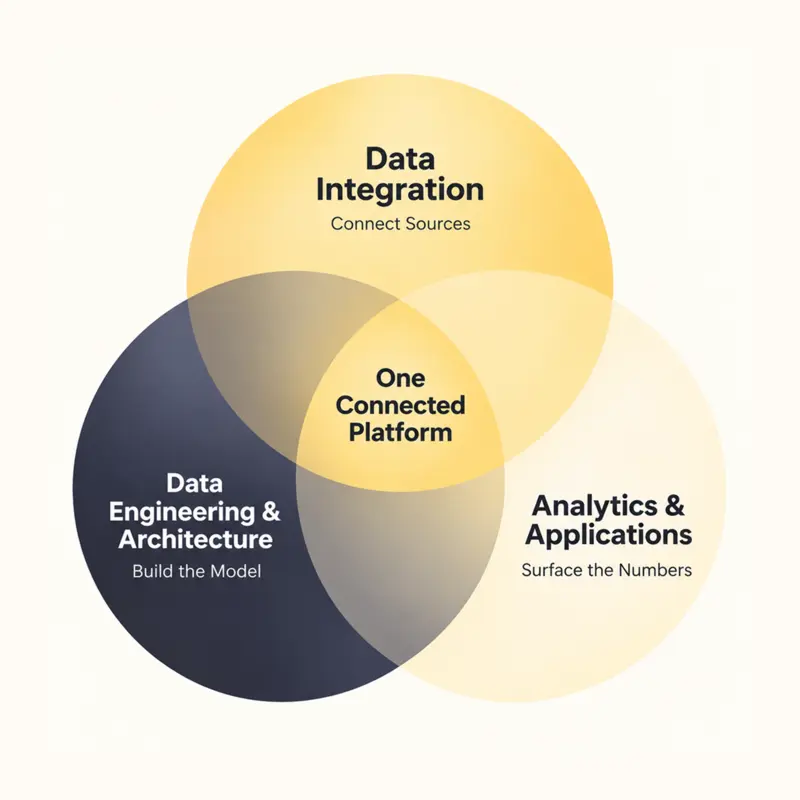
ORIL works as the engineering partner that designs and builds this kind of post-M&A data architecture. That work spans three connected capabilities:
- Data Integration: connecting CRM, PMS, ERP, MLS, acquired-company systems, APIs, files, and third-party sources into a controlled integration architecture, with the ingestion, transformation, and orchestration built as production infrastructure.
- Data Engineering & Architecture: building the canonical data model, entity resolution logic, normalization pipelines, validation and quality rules, and the underlying cloud data infrastructure that everything else depends on.
- Analytics & Applications: turning the consolidated environment into governed metrics, dashboards, and operational analytics that the acquired and existing business can both rely on.
These work as one connected architecture rather than three separate engagements, which is designed to help real estate data integration services hold up once a second or third acquisition adds to the same platform.
What a Successful Post-M&A Data Environment Looks Like
Done well, a post-M&A data environment tends to provide:
- Core entities linked through a consistent identification strategy
- Metrics defined and reused through governed analytical models
- Data flows that are monitored, documented, and assigned clear ownership
- Less reliance on manual spreadsheet reconciliation for routine reporting
- Acquired and existing operations available through a common analytical framework
- Reusable integration patterns that can support future acquisitions
The same foundation can support later AI, forecasting, and automation work. Clean, governed data with consistent entities and clear lineage becomes increasingly important as AI moves from experimentation into production use cases.
The NAREIM/Juniper Square 2026 Technology, Data, and AI Survey found firms rated data timeliness as the weakest dimension of their data quality, and that only about a third had extended formal governance to cover what data their AI tools can access. The findings point to the same practical requirement: data quality and governance need to be addressed before AI tools can reliably operate on enterprise data.
Build a Unified Data Architecture After Your Acquisition
Post-M&A data issues can remain visible long after the deal closes: a KPI may not reconcile, or the same property may appear twice in a portfolio report.
A canonical model, resolved entities, and a validated pipeline help prevent those issues from spreading as the combined portfolio grows.
At ORIL, this is the kind of platform we build for real estate and PropTech companies working through consolidation, engineered around the specific systems and reporting needs of the combined business.


