

A leasing team lowers the admin fee on a two-bedroom unit inside the PMS on Monday. By Friday, the property’s own site still shows the old figure, two syndication partners show a third number, and the Google Business Profile lists no mandatory fees at all.
Every one of those surfaces is an advertisement. Under a growing set of state all-in-pricing laws, each one is supposed to display the same total monthly price.
The regulation itself is readable in an afternoon. Keeping thousands of published listings consistent with it, across channels you don’t fully control, while fees and jurisdiction rules keep changing, is a data engineering problem.
A fee transparency compliance system is the software layer that continuously collects published listings, extracts and normalizes their fee data, checks each listing against jurisdiction-specific disclosure rules, and stores timestamped evidence of what was shown and when. At ORIL, we treat this as a platform capability wired into the product.
This guide walks through the architecture: how listing data is collected and normalized, how a rule engine adapts to new laws, where an evidence vault fits, what AI can realistically do inside the pipeline, and how to decide between building and buying.

Why Fee Transparency Has Become a Software Engineering Problem
Three forces collide here:
- Listings change often.
- They publish to many channels at once.
- The rules governing them differ by state and take effect on different dates.
The exact legal requirements will continue to evolve, which is why software architecture should be designed to accommodate rule changes rather than encode today’s regulations into application logic.
That third force is the one that turns compliance into engineering. The National Apartment Association counted four states requiring “total price” advertising, where mandatory fees must be combined with rent into a single figure in listings, alongside a larger group requiring itemized disclosure before lease signing.
Colorado’s rule (effective January 1, 2026) requires the total price to appear more prominently than any component fee, while Connecticut’s (effective October 1, 2025) applies wherever rent is advertised.
The demand side reinforces it. Zillow‘s Consumer Housing Trends Report found that 94% of renters say listings should show all fees up front, and 74% say a listing that displays a total monthly price feels more trustworthy.
Platforms serving multifamily operators increasingly need real estate software development services that push pricing logic into the data model rather than leaving it to manual review at the edges.
Why Manual Compliance Processes Break at Scale
Spreadsheet-and-audit workflows fail on a predictable schedule. Someone updates the PMS but not the shared sheet, and a quarterly audit catches the drift eight weeks after listings went live with the wrong number. Two structural gaps make this inevitable:
- No live connection to what’s published. Manual review can’t see what websites, ILS feeds, and syndication partners are actually showing right now.
- No defensible history. When a regulator or plaintiff asks what a listing showed on a specific date, “we think it was correct” is not evidence.
Human review can spot-check hundreds of listings. It can’t watch thousands continuously, and it can’t reconstruct past states it never recorded.
Why Every Listing Platform Needs a Continuous Compliance Pipeline
Continuous compliance means validation runs on every listing change and on a schedule, not on a calendar quarter. A fee update fires an event, the affected listings are re-checked, and any that fall out of policy surface immediately with a record of the discrepancy.
At that point compliance starts to resemble observability: you want health metrics on the share of listings passing current rules, change detection on external channels, and alerts when a syndication partner republishes a stale price.
Pulling live pricing from channels you don’t own also raises a security surface, which is why securing third-party API integrations with strict validation at the gateway belongs in the design from day one.
Architecture of a Modern Fee Transparency Compliance Platform
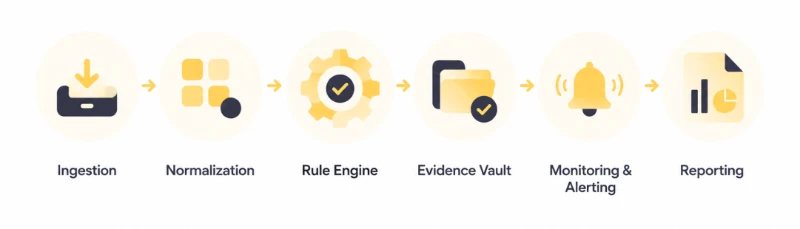
Data moves through a predictable sequence:
| Layer | Responsibility |
| Ingestion | Collect published listings from every customer-facing channel |
| Normalization | Turn raw fee text into a standard, comparable data model |
| Rule engine | Evaluate each listing against jurisdiction-specific policy |
| Evidence vault | Store immutable, timestamped records of every check |
| Monitoring & alerting | Detect drift, score severity, route issues to owners |
| Reporting | Produce dashboards and audit-ready exports on demand |
The foundation underneath all of it is the data model. In practice, this data model typically sits on top of an integration layer that continuously ingests data from PMS platforms, syndication feeds, websites, and internal systems before normalizing it into a common representation.
Structuring the backend to hold base rent, recurring mandatory fees, situational fees, and one-time charges as distinct, related entities is what the later stages depend on. It’s the difference between a system that can answer “is this listing compliant in this state today” and one that can only store a price string, and building it is core property management software development.
Collecting Listing Data Across Every Publication Channel
A monitor only covers the surfaces it actually reads, so ingestion has to reach every surface where a price appears, not just the internal system of record: API integrations with the PMS, connectors to ILS and syndication partners, scheduled crawls of the operator’s own property sites, and Google Business Profile data. Building this reliably is a continuous-sync problem, which is the core of property listing software development rather than a one-time import.
Feeds also arrive in different shapes. MLS and syndication payloads carry their own schemas, field names, and update cadences, the kind of variation anyone who has worked through an MLS integration overview will recognize. The compliance layer inherits all of it and has to normalize past it.
Extracting and Normalizing Fee Information
Raw listings describe the same fee in a dozen ways. “Admin fee,” “administrative charge,” and “leasing fee” may all mean the same recurring cost, sometimes buried in a free-text description rather than a structured field.
Two steps turn that into checkable data:
- Extraction pulls the values out.
- The canonical model defines how different fee representations map into a shared internal structure, while preserving source-specific details needed for downstream reporting and auditing.
This is close-quarters real estate data integration services work: parsers, entity mapping, and metadata enrichment.
The harder part is doing it at volume without introducing errors. Resolving schema mismatches across national feeds so a total price calculates correctly every time is the same discipline behind MLS data normalization at scale.
Building a Rule Engine That Evolves With Regulations
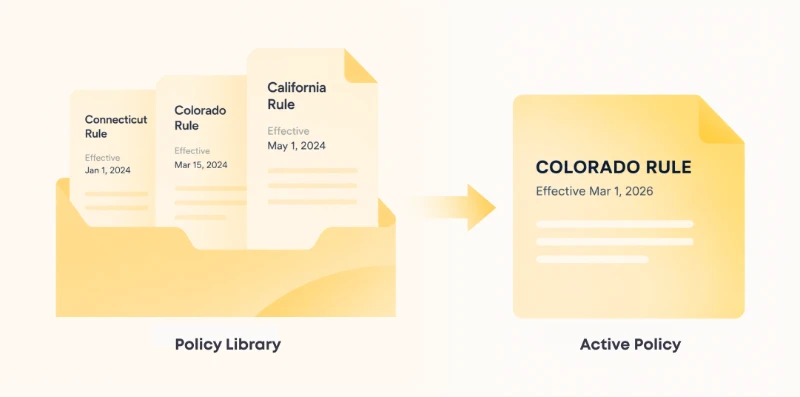
Compliance logic belongs in configuration. Hardcoding “include utilities in the total” works until Colorado exempts actual utility dollar amounts and another jurisdiction asks only for disclosure. A configurable rule engine keeps that logic as data, editable without redeploying the platform:
- Jurisdiction-scoped policies with effective dates, so a law that starts on January 1 activates on its own.
- Versioning and exception handling, so past checks stay tied to the rule that was live at the time.
When a new state law lands, an engineer updates a policy record. The engine is only as accurate as the jurisdiction metadata behind it, which is where real estate data enrichment services connect directly to the result.
Creating an Immutable Evidence Vault for Audit Readiness
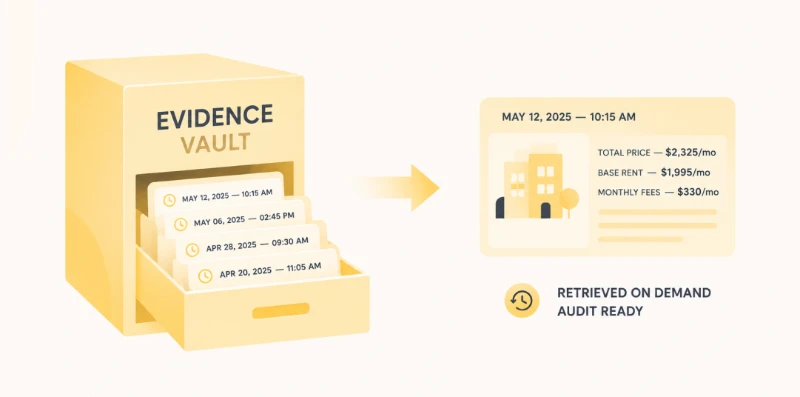
Detecting a violation matters less if you can’t prove what happened afterward. An evidence vault records, for every check, a timestamped snapshot of the listing’s state, the rule version it was checked against, the outcome, and any remediation that followed. Write-once storage keeps that history tamper-evident.
The payoff shows up under pressure. When a regulator requests the disclosed price for a specific unit across a date range, the platform produces the record automatically instead of sending someone to reconstruct it from screenshots.
Monitoring Compliance Every Day Instead of Every Quarter
Monitoring runs on two triggers:
- Every listing change re-checks the affected listings immediately, so a fee edit is validated as it happens.
- A recurring schedule re-validates the whole inventory against current rules, catching anything the event stream missed.
Change detection watches external channels too, so a partner republishing a stale price gets caught in hours rather than at the next quarterly audit. Building checks into the backend this way echoes how data-native real estate platforms run validation at the data layer rather than bolting it on later.
Detection is only useful if issues reach an owner. Severity scoring separates a missing mandatory-fee disclosure from a cosmetic mismatch, and routing sends each issue to the right queue with remediation tracking.
Handling this volume continuously is a backend throughput problem, and the Rentometer batch processor we built runs rent analyses across up to 500 properties in a single batch by connecting to Rentometer’s existing analysis engine through its API.
Where AI Adds Real Value in Fee Transparency Compliance
AI is a component of this pipeline, not the pipeline itself. Its strongest role is reading the messy, unstructured parts of a listing:
- Extracting fee mentions from free-text descriptions
- Classifying disclosure language
- Flagging listings that appear to be missing a mandatory fee
- Detecting anomalies across channels for the same unit
Each output carries a confidence score, and low-confidence cases route to human review instead of auto-resolving. Using an LLM to turn unstructured language into structured, queryable fields is a technique we’ve applied in an AI-powered property search build, where natural-language input becomes structured search parameters against a real estate API.
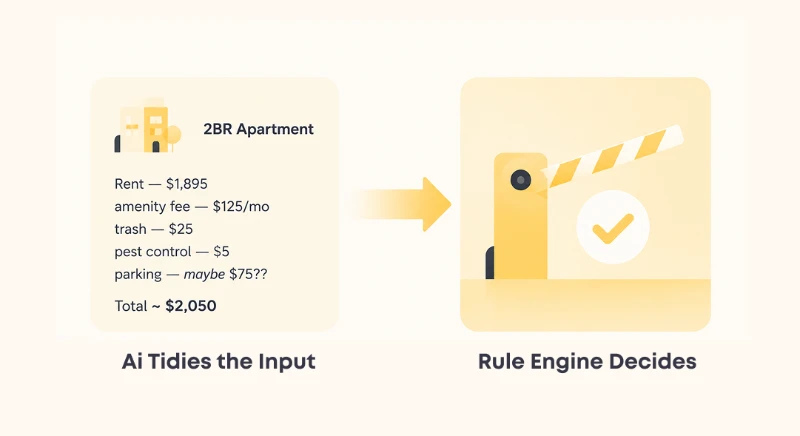
The boundary matters. A model can suggest a listing looks non-compliant, but the binding decision should come from the deterministic rule engine, because “the fee is missing” is a policy judgment with legal weight. AI accelerates the reading and triage; structured data and versioned rules make the call. That division of labor is consistent with how we approach real estate operations with AI generally.
Common Engineering Mistakes When Building Compliance Platforms
- Validating only internal systems. Checking the PMS while ignoring what syndication partners actually publish leaves the riskiest surfaces unmonitored.
- Hardcoding regulations. Baking jurisdiction rules into application code turns every legal change into a release cycle.
- Treating AI as the compliance engine. Probabilistic output driving binding decisions produces confident, unauditable errors.
- Skipping historical evidence. Without immutable records, you can detect problems but can’t prove past compliance.
- Point-to-point integrations. Wiring each channel directly to each check creates a fragile mesh that tends to break as channels are added.
- Under-modeling fee data. Storing a single price field instead of structured, categorized fees makes state-specific rules impossible to evaluate.
When an existing schema can’t represent itemized fees at all, the fix is structural, and our guide to revamping legacy applications covers the refactoring approach.
Build vs. Buy: When Does Custom Software Make More Sense?
Packaged compliance tools can cover common cases quickly. The tradeoffs surface as your requirements get specific.
| Consideration | Packaged tool | Custom platform |
| Rule ownership | Vendor-defined, limited edits | You own and version every rule |
| Integration fit | Standard connectors | Fits your PMS, feeds, and data model |
| Regulatory adaptability | Waits on vendor roadmap | Update rules the day a law changes |
| Data model control | Fixed schema | Modeled to your fee structure |
| Total cost of ownership | Lower upfront, recurring license | Higher upfront, lower long-term operational constraints |
Custom development earns its keep when compliance is core to the product, integration with your systems is deep, or you need to move faster than a vendor’s release schedule. Weighing that honestly is what our real estate software build vs buy guide is for. And because the case for a custom engine usually has to clear a budget conversation, measuring real estate integration ROI across the platform gives stakeholders a concrete number rather than a hunch.
Keeping the Platform Compliant as Regulations Keep Moving
The architecture handles new rules cleanly, but the rule set is usually what falls out of date first. A rule engine only stays accurate if someone is watching the statutes and translating them into policy records before their effective dates, and that work doesn’t belong to engineering alone.
The teams that keep this current treat regulatory intake as a standing process:
- A legal or compliance owner flags a change.
- An engineer encodes it as a versioned rule with an effective date.
- The evidence vault captures the switch-over so you can later prove which rule was live when.
The failure mode is subtler than a bug. A platform can run flawlessly against last year’s rules and be confidently, invisibly non-compliant the day a new law takes effect. Building the human-to-rule-engine handoff into the roadmap, rather than bolting it on after the first missed deadline, is the kind of sequencing our real estate product roadmap guide lays out for scaling technical infrastructure.

Build a Future-Ready Compliance Platform for Multifamily Listings
Staying ahead of fee-transparency rules means treating compliance as a system to run, not a document to update.
Everything in this article points the same direction: normalized fee data, a rule engine that changes by configuration, an evidence vault that can answer a regulator without a fire drill, and monitoring that watches every channel a price appears on.
ORIL builds this kind of infrastructure into existing real estate platforms, integrating with the systems, data sources, and workflows already in place rather than replacing them. We bring the data engineering, integration, and AI capabilities needed to make these platforms more scalable, reliable, and adaptable as business requirements evolve.


