

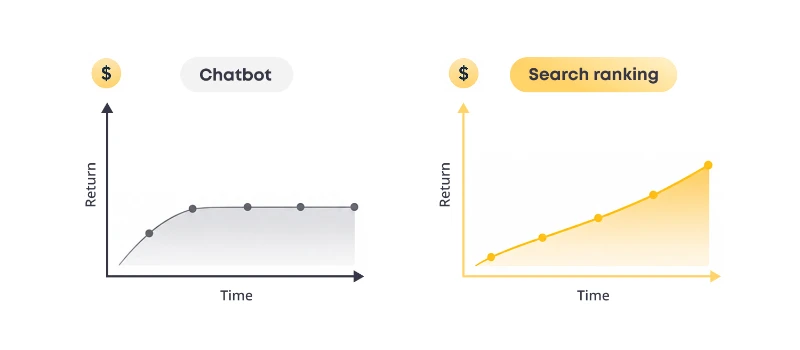
Two AI features can cost the same to build and land on opposite sides of the P&L. Add a chatbot to a listing page, and you get a support-deflection number that plateaus in a quarter. Rework search ranking so a buyer who types “quiet street, near a school, room for an office” gets the right ten homes instead of 400 filtered results, and you move search-to-contact conversion, which sits at the top of every revenue metric downstream.
Same engineering budget, different order of magnitude in return. That gap is what return on AI actually measures on a brokerage platform, and it is why the useful question is which workflows to redesign, not whether to adopt AI.
This article provides a practical framework for product and engineering teams to prioritize AI capabilities and make informed build-versus-buy decisions.
For every capability we cover, we walk the same path: business goal, data required, engineering complexity, expected KPI, and build-vs-buy. By the end you should be able to look at your own roadmap and say which AI initiatives earn funding now, which can wait, and which become a durable advantage only if you build them yourself. And because none of these capabilities ship as slideware, we keep returning to the engineering underneath each one. Our perspective comes from designing and building custom brokerage platforms, listing marketplaces, and AI-enabled real estate software where these architectural decisions directly affect product performance.
What Return on AI Looks Like on Brokerage and Listing Platforms
Before you rank opportunities, you need a shared definition of return. On a brokerage or listing product, value shows up in four distinct places, and some teams only measure the third.
| Category | What it looks like | KPIs to track |
| Revenue growth | More qualified leads, higher search-to-contact conversion, faster transaction velocity | Search-to-contact conversion, lead-to-viewing rate |
| Customer experience | Faster discovery, relevant results, personalization | Session duration, repeat visitors |
| Operational efficiency | Less manual moderation and data entry, higher broker productivity | Operational cost per listing, listings published per employee |
| Competitive advantage | Proprietary property intelligence and an experience competitors cannot license | Revenue per active user, customer lifetime value (LTV) |
The largest and most defensible returns usually sit in the first and fourth categories. The third is the easiest to measure, which is exactly why teams over-index on it and mistake automation savings for strategic value.
Two of these categories justify custom software; two often do not. Revenue growth and competitive advantage lean on models tuned to your own data and workflows, which points toward custom development. Operational efficiency and much of customer experience can start with bought or integrated components. That split sets up the build-vs-buy decision later, and it is the first place engineering choices start diverging from business ones.
Return is easier to judge once you see where intelligence sits in your architecture and which systems it reads from, a question best answered against your overall real estate software stack rather than feature by feature.
A Framework for Prioritizing AI Investments
Prioritization gets easier when every candidate initiative is scored on the same dimensions instead of argued case by case. A simple six-dimension scorecard, each scored 1 to 5, does the job:
- Business KPI impact. Does it move a metric leadership already reports, and does that metric connect to revenue, directly or on a lag?
- Customer value. Does the user feel it, or is it invisible plumbing? Invisible-but-valuable is fine; the question is whether it earns its place in the experience or the operation.
- Data readiness. Do you already own the data (listings, user behavior, CRM, MLS feeds) at the quality and freshness the model needs, or is a data project hiding inside this one?
- Engineering simplicity. Weeks, a quarter, or a platform re-architecture? Higher scores mean simpler builds.
- Build vs. buy. Commodity, integrate, or strategic build? This flags how to source the capability, not just whether to fund it.
- Long-term competitive advantage. Copyable in a quarter, or compounding?
For a quick rank, sum the six. For a sharper read, weight Business KPI impact and Long-term competitive advantage double, since those two separate a paying capability from a demo.
Here is the same scorecard applied to semantic property search versus a generic support chatbot:
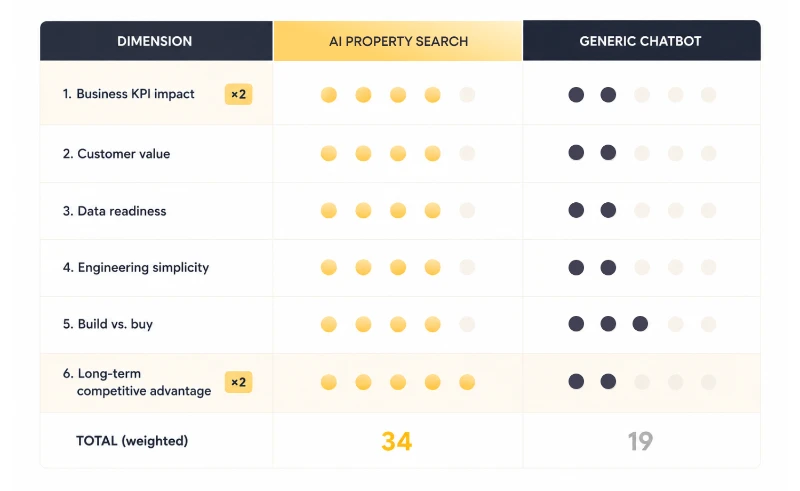
The chatbot is easier to ship and carries a lighter data burden, yet scores far lower, because it moves a marginal KPI and any competitor can buy the identical thing next week. Search costs more and leans on data you have to get right, but it feeds top-of-funnel conversion and compounds into an advantage. The scorecard makes that tradeoff explicit instead of letting “which is easier” win by default.
Treat the output as a decision aid, not a verdict. It forces the hard columns, data readiness and competitive advantage, into the conversation early; a product leader still makes the call.
Scoring these dimensions honestly is itself a discovery exercise, the same structured product strategy and design work that pinpoints high-friction bottlenecks in agent and buyer workflows before a line of model code is written.
Once priorities are clear, the challenge shifts from business planning to engineering execution: designing the data architecture, integrations, and product workflows required to deliver those capabilities reliably.
At ORIL, we use a similar kind of prioritization to shape engineering roadmaps, helping product teams decide which AI capabilities to build first and how each one fits into the overall software architecture.
Where AI Creates the Highest Revenue Impact in Brokerage Platforms
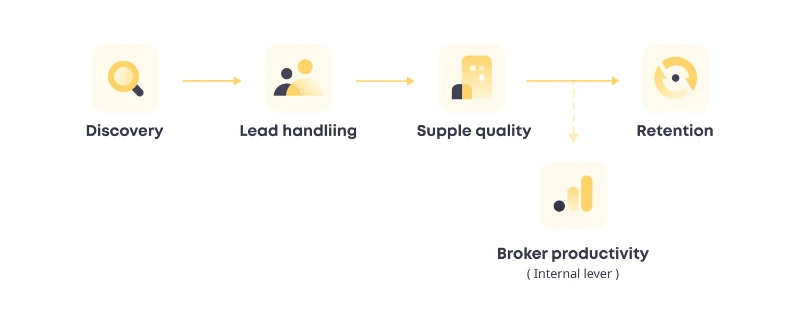
Revenue impact concentrates in four customer-journey workflows: discovery, lead handling, supply quality, and retention, plus one internal lever, broker productivity. Each of the following pairs the business case with the engineering it actually requires.
Increase Property Discovery and Search Conversion With AI
Filter-based search loses buyers who do not think in dropdowns, and irrelevant results damage the first and most important marketplace interaction.
The fix is semantic retrieval: natural-language understanding, intent parsing, and recommendation-engine ranking over embeddings and vector search, with MLS synchronization feeding a clean index.
What you build is a search infrastructure that combines an embedding pipeline, a vector store, and a ranking model with a feedback loop, all reading from a listing index that stays current with a constantly changing feed. Relevance is a platform-scalability problem as much as a modeling one; a vector store sitting over a stale index decays fast.
KPIs: search-to-contact conversion, engagement rate, session duration.
Replacing rigid dropdowns with the language a buyer actually uses is one of the clearest applications of intelligent search, a pattern we have built into an AI-powered property search product. Sub-second, relevant matches at scale depend on the indexing layer as much as on the model, the kind of performance-focused property listing platform development that keeps spatial data and pricing feeds query-ready.
Improve Lead Quality With AI-Based Qualification and Routing
Brokers lose hours on low-intent leads, inquiries sit unanswered, and the best lead goes cold.
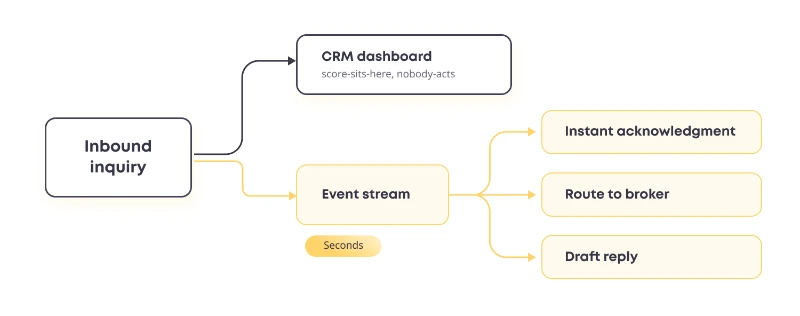
Lead scoring reads behavioral signals, CRM history, transaction outcomes, and engagement patterns, then adds intent detection, broker matching, and CRM automation wired through workflow orchestration. The engineering that matters is the wiring: the score has to fire an action (route, notify, draft) inside the event stream, not sit in a report. A score nobody acts on is a dashboard, not a return.
Speed compounds the effect. The MIT Lead Response Management study found that contacting an inbound lead within five minutes makes a business up to 100 times more likely to reach it than waiting 30 minutes. An always-on system that answers in under a minute wins on consistency alone, before it does anything clever.
KPIs: qualified-lead percentage, first-response time, broker productivity.
Connecting behavioral scoring directly to CRM action triggers, rather than a passive dashboard, is where PropTech AI enablement tailored to broker workflows earns its return.
Increase Listing Performance Through Enrichment
Thin, duplicate, or low-quality listings suppress engagement and marketplace liquidity, and manual moderation does not scale.
Listing enrichment automates generated descriptions, missing-field detection, image analysis and tagging, categorization, and duplicate detection, then appends neighborhood, school, tax, and risk data and rolls everything into a listing-quality score that surfaces weak supply for fixing.
Computer vision can tag hundreds of standardized listing attributes from photos in seconds, work that may take roughly an hour by hand.
The engineering payoff sits in the pipeline: an enrichment service that ingests raw records, calls vision and language models, and writes structured, scored output back to the listing store.
Better supply quality lifts buyer engagement and conversion, and better liquidity keeps both sides of the marketplace active.
KPIs: listing engagement, time-on-market, operational cost per listing.
Automated copy generation paired with real estate data enrichment solutions turns sparse raw records into listings that convert, provided the enrichment pipeline is custom-built around your data model rather than a generic add-on.
Increase User Retention Through AI Personalization
Buyers browse once and vanish, and generic alerts train users to ignore them.
Personalization runs on recommendation systems fed by saved-search intelligence, behavioral analysis, and preference modeling, delivered across email, push, and on-site surfaces. It works only on a product-specific data model paired with continuously updated behavioral signals; personalization is never built on a static data model alone.
That dependence on your own inventory and your own users is what puts it in competitive-advantage territory and makes it hard to buy off the shelf. Delivering it means engineering a behavioral pipeline that captures saved-search and browsing events, updates each user’s preference model continuously, and feeds recommendations back into the product in near real time.
KPIs: repeat visits, retention, LTV.
Beyond simple saved-search alerts, well-designed real estate listing platform features keep active buyers returning with recommendations tuned to how they actually search.
Improve Broker Productivity With AI Workflow Automation
Brokers spend selling hours on admin: document handling, reporting, communication, and knowledge lookup.
The build is a set of broker copilots and workflow automations, document processing and classification, automated reporting, communication drafting, and knowledge search, each integrated into the tools brokers already use rather than bolted on beside them. Augmentation tends to out-earn replacement here because judgment and relationships are the broker’s real value.
The same automation logic extends across PropTech subdomains, into property management (tenant communication, maintenance triage) and mortgage document intelligence, which is why the underlying orchestration is worth engineering well once.
KPIs: transactions per broker, admin hours saved, cycle time per deal.
Removing repetitive admin lifts transaction throughput directly, the productivity dividend we unpack in workflow speed and execution.
Where AI Does Not Create Real ROI (And Why Many Projects Fail)
Not every AI project pays back:
- Isolated features with no workflow integration. The score or summary nobody acts on.
- Generic chatbots on low-traffic surfaces. A bot fielding 50 visitors a month moves nothing.
- AI on a broken data foundation. Fragmented listings and no single source of truth produce confident, wrong output.
- No owner, no baseline, no metric. If you did not measure the before, you cannot defend the after, and it is first cut when budgets tighten.
- Many disconnected point tools, each owning a slice of your data, quietly eroding the return.
The common root cause is data. On an episode of our Innovation Blueprint podcast, Oyster Data’s Joe Stockton made the point plainly: asset managers lose 20 to 30 percent of their time just answering basic questions about their portfolios, because operational data lives scattered across property management systems, spreadsheets, and PDFs. Models deployed on that kind of fragmented foundation return commodity results at best. In engineering terms, the fix precedes the model: consolidate the data layer first, then build on it.
Build vs Buy: Which AI Capabilities Should Brokerage Platforms Develop Internally?
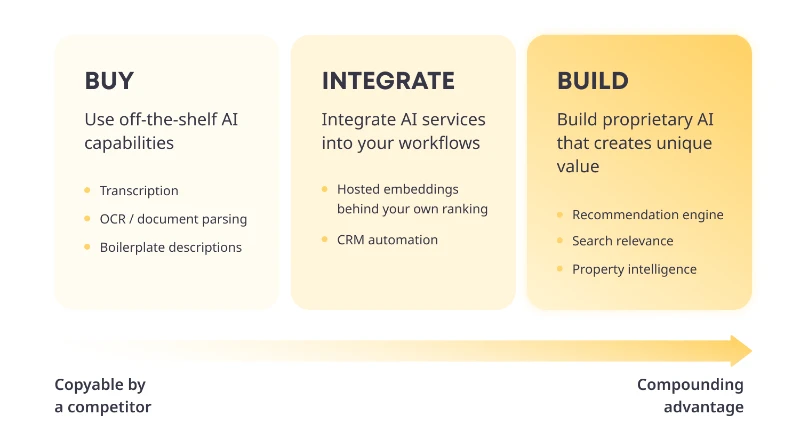
Three tiers cover most decisions on sourcing an AI capability:
- Buy commodity capabilities where owning the model gains nothing: transcription, generic OCR, boilerplate description generation.
- Integrate mature services into your workflow: a hosted embedding or LLM API behind your own ranking algorithms and CRM automation. You own the orchestration and the data; the vendor owns the model.
- Build the differentiating layer: a proprietary recommendation engine, search relevance tuned to your inventory, your own property intelligence and scoring models.
There is a fourth pattern worth naming, because it is where most strong products actually land: hosted models with proprietary logic on top. Many successful platforms combine hosted foundation models with their own ranking, retrieval, and business logic instead of training models from scratch. The moat is not the model; it is the orchestration, the data, and the workflow around it.
The principle is simple: buy the commodity, build the moat. The common mistake inverts it, building a chatbot from scratch while renting the recommendation logic that would have differentiated the product.
Weighing the long-term economics of custom development against third-party licenses is exactly the build vs. buy real estate software call, and it is rarely as simple as the cheaper sticker price. For an engineering team, this decision sets the integration surface and the maintenance obligation for years, which is why it belongs in architecture review, not just budgeting.
Integrating a hosted model cleanly behind your own retrieval and business logic is core to how we build AI into existing PropTech products without a rebuild.
The Engineering Foundation Behind High-ROI AI Features
Every capability above rests on the same foundation. Skip it, and the model starves.
- Data pipelines and MLS synchronization. Clean, normalized, de-duplicated, fresh inventory is the precondition for everything else.
- Search and retrieval architecture. Index freshness, a vector store, and a ranking feedback loop.
- Analytics and visualization. Turning model output into decisions operators actually act on.
- Scalable cloud and monitoring. Platform scalability, drift monitoring, and feedback loops so models improve rather than decay.
High-precision search and matching depend on clean real estate data integration that normalizes and aggregates multi-source listings before any model sees them. This is the layer we work in daily: our concept builds for AI-powered property search and AI-powered sentiment analysis both hinge on a backend that extracts structured signal from messy input and returns it to the product fast enough to matter. The model is the visible part. The pipeline and integration work underneath determine whether it holds up in production.
How to Prioritize Your AI Roadmap: Quick Wins vs Strategic Investments
Sequencing beats scale. Roll capabilities out in three phases:
- Quick return. Listing enrichment and automation, duplicate detection, internal copilots. Low data burden, fast payback, often buy or integrate.
- Growth AI. Search relevance, recommendation systems, and lead scoring wired into CRM automation. Higher engineering lift, higher revenue impact.
- Strategic AI. Proprietary property intelligence, predictive pricing assistance, and differentiated intelligence layers.
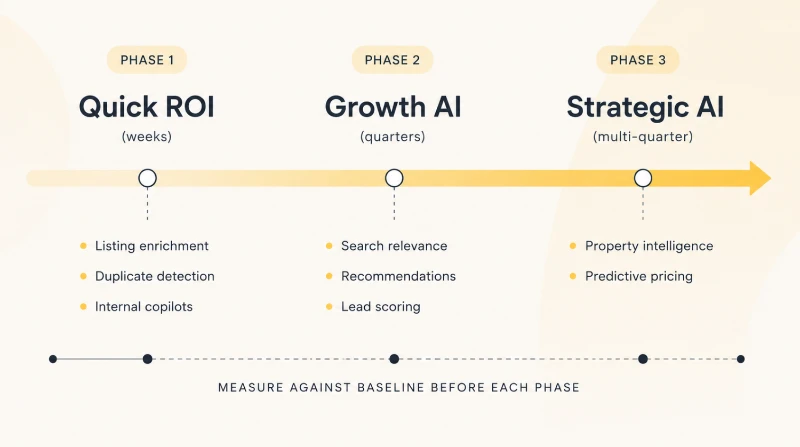
The discipline that makes this work is simple: one workflow at a time, each measured against a baseline, each integrated before the next. To de-risk the spend, structure the rollout as a validated real estate product roadmap that tests core AI hypotheses early rather than committing full budget up front. Each phase also raises the architectural bar, which is why the data and integration layer should be built to carry Phase 3 before you ship Phase 1.
Real-World AI Implementation Scenarios in Brokerage Platforms
Each is a common build shape, with the engineering decision that determined whether it paid off.
A marketplace lifts search conversion with semantic retrieval
A buyer searches once, gets 400 results ranked by newest, and leaves. Rebuilding that path means:
- Parsing the natural-language query into intent
- Running vector search over listing embeddings, backed by hybrid retrieval that pairs semantic similarity with structured filters (price, location, property type)
- Re-ranking on signals the buyer never types: proximity to prior views, price elasticity, days on market
The part that makes or breaks it is index freshness. On a feed syncing thousands of MLS updates a day, nightly embeddings are stale by morning, so the pipeline has to re-embed on change, not on a schedule. Get that right and abandoned searches fall while inquiries rise.
A brokerage cuts response time with lead prioritization
Most brokerages collect enough signal to score a lead. Few act in the seconds that matter. A working build reacts to a high-intent inquiry before a human opens the CRM: instant acknowledgment, routing to the right broker by specialty and territory, and a drafted first reply, all fired through workflow orchestration.
Whether it pays off comes down to where the score lives. In the CRM it is a dashboard number; in the event stream it becomes an action, and only the second moves first-response time.
A listing platform lifts engagement through enrichment
Thin and duplicate listings drag engagement on both sides of the marketplace. The enrichment pipeline does four things to fix that:
- Generates missing descriptions
- Tags attributes from photos with computer vision
- Flags duplicates before they publish
- Appends neighborhood, school, and risk data, then rolls everything into a quality score that routes weak supply back for fixing
None of it works on a generic template. The scoring rubric has to encode what “good” means for your inventory.
A property platform raises retention through personalization
Generic alerts train users to ignore them. This one is short on components and long on constraint: model preferences from saved search and browsing behavior, then drive lifecycle messaging off that model. It works only on your own data model and behavioral signals, which makes it a build rather than a buy, and the advantage compounds over time.
These patterns extend well beyond brokerage. Dynamic deal matching creates real advantage in transaction portals, a core component of our real estate bidding platform project, and real-time automated reporting sharply cuts inquiry response times, as in our AI analytics assistant for property managers and owners.
How ORIL Helps Build AI-Powered Brokerage and Listing Platforms
The highest-ROI AI initiatives succeed because they’re backed by the right software architecture, data foundation, and engineering execution. That’s where ORIL comes in.
We design and build custom AI-enabled real estate software: brokerage platforms, listing marketplaces, property data systems, intelligent search.
The process below is engineering-led at every step.
- Opportunity assessment. Prioritize AI initiatives and separate quick wins to buy from moat capabilities to build.
- Product strategy. Validate every initiative against business outcomes and product workflows before committing engineering effort.
- Architecture design. Decide the shapes that determine return: event-driven vs. batch sync, where the score lives (stream vs. CRM), re-embed-on-change indexing, and platform scalability from day one.
- Data and integration layer. MLS synchronization, normalization, de-duplication, and the pipelines that keep inventory fresh enough for models to trust.
- Custom AI development. The differentiating build: recommendation engines, search relevance tuned to your inventory, and proprietary property intelligence and scoring models.
- Continuous optimization. Ranking feedback loops, drift monitoring, and retraining so models improve rather than decay.
Our team brings deep domain grounding in custom real estate software development, which is what lets us architect AI features on foundations that can actually support them.
Key Takeaways: Return Comes From Better Products, Not More Features
- AI pays when it targets a measurable workflow, not when it exists as a feature.
- The highest and most defensible returns cluster in discovery, lead quality, listing quality, retention, and broker productivity.
- Buy the commodity, integrate the mature service, build the moat, and put your own logic on top of hosted models.
- No baseline, no proof. Measure before and after.
- The data foundation and integration layer decide whether any of it works.
Capturing that value takes a coherent real estate digital transformation approach across the product rather than a scatter of standalone features.
The Best AI Investment Is the One That Improves Your Product Metrics
Every capability in this article rewards the same order of operations: pick the workflow where the return is measurable, design the AI into it, build the data foundation underneath, then prove the change against a baseline before scaling. Reverse that order and you get the feature that demos well and moves nothing.
That sequence is also what separates a capability you can buy from one worth building. The commodity layer is a purchase decision; the ranking model, the recommendation engine, and the property intelligence tuned to your own inventory are where custom engineering compounds into an advantage a competitor cannot license. Knowing which is which, for your platform and your data, is the whole game.
Knowing which capabilities to build is the first half; building them on foundations that hold up is the second. A dedicated engineering team can score your roadmap, design the architecture, and ship the highest-return capabilities into your platform.


