

A prospective renter checks an apartment on Zillow, then on Apartments.com, and sees two different prices. They are not comparing two units. They are looking at one property described by two systems that disagree. Most property platforms treat that gap as a data-quality nuisance to clean up after the fact. It has quietly become something else: a signal that shapes whether customers, syndication partners, and now AI search tools trust the platform at all.
Listing consistency means that authoritative property data, such as price, availability, amenities, media, and fees, is governed from a trusted source and remains consistent across distribution channels, even when each channel applies its own presentation rules. This article covers why the problem is structural, why synchronization alone rarely resolves it, and how engineering teams keep listings aligned as a continuous platform function.
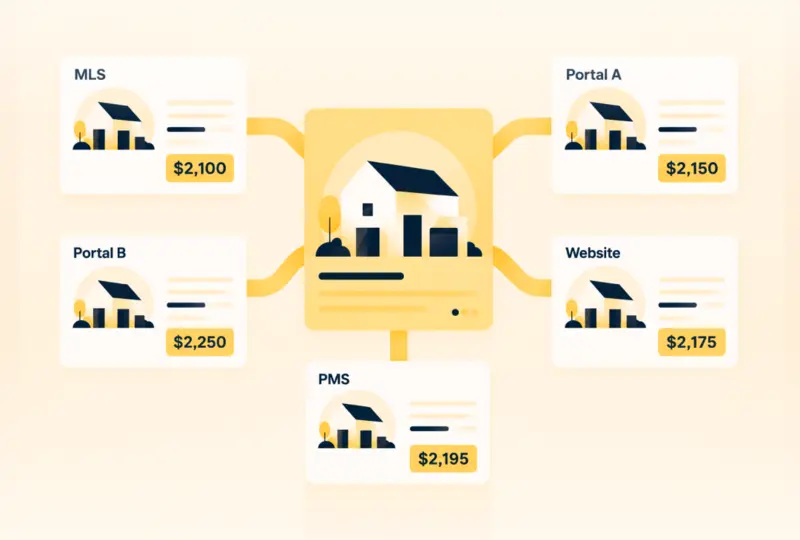
Why Listing Consistency Is a Revenue Problem
Inconsistent listings cost money before they cost anyone a data-quality ticket.
When a unit shows three different prices across three portals, the renter does not assume three systems fell out of sync. They assume the platform is careless, and they extend that doubt to everything else on the page.
| Channel | Price shown | What the renter сan conclude |
| Zillow | $2,150 | “Which one is real?” |
| Apartments.com | $2,250 | “Is the availability date wrong too?” |
| Apartment List | $2,195 | “I don’t trust this listing.” |
A renter who catches one discrepancy stops trusting the rest: the availability date, the pet policy, the parking fee, the floor plan.
That distrust surfaces in metrics engineering and product leaders already watch. Diverging prices and stale availability drive abandoned inquiries, lower lead quality, and wasted leasing-team time chasing prospects toward apartments leased days ago.
Behind the customer-facing damage sits operational load: engineers maintaining brittle integrations, support staff fielding “which price is right” tickets, and analysts reconciling reports built on contradictory records. When multi-channel syndication feeds drift out of sync, the resulting data debt in PropTech inflates support costs and slows every decision that depends on the listing being right.
For a small catalog, teams absorb this manually. As inventory and channels grow, manual reconciliation stops scaling, and consistency graduates from an operations chore into an executive-level concern.
Why Listing Consistency Is Becoming a Competitive Advantage
Once inconsistency is a platform-level problem, consistency becomes a platform-level advantage. A platform whose listings agree across every portal earns:
- Higher inquiry quality and better inquiry-to-tour conversion
- Cleaner analytics, because reports read from records that agree
- More confident syndication partners
- Fewer compliance exposures around displayed pricing and fees
None of these come from a marketing campaign. They come from the data being reliable at the source.
The advantage is durable because it is hard to copy. A competitor can match your inventory or your interface in a quarter. Rebuilding fragmented listing infrastructure into a coherent architecture is a multi-quarter engineering commitment, which is why consistency holds once it is embedded.
Turning listing accuracy into a differentiator rather than a recurring cleanup effort takes real estate software development services that enforce one canonical schema across every channel instead of patching each feed in isolation.
Why Most Property Platforms Struggle to Keep Listings Consistent
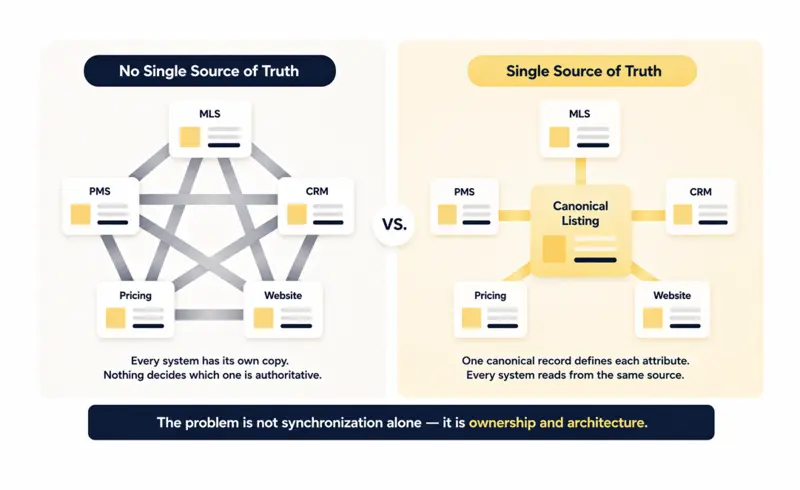
Inconsistent listings rarely trace back to a leasing agent typing the wrong number. They trace back to how the software is wired. A typical platform reads from many systems, and each holds its own copy of the listing:
- MLS feed
- Property management system (PMS)
- CRM
- One or more syndication partners
- Pricing engine
- Marketing site
Without an explicit ownership model, it becomes unclear which copy is authoritative for each field.
The Hidden Architecture Problem: There Is No Single Source of Truth
A single source of truth is a canonical data model that defines how authoritative values are represented and reconciled, while source ownership can remain contextual to each domain or attribute.
Some platforms just grew by adding integrations, and each integration brought its own schema, its own update cadence, and its own idea of what “available” means.
Three failure modes follow:
- Duplicated entities: the same unit represented three ways
- Asynchronous updates: changes landing at different times, or not at all
- Contested ownership: two systems both believing they are authoritative for the same field
These modes show up in small, visible ways: the same unit’s photos appear in a different order on each portal, because media has no single owner deciding the canonical sequence.
MLS feeds make this sharper, because schemas and field definitions vary by region. Resolving those field-level discrepancies starts with an architectural read of how the feed is structured, which our MLS data structure guide walks through.
Synchronization cannot fix a problem that lives in ownership.
Why Synchronization Alone Rarely Solves Listing Consistency
The instinct when listings drift is to add another sync job. That can make things worse.
In a fully connected point-to-point architecture, the number of potential connections grows roughly quadratically as systems are added, increasing the surface area for conflicts and failures. Moving inconsistent data faster does not make it consistent. It distributes the disagreement more efficiently.
| Point-to-point sync | Centralized platform architecture | |
| Connections | Grow ~quadratically | Grow through a shared integration layer |
| Field ownership | Undefined | Canonical model governs field representation and ownership rules |
| Conflict handling | Ad hoc per integration | Governed in one place |
| Validation | Rarely present | Gated before publication |
Synchronization also transports data without governing it. A webhook can push a price change to five portals in seconds, but nothing in that pipeline decides whether the change was valid or which system had the right to make it. Even with reliable pipes, teams still need to prioritize securing third-party API integrations behind managed validation rather than trusting raw connections to arbitrate correctness.
How Modern Property Platforms Engineer Listing Consistency
Mature platforms treat consistency as an architecture rather than a set of jobs. A listing moves through a defined lifecycle, where each stage hands off to the next:
- Business systems feed raw listing data in (MLS, PMS, CRM, pricing engine)
- Canonical data model resolves that input into one authoritative record
- Validation layer checks the record against business rules
- Synchronization engine propagates approved changes outward
- Distribution services publish to each channel
- Monitoring tracks consistency in production
- Analytics and AI read from the trusted record
Everything downstream inherits its reliability from the canonical model near the front of that sequence. The four engineering layers below do most of the active consistency work.
A Canonical Listing Data Model
Every scalable listing platform starts with unified business entities, each defined once: property, listing, unit, pricing, availability, amenity, media, fee, and promotion.
Treating media, fees, and promotions as first-class entities rather than free-text fields is what lets a move-in special or a parking fee stay identical everywhere it appears, instead of drifting per channel.
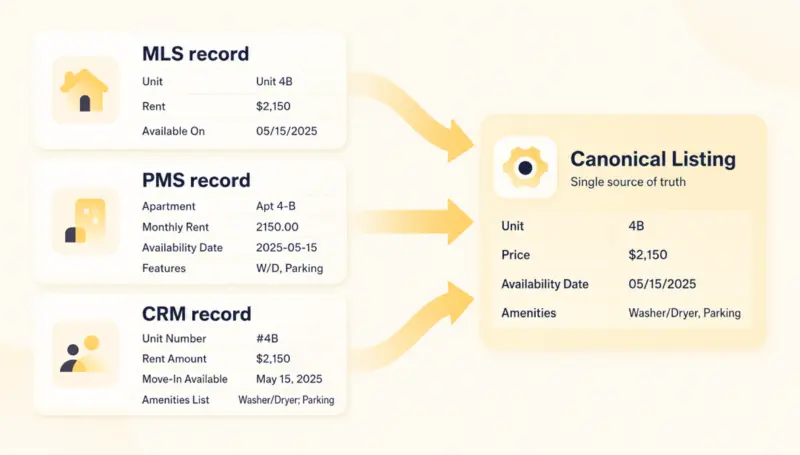
External systems map into that model rather than defining it, so an MLS field, a PMS record, and a CRM object all resolve to the same canonical listing. Doing that reliably takes entity resolution: deciding that a unit arriving from the MLS, a record in the PMS, and an object in the CRM are the same physical listing, then collapsing them into one authoritative entity rather than three near-duplicates.
A canonical model does not make every source equally authoritative. It defines how each source’s data is represented and reconciled inside the product, while authority over a given field stays contextual to the business domain that owns it: the MLS for listing status, the PMS for availability, and so on.
Building that unified schema is where dedicated real estate data integration services earn their keep, translating disparate feed structures into one central model.
Synchronization Services Instead of Point-to-Point Integrations
At the platform level, synchronization becomes a service with clear responsibilities:
- Change detection and versioning
- Conflict resolution
- Retry and backoff
- Incremental updates rather than full re-syncs
Where real-time propagation is required, an event-driven design lets a single change to the canonical model propagate outward on a defined contract, so portals subscribe to updates instead of being wired directly to source systems. Replacing brittle point-to-point scripts is the practical core of the broader real estate API integration transformation, where event-driven pipelines keep inventory aligned as it scales.
Validation Engines That Catch Problems Before Publication
A validation engine checks a listing against business rules before it reaches any channel: required fields present, pricing within expected bounds, media meeting spec, no duplicate unit, fees disclosed. Publication becomes a gated step rather than an open pipe.
Preventing duplicate records and mismatched pricing across nationwide feeds is what MLS data normalization at scale is built to do.
Validation pairs with enrichment at ingestion. Cleaning and standardizing incoming pricing, amenities, and availability before a record is written is where real estate data enrichment services reduce the number of conflicts the synchronization layer ever has to resolve.
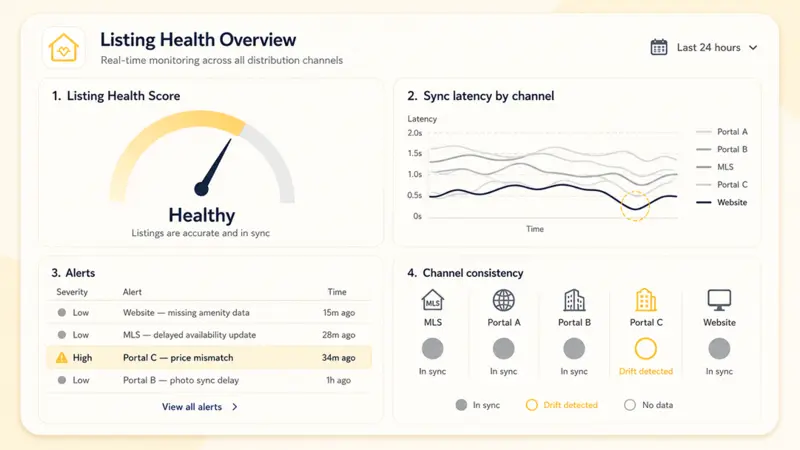
Monitoring Listing Health Across Every Distribution Channel
Consistency is a running-state property, so it needs observability:
- Dashboards tracking sync success and latency
- Anomaly detection on prices and availability
- A listing-health score per property
- Alerts on failed updates
- Channel-to-channel comparison that flags a portal falling behind
Monitoring closes the loop the other layers open. The canonical model, validation, and synchronization keep listings aligned at write time; observability confirms they stay aligned in production and surfaces drift before a customer or a syndication partner finds it first.
How Consistent Listing Data Powers Analytics, Automation, and AI
Consistent listing data is the precondition for everything a platform builds on top of it. Recommendation engines, pricing intelligence, automated merchandising, forecasting, and conversational search all read from the listing layer, and they inherit whatever inconsistencies live there. AI amplifies clean data and dirty data with equal reliability.
This matters more now that AI systems, not only human visitors, read your listings.
Real estate is not yet the hardest-hit sector: as of late 2025, roughly 5.8% of real estate queries triggered a Google AI Overview, compared with far higher rates in tech and health (Ahrefs, Nov 2025). But the direction is set. Across search generally, about 60% of Google searches already end without a click, and when an AI Overview is present, that rises to 83% (Bain, Feb 2025; Semrush, Sept 2025).
The mechanism behind those numbers is what should concern platform teams. AI systems may produce less reliable or conflicting answers when the same property is represented differently across sources. Whether your platform gets cited in an AI answer increasingly depends on whether your listing data agrees with itself.
The failure is visible to the user, too: an AI search assistant confidently recommends an apartment that leased days ago, because it read availability from a channel the platform never brought back into sync. The prospect blames the platform, not the stale feed behind it.
Running LLMs or automated valuation models over un-normalized feeds tends to fail unless the team has done the work of preparing property data foundations for AI initiatives first.
Where AI Helps Enforce Consistency
Clean data is what AI needs, but AI also earns its place on the enforcement side, inside the validation and monitoring layers rather than on top of a fragmented one. A few applications do real work once a canonical model exists to run them against:
- Duplicate and entity detection: matching listings that describe the same unit under slightly different addresses or unit labels, which rule-based checks miss.
- Anomaly detection: flagging a price or availability change that falls outside a property’s normal range before it publishes.
- Missing-attribute identification: catching a listing that dropped its floor plan, pet policy, or fee schedule in transit from a source system.
- Semantic consistency checks: noticing that “in-unit laundry” on one channel and “shared laundry” on another describe the same unit in conflicting terms.
None of this replaces the engineering underneath it. These models read from the canonical record and write back into validation, so they sharpen a working pipeline rather than compensate for a broken one.
How ORIL Builds Listing Infrastructure That Scales With Business Growth
ORIL approaches listing infrastructure as a sequence of engineering decisions rather than a feature list:
| Phase | What it decides |
| Platform discovery | Which systems own listing data today and where they conflict |
| Business-entity modeling | The canonical schema |
| Architecture & integration strategy | What maps into the model, and how |
| Synchronization services | How changes propagate |
| Validation engines | What gets blocked before publication |
| Monitoring & observability | How drift is detected in production |
| AI-ready data foundation | How the model supports downstream AI |
Two decisions tend to shape the whole engagement:
- Build vs. buy for the ingestion and synchronization layer. Licensing middleware and engineering a custom pipeline carry different long-term flexibility, a call our real estate software build vs buy guide frames.
- Justifying the work to executives, which usually comes down to measuring real estate integration ROI so a data-architecture investment reads as revenue protection rather than cost.
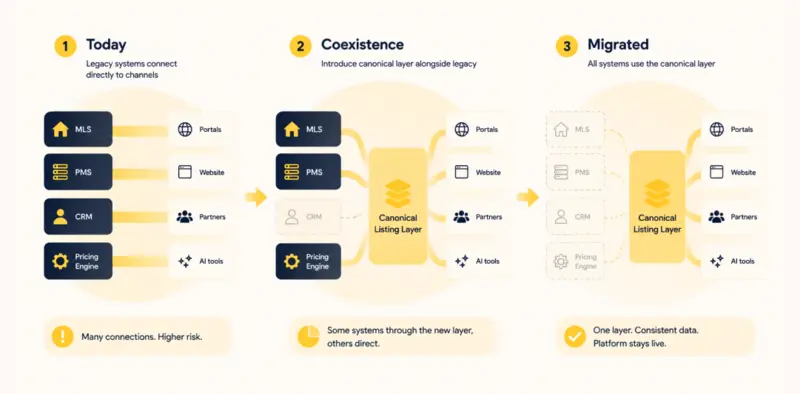
Modernizing Existing Property Platforms Without Starting Over
Consistency does not require throwing away a working platform.
The canonical model can be introduced as a layer beside existing systems, with source systems migrated onto it incrementally while the current product keeps serving traffic. Event-driven synchronization and API orchestration let legacy and modern components coexist during the transition.
When legacy schemas cannot support real-time sync across channels, our guide to revamping legacy applications covers refactoring strategies that avoid a big-bang rewrite.
Phased migration carries its own risk worth engineering around. Canonical model changes rolled out unevenly across services can produce silent schema drift between staging and production, which is why aligning development environments matters as much during a consistency migration as the data model itself.
The Platforms That Win Will Be the Ones Customers Trust Most
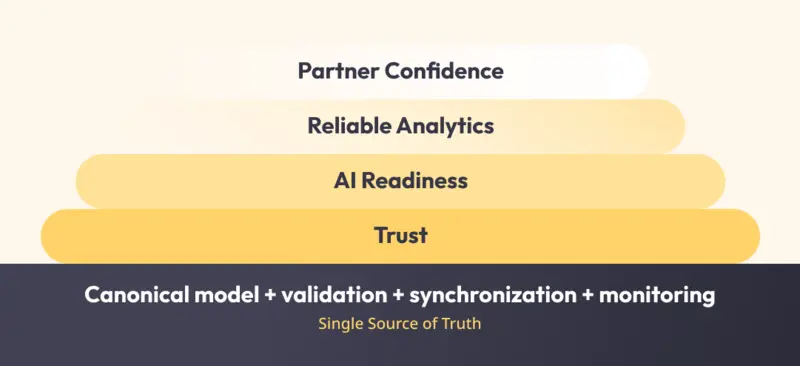
The reason listing consistency turns into an advantage is the same reason most platforms never achieve it: it has a running cost. A canonical model, validation gates, and monitoring are not a project that ships and closes. They are infrastructure a team funds every quarter, the way it funds uptime.
That is what makes consistency hard to copy. A competitor can clone an interface in a sprint, but matching a platform whose listings hold together across every channel means committing to the architecture and the operational discipline behind it. The advantage compounds because the work never fully ends, and that is the point.
Build a Property Platform Where Every Listing Tells the Same Story
Every problem here traces back to the same root: drifting prices, stale availability, listings AI won’t cite, all come from an architecture that never decided which system tells the truth. No amount of operational effort fixes that, because it is an engineering problem. It gets solved at the data layer, or it doesn’t get solved.
That is where the advantage is actually built. A canonical model, validation gates, event-driven synchronization, and monitoring are engineering decisions, and the platforms whose listings hold together are the ones that treated them as such rather than as integrations to bolt on later.
If you are planning a modernization, a marketplace expansion, or an AI initiative, the listing layer is where those plans hold or stall. ORIL works with property platforms on this: mapping where listing data diverges today and engineering the canonical model and synchronization strategy that keep it aligned as the platform grows. Fitting that work into a longer product arc is something our real estate product roadmap guide lays out.


