

Quick answer:
Real estate data often differs across systems because MLS, PMS, CRM, and ERP platforms use different identifiers, schemas, formats, and update rules to represent the same property. Fixing it isn’t a one-time cleanup. It requires a reconciliation capability: identify candidate matches, normalize values, validate them, enrich missing fields, consolidate confirmed duplicates, resolve source priority when systems disagree, and monitor for new inconsistencies as records change.
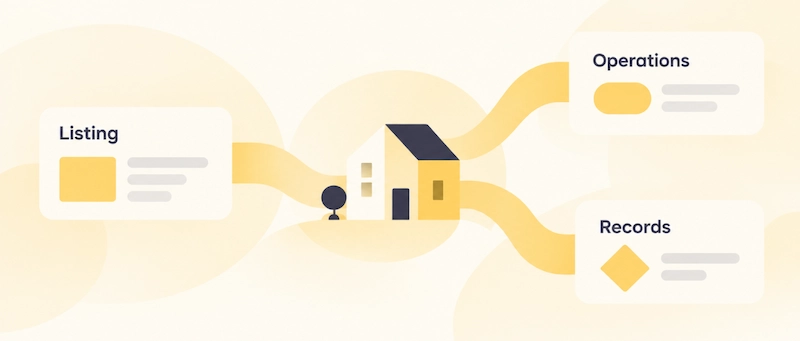
Consider a single property. It may appear in the MLS under one listing ID, in the property management system under a property or unit ID, and in the CRM as a property associated with a lead, contact, or opportunity.
Addresses get spelled and abbreviated differently across systems, and property types get sorted into different taxonomies. None of these records has to be incorrect on its own: the systems may simply represent the same property differently, because they were built for different operational purposes and don’t share the same data model.
For a Head of Data, a BI lead, or a CTO trying to build a single portfolio report, an AVM feed, or an underwriting model on top of records like these, the result is usually familiar: joins that don’t resolve cleanly, totals that need reconciling before anyone trusts them, and a recurring manual step where someone decides which version of a property to use.
This kind of mismatch is usually a sign of broader real estate data fragmentation across the PropTech systems a portfolio runs on, rather than a flaw in any single platform, and it tends to surface hardest during a merger, a market expansion, a new data hire, or a new data source.
In this article, “property record” refers to a source system’s representation of a real-world property, listing, unit, or asset, an MLS listing, a PMS property record, a CRM contact-linked property. The same property can have several such records, which get linked to a single, persistent internal property entity once they’re matched.
Why Real Estate Systems Create Conflicting Records
Real estate data is unusually hard to reconcile because properties, listings, ownership records, tenants, and financial assets are represented across operational, financial, listing, and third-party systems that weren’t necessarily designed to share a common data model. Each one solves a different job:
| Root cause | What it looks like in practice |
| Different schemas and purposes | An MLS models a listing. A PMS models a unit under management. An ERP models a financial asset. The same physical property is a different kind of record in each. |
| System-specific identifiers | Property IDs, parcel numbers, and internal keys may not carry over between systems, so records often require explicit mapping or matching before they can be linked reliably. |
| Naming and formatting conventions | Address abbreviations, unit suffixes, and property-type labels vary by system and, in the case of MLS data, often by region. |
| Different source definitions | “Occupied,” “active,” or “available” can mean different operational states depending on which system defines them. |
| Update cycles that don’t align | One system may receive changes in near real time, while another updates on a schedule or only after a financial close, leaving the same record at different points in time across systems. |
| Missing or partial data | A record created quickly in one system may be missing fields that a downstream system expects to be populated. |
| Historical and third-party records | Public tax data, prior listings, and vendor feeds add versions of a property that were never reconciled with the operational systems in the first place. |
This isn’t specific to any one vendor. Even standardized formats leave room for divergence: RESO, the organization that maintains data standards used across most U.S. MLSs, documents that field names, structures, and value formats can still differ between implementations, which adds mapping work whenever data from more than one MLS gets combined.
That kind of divergence is exactly why aggregating listings across more than one MLS often produces property record discrepancies before any normalization work happens.
It’s also worth being clear about what “authoritative” means here. It’s tempting to designate one system as the master record for a property, but that usually breaks down in practice.
For example, a PMS may be the designated source for occupancy and lease terms, while accounting is the source for financial values and an MLS provides the current listing status. Reliable data usually comes from defining, attribute by attribute, which source to trust and why, rather than from picking one master system.”
How to Reconcile Real Estate Data Across Systems
The goal is to make the differences manageable enough that downstream systems can work from the same property identity, comparable values, and clearly defined source rules. That usually means moving through several connected steps, from figuring out which records belong together to deciding what happens when trusted sources still disagree.
| Stage | What it addresses |
| Identify | Surface records that are plausible candidates for the same real-world property. |
| Match | Confirm which candidates represent the same entity. |
| Normalize | Bring values into a comparable format (addresses, names, types, statuses, dates). |
| Validate | Check completeness, consistency, and business rules before values are trusted. |
| Enrich | Fill gaps using trusted internal or external sources. |
| Deduplicate | Deduplicate: link confirmed duplicates to a canonical entity while retaining source records and provenance. |
| Resolve source priority | Decide, attribute by attribute, which system’s value to trust when sources disagree, and route unresolved conflicts for review. |
| Monitor | Watch for new duplicates, stale records, and mapping failures as systems change. |
Identify and Match Records That Represent the Same Property
The first problem is more basic than data quality: figuring out whether the records belong to the same property at all. A listing ID, a PMS property ID, and a CRM record may all point to one building without sharing any identifier that makes that relationship obvious.
Formatting comes after that. Normalizing a value makes two records easier to compare; it doesn’t by itself establish whether they’re the same entity.
Real estate matching typically combines two approaches:
- Deterministic matching can use reliable shared identifiers where they exist, but the identifier’s scope matters. A parcel/APN may identify a land parcel rather than an individual unit, while an MLS ID usually identifies a listing record within a specific MLS.
- Confidence-based matching scores candidates on address similarity, geographic proximity, owner name, and other attributes when no shared ID exists, common when linking public records to a PMS. These scores identify likely candidates for review, not confirmed identity.
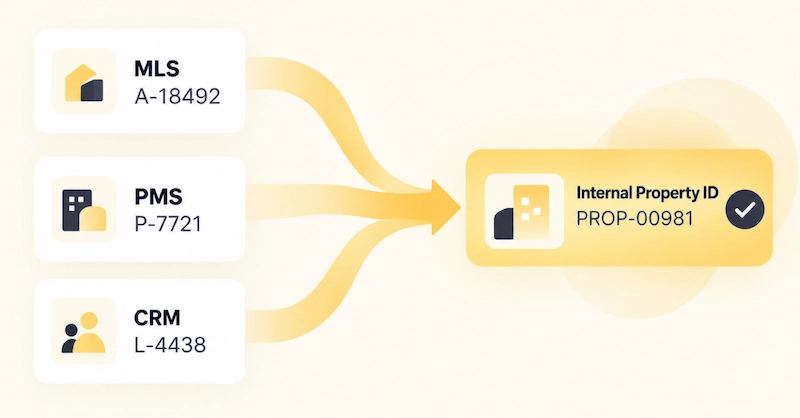
The original source IDs stay available for traceability, while downstream applications use the internal ID to refer to the same property consistently.
Once two records are confirmed as the same property, the next problem is making their values speak the same language. Matching tells you what belongs together. Normalization determines whether those records can actually be compared without formatting differences creating another layer of noise.
Normalize and Validate Property Data
Normalization makes records comparable. It doesn’t make them correct or determine whether two records represent the same property. That distinction belongs to the matching stage. A single property can show up differently across systems:
- Address: “123 Main St.” in one source, “123 Main Street, Unit 2” in another
- Property type: “single-family residence” in one system, “1-unit dwelling” in another
- Status values, date formats, and unit suffixes that follow different conventions per system
Validation is a separate pass on top of that: checking completeness (are required fields populated), consistency (do values agree with related fields), validity (does a value fall within an expected range), and referential integrity (does a foreign key point to a real record).
With values normalized and validated, records from different systems can be compared without formatting differences being mistaken for substantive ones.
In practice, some normalization happens before matching to make candidate comparison possible; deeper normalization and validation continue after identity is established.
Once values are comparable and validated, what typically remains is missing data, filled in during the next stage.
Enrich and Deduplicate the Unified Record
At this point, the records are comparable, but the unified picture may still be incomplete. One source may have occupancy data, another may have ownership information, and a third may contain a more recent property attribute. Enrichment fills those gaps, while deduplication makes sure confirmed copies of the same entity don’t continue to behave like separate properties.
The line worth holding is between confirmed duplicates and records that merely look similar. A record shouldn’t be removed or merged solely because it shares an address with another one; a single address can cover multiple units, ownership records, or listings. In practice, consolidation of this kind usually means:
- Confirmed duplicates get merged into a canonical record.
- Original source records, mappings, and provenance stay available for traceability.
Real estate data enrichment and consolidation done this way strengthens the unified record instead of just shrinking the dataset.
A clean, deduplicated record still leaves one thing unresolved: what happens when the surviving sources disagree.
Resolve Conflicting Values With Source Priority
This is where reconciliation stops being a cleanup exercise and becomes a question of business meaning. Two systems can both contain valid information about the same property and still disagree because they measure different things, operate on different timelines, or serve different purposes.
Source priority should be applied only after the business meaning, effective date, and provenance of the attributes are understood. Attribute-level source priority is built to handle exactly this kind of disagreement, once that groundwork is done.
Rather than treating one system as universally authoritative, priority is assigned per attribute, often informed by timestamps, business rules, and data provenance. One common, though not universal, pattern:
| Attribute | Often the designated source |
| Operational status | PMS |
| Financial values | Accounting |
| Listing status, while active | MLS |
None of this holds on its own once the underlying systems keep changing. And this is where reconciliation becomes more than a data-engineering concern. The need for these rules usually becomes visible when something changes around the data: a company acquires another portfolio, enters a new market, replaces a provider, or inherits a data environment that has grown faster than its underlying architecture.
When Real Estate Data Reconciliation Becomes a Business Problem
Reconciliation becomes especially important when the underlying data landscape changes. Four situations tend to expose gaps quickly: an acquisition, a move into a new market, a new data or analytics leader taking stock of existing reporting, or a new third-party data source. Each one surfaces a different kind of gap.
M&A: When Two Portfolios Become One Dataset
An acquisition can bring a second PMS, CRM, accounting system, property ID scheme, and historical dataset into an existing environment. The same property may now exist under two internal IDs, with ownership, occupancy, financial, and listing attributes coming from different sources.
Before consolidated reporting or underwriting can work reliably, someone has to determine which records represent the same property, preserve the historical mappings, and decide which source takes priority for each attribute. A simplified example:
- Before: Portfolio A tracks the property as PROP-1842; the acquired portfolio tracks it as PROPERTY-7719.
- After: Both resolve to a single internal ID, PROP-00981, with both source IDs retained for traceability.
New Market: When a New Geography Means a New Data Model
A company expanding from one market into another may add a new MLS, public-record source, property taxonomy, or vendor feed. Even when both markets describe similar properties, several things can differ between them:
- Field names and enumerations
- Identifiers and ID schemes
- Update schedules
- Which attributes are even available
The integration challenge involves more than connecting another API: the new source has to fit the existing canonical data model without breaking the rules and definitions downstream applications already rely on. A new market typically brings new integration, normalization, and mapping work alongside the new data source itself.
New Head of Data or Analytics: When Existing Data Debt Becomes Visible
A new Head of Data or Analytics often inherits reporting pipelines, source mappings, and reconciliation rules that evolved incrementally, some living in SQL scripts, spreadsheets, BI transformations, or informal processes rather than a documented, shared data model.
One of the first challenges is usually figuring out how property records are matched, which source is treated as authoritative for each attribute, and where inconsistencies get introduced before data reaches reporting or analytics. That turns reconciliation from a cleanup exercise into a data-governance and architecture question.
New Data Source or Provider
Adding a third-party provider, ownership, mortgage, rental, property intelligence, or market data, can introduce identifiers and definitions that don’t align with the existing property model. The integration work looks similar to a market expansion, but here the trigger is a vendor relationship rather than a new geography.
Whatever the trigger, keeping data quality intact afterward requires monitoring for new duplicates, changed identifiers, stale records, failed mappings, and unexpected values, typically through automated validation checks, quality metrics, and exception workflows that flag problems for review. Automated data quality monitoring helps detect when reconciliation rules, mappings, or source data begin to degrade after launch.
The Architecture Behind Continuous Reconciliation

The workflow above maps onto production infrastructure, with monitoring running alongside every stage to catch failures and stale data. Rule-based steps tend to run unattended once tuned; ambiguous matches and source-priority edge cases still benefit from a person reviewing them. None of it works off the shelf: matching logic needs tuning to real estate identifiers, and the whole sequence has to be engineered around a specific organization’s systems rather than treated as generic. Custom data integration pipelines are what let it run continuously instead of as a recurring manual project.
What Reliable Real Estate Data Enables
Reconciliation is infrastructure work, but its value shows up downstream. Once property records are matched, normalized, and governed by clear source-priority rules, a few things tend to follow:
- Portfolio reporting gets more consistent, because totals stem from a reconciled dataset rather than several competing exports.
- Integration workflows have fewer data-quality failure points, because downstream systems are consuming validated, consistently mapped records instead of raw feeds.
- Analysts spend less time manually reconciling spreadsheets before a report can go out.
- Dashboards, AVMs, and underwriting models can operate on data that has passed defined validation checks, instead of assuming incoming records are already consistent.
A portfolio report that previously required analysts to reconcile three separate property lists can instead consume the reconciled property ID and source-priority rules directly. The reporting layer still needs its own metric definitions and validation, but it no longer has to re-solve property identity every time the report runs.
AI readiness is a secondary consideration, but a relevant one. Deloitte’s 2026 commercial real estate outlook reports that 27% of surveyed C-suite real estate executives are running into AI implementation challenges, including technical issues and gaps in expertise.
Reliable, well-structured data doesn’t guarantee a successful AI implementation, but it gives AI and other analytics a more consistent unified property data infrastructure to work from.
How ORIL Builds Real Estate Data Integration and Enrichment Solutions
At ORIL, we approach this as custom data integration and data enrichment engineering, not manual data cleanup or a one-time consulting exercise.
That distinction matters because reconciliation logic, matching rules, source-priority decisions, and validation checks need to be built around a specific organization’s systems, property types, and business rules.
A generic deduplication tool may struggle across MLS, PMS, CRM, and ERP data when its matching rules don’t reflect the organization’s property structure, identifiers, and business rules.
The engineering work spans both sides of the problem:
- Integration: connecting source systems, MLS, CRM, PMS, ERP, accounting, and third-party feeds, through APIs, scheduled feeds, and pipelines designed around each source’s available update pattern.
- Enrichment: building the entity resolution, normalization, validation, and enrichment logic that turns those connections into a dataset teams can trust.
ORIL’s engineering work with third-party data providers follows a related pattern: integrating an external data source and building the logic that turns it into something a production application can trust.
Making Reconciliation Part of the Architecture
For a small, stable dataset with limited downstream dependencies, a spreadsheet or a periodic cleanup pass may be enough. As the number of systems, properties, and update cycles grows, recurring manual reconciliation gets harder to sustain. At that point, the practical question is whether reconciliation stays manual or becomes part of the organization’s data architecture.
If you’re working through this during an acquisition, a market expansion, or a broader data-platform initiative, it’s worth talking through what a reconciliation pipeline would look like for your stack. ORIL can help assess the source systems, matching rules, enrichment requirements, and pipeline architecture involved, and walk through how an enterprise data platform could support continuous property-data reconciliation as the portfolio grows.


