
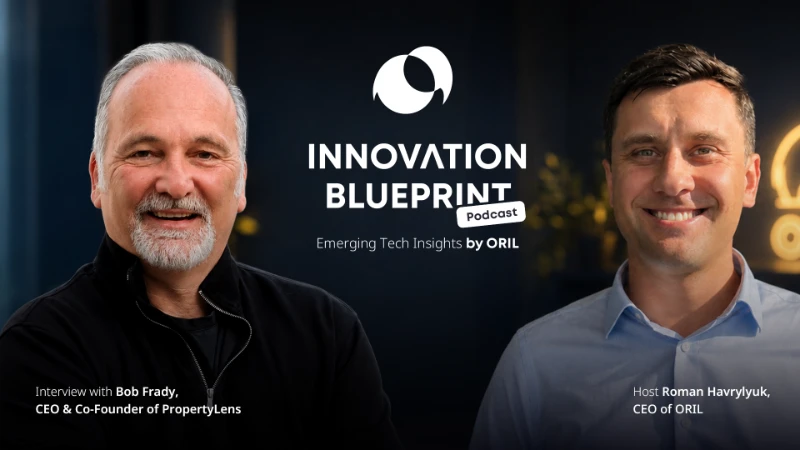
Buying a house is one of the only major purchases most people make with almost no access to the thing’s actual history. On a recent episode of The Innovation Blueprint Podcast, ORIL’s series on emerging PropTech, hosted by ORIL’s CEO Roman Havrylyuk, that gap was the whole starting point for a conversation with Bob Frady, co-founder and CEO of PropertyLens.
Frady’s path into this problem wasn’t planned. He’d previously built and sold a natural hazard risk assessment company — flood and wildfire data, the kind insurers rely on. After the sale, he went to buy a house himself and wanted something that would tell him its actual history before he made a six-figure decision. Nothing existed. So he pulled the data together himself, used it to negotiate the price, and found things about the house that hadn’t been disclosed. “After we bought the house, I said, well, couldn’t anybody use this?” he said. “And the answer was yes.” PropertyLens is what came out of that question — a home history report built to surface what a buyer wouldn’t otherwise find out until it was too late.
A few threads from the conversation are worth pulling out, whether you’re thinking about buyer risk data specifically or property data more generally.
Roman opened the episode with an observation of his own that framed a lot of what followed: “I’m often very surprised how real estate technology is lagging behind something like FinTech and adjacent areas of the technology landscape.” It’s a gap that shows up repeatedly in this conversation — not because the data doesn’t exist, but because almost nobody outside the industry knows to ask for it
The customers nobody expected
Bob assumed first-time home buyers would be the core market. They’re actually the smallest segment. The two groups that use PropertyLens the most are real estate investors and repeat buyers who’ve already been burned by an expensive surprise once.
The investor use case, in particular, wasn’t one Bob anticipated: one customer manages eighty properties and pulls a report on each one to decide which to keep, sell, or improve — he walked in asking for a hundred reports at once. “Investors don’t care about the emotion of buying a house,” Bob said. “They fall in love with the dollars — can I make money on this house, and are there unexpected expenses hiding in it that I can anticipate before I buy?” Repeat buyers, meanwhile, come in already knowing something can be hiding; they’ve just never had a tool that could tell them what.
The pattern underneath both groups is the same: people who’ve already paid the cost of not knowing are the ones who understand the value of finding out in advance.
Roman connected that pattern to something broader than PropertyLens itself: “that’s why we also try to focus on educating some people in the ecosystem — that might be buyers, that might be property owners. That’s one of the purposes of this podcast as well, just to spread the word and help people out in this regard.” The inexperience gap isn’t a PropertyLens problem to solve alone — it’s closer to a standing feature of the industry.
Making the data legible to people who don’t already know what to ask for
Explaining the value of property risk data to someone shopping for their first house is genuinely hard, and Bob was candid about that. The tool that’s landed best with customers isn’t the most technical one — it’s a projection of expected repair costs over the next two years, built by estimating the age of a home’s major systems and mapping that against typical useful life for the area. A twenty-year-old HVAC system reads very differently to a buyer once it’s phrased as “this is near the end of its expected life and here’s roughly what replacing it will cost” rather than as a data point buried in a report.
Data you build versus data you buy — and the hard part in between
PropertyLens pulls from around ninety data sources, split between data the company builds itself (hazard data, fire station and hydrant locations, prior property damage records — pulled directly from Bob’s risk-data background) and data it sources through partnerships (building permits, roof condition and satellite imagery, crime rates). The company also runs a B2B API business now — built a little over a year ago at customers’ request, not as an original plan, and already at 53 signed-up API customers spanning insurance and inspection companies.
The genuinely hard part, in Bob’s telling, isn’t collecting any single dataset. It’s what comes after: “everybody says building databases is easy, but getting those databases to talk to each other, and to be consistent, and to work together — that’s a hard trick to master.” It’s a version of the same problem that keeps surfacing across conversations with property data companies on this podcast — different sources built independently, in different formats, with no shared structure to reconcile them against.
Where AI actually shows up in the workflow
Bob named three specific areas where AI has changed how PropertyLens operates, and none of them were about a flashy new feature. First, coding — AI-assisted review has made the engineering team meaningfully faster. Second, data normalization — PropertyLens pulls from roughly two-thirds of the country’s 8,000-plus municipalities, each with its own data formats, and AI has become the practical way to reconcile and present that data consistently. Third, and the one Frady seemed most interested in: decisioning. The raw data components — market conditions, sale history versus current value, system age — were always there. What AI adds is a logic layer on top, letting a buyer ask a plain-language question like “what should my strategy be on this house?” and get an answer grounded in the underlying data rather than having to interpret the report themselves.
“It has made us much, much, much, much, much more efficient,” he said — while also noting the same efficiency lowers the barrier for anyone to try to copy a working product, which he treats as a cost of doing business now rather than a reason to slow down.
What actually differentiates a data company once AI levels the playing field
Bob’s answer to competitive differentiation wasn’t about technology stack. It was about what he called data creativity — the ability to understand not just what a dataset contains, but how it was built, how it can be reshaped, and how different sources can be recombined to answer a specific customer’s problem. “Understanding all of that data, understanding how it’s built, how you can tweak it, how you can change it, how you can get different sources — that’s something that is creative rather than machine-oriented. Not a lot of companies have it.”
On the business side, he pointed to something less technical: a shift toward API-based, pay-for-what-you-use access with no required long-term commitment — a model showing up across more property data companies as the traditional enterprise contract approach loses ground to self-serve access. He was also clear-eyed about PropertyLens’s own identity in the PropTech conversation: “we look at ourselves as a data company that lives in the PropTech world, not a PropTech company per se.” The category itself, he argued, is too broad to be useful as a label — automating rent payments and judging structural safety are both technically ” PropTech,” but they have almost nothing in common as problems.
Roman agreed with the underlying premise, and framed why it matters for how a company competes now: “AI leveled the technological plane in many instances. So if the goal is to outrun your competition in terms of technology, it’s a much harder game to play at this moment.” When technical execution stops being the differentiator, what a team understands about the problem — not just the stack it’s built on — becomes the thing worth competing on. Roman also agreed with Bob’s resistance to the “PropTech company” label itself: “I one hundred percent agree with you, because the breadth of this landscape is just too broad.”
A test case for where AI valuation still runs into trust
One story from the episode is worth sitting with on its own. After a major renovation, Bob needed a construction loan refinanced and had a professional appraiser value the house — who came back with a number lower than what he’d paid, despite having put half the home’s value into improvements. He ran the same property through his own data and an AI model and got what he considered an accurate valuation in about five minutes, versus the $1,900 professional appraisal that was, in his words, “so far wrong it was almost laughable.”
His broader point isn’t that AI valuation is ready to replace appraisers outright — it’s that the parts of the property transaction process most overdue for disruption are exactly the ones institutions are slowest to trust, because title and lending companies won’t accept an AI-generated valuation until they’re confident it holds up. That gap between “the technology works” and “the industry trusts it” is likely to be one of the more interesting fights in PropTech over the next few years.
The disclosure problem doesn’t have one answer — it has fifty
Bob’s read on the biggest near-term challenge in his corner of the industry is structural: buyers are still largely on their own. Disclosure requirements vary significantly by state and change piecemeal — Florida only started requiring flood-history disclosure last year; Massachusetts recently banned waiving the home inspection contingency; whether a death occurred in a home is a disclosure requirement in only a handful of states. “Regardless of the disclosures, regardless of the law, you don’t really have any recourse,” he said. “Post-settlement lawsuits are really hard to win. So it’s always buyer beware.”
His research found that more than 40% of buyers end up with a repair that meaningfully strains their budget — one they could have been warned about beforehand. He described one recent case: a friend’s house had an undisclosed soil problem with unpermitted repairs; Bob flagged it before the sale, the buyer kept the inspection contingency, and it turned into a $75,000 fix that he was at least able to negotiate a credit for instead of discovering after closing.
Roman pushed on the trust dynamic behind all of this: “I think for many brokers it might seem to be a good idea to maybe hide some of the details or not disclose all of the details. But at the end of the day, if you’re very transparent with the way you communicate with your potential customers, you can build more trust with them.” He also tied the state-by-state disclosure patchwork to a wider regulatory pattern he’s been tracking: “probably you know about the Fee Transparency Act that just rolled out fairly recently — it’s related to rentals, but it’s a kind of similar theme conversation here, because you need to know what your cost is going to be, whether you’re renting or buying a home. I believe there’s probably some regulatory space for that as well.”
Where ORIL fits in this picture
The specific problems in this conversation — reconciling data sources that were never built to talk to each other, adding an AI decisioning layer on top of raw property signals, making a report legible to someone who doesn’t know what to ask for — aren’t unique to one company’s product. They’re the same kind of work ORIL does with real estate and proptech clients: data integration across disparate sources, data enrichment that fills the gaps a single dataset can’t cover, and visualization that turns a normalized dataset into something people can actually act on.
This is the kind of conversation The Innovation Blueprint Podcast keeps coming back to — not one company’s product roadmap, but the underlying shifts in property data, AI, and buyer risk that everyone building in this space is navigating at the same time.
Join the Conversation
Want to join the podcast? Drop us a line and share your insights on how innovation is shaping the future of real estate and PropTech!


