

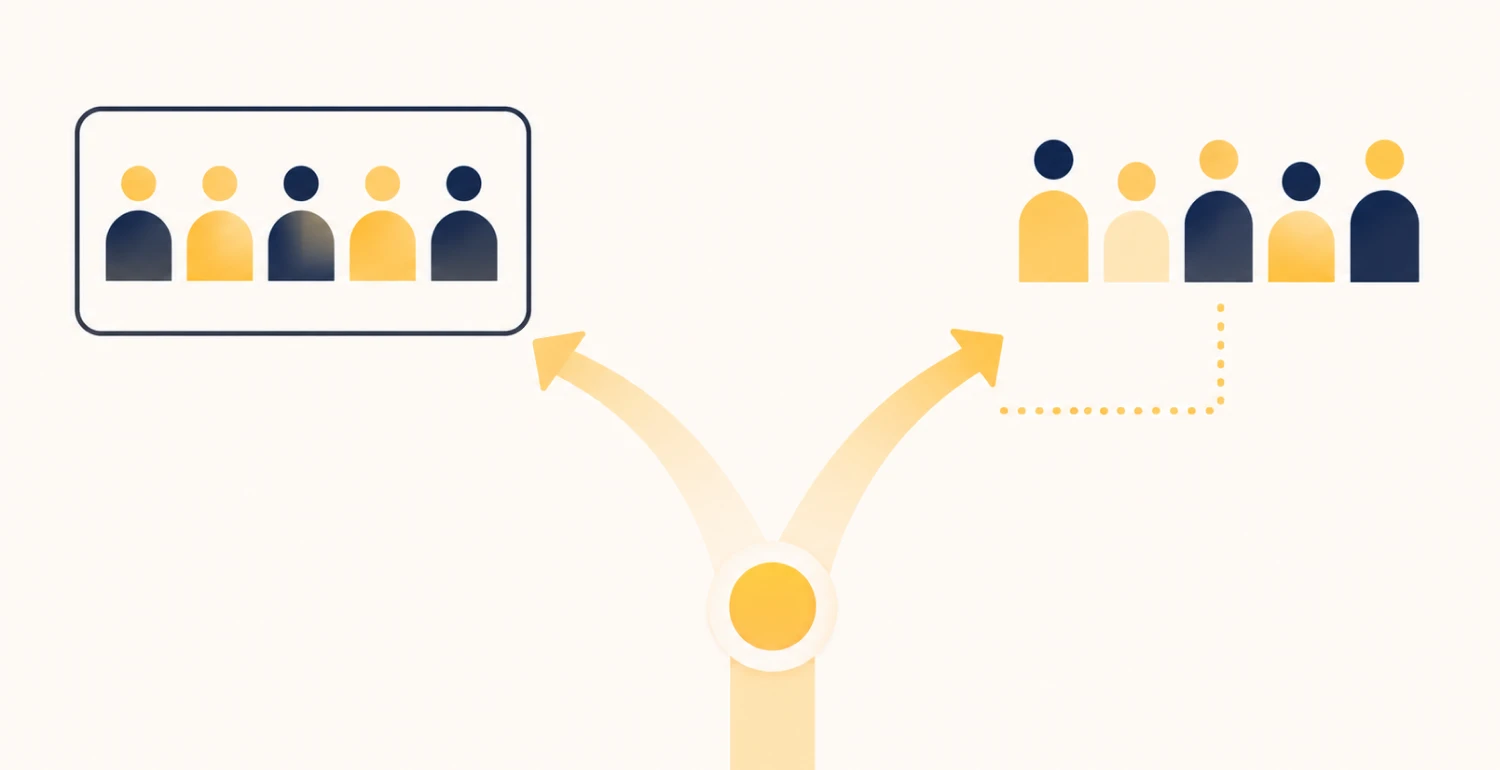
Every real estate and PropTech team that builds a serious platform eventually hits the same fork: hire engineers and own the work, or bring in a software vendor to do it. The choice sometimes gets made early, under deadline pressure, and it may quietly set the cost and pace of everything that follows for years.
In practice, the two are ends of a spectrum more than a strict either/or because most mature teams end up blending them.
It also gets tangled up with a different question. Deciding who builds your listing platform, AVM tool, or analytics dashboard is not the same as deciding what to build. However, teams routinely collapse the two and end up answering neither well.
The stakes are highest for the products these decisions usually involve: real estate listing platforms, automated valuation model (AVM) tools, analytics platforms, investor portals, and property management systems, and the systems around them: construction management platforms, IoT and smart-building integrations, and energy-management tools. These live for years, accumulate MLS and PMS integrations, and carry maintenance obligations long after launch. The team model you pick shapes how well they age.
What Is a Software Vendor?
A software vendor is an external company you hire to design, build, and maintain your software instead of relying only on an internal team. This is outsourced software development, and it comes in two meaningfully different shapes.
A full-service vendor owns delivery: discovery, architecture, build, and ongoing support, as a partner accountable for outcomes. Staff augmentation is narrower. Individual contractors slotted into your process and management. The distinction matters because you’re buying different things. The first buys delivery ownership and domain expertise; the second buys capacity you still have to direct.
Vendors earn their place where specialized experience is expensive to grow internally. A team that has already shipped MLS integrations, built valuation pipelines, or stood up a real estate analytics platform arrives with hard-won pattern recognition. It knows the failure modes, the schema mismatches, and the data-quality traps before they surface. That experience often translates into better architectural decisions long before implementation begins, reducing rework as the platform grows.
An internal generalist team would spend months acquiring that same instinct, and it would do so on your budget and your timeline.
What Is In-House Software Development?
In-house software development means building and maintaining your product with your own full-time employees rather than an external partner. The team reports through your management, works only on your products, and its knowledge stays with you between projects.
That last point is what makes the model distinctive. An in-house software development team is a standing capability, not a service you switch on and off. Over time it accumulates context: why a particular integration was built the way it was, which edge cases broke in production, where the technical debt is buried. That context compounds.
For a real estate firm, this often looks like a small internal product team that owns a listing platform end to end. It understands the quirks of each regional MLS feed it pulls from, the agent workflows the platform has to support, and the pricing logic that changes with the market. Because the domain lives inside the team, shipping product changes typically requires less knowledge transfer than working with a newly onboarded external team.
Advantages of Working With a Software Vendor
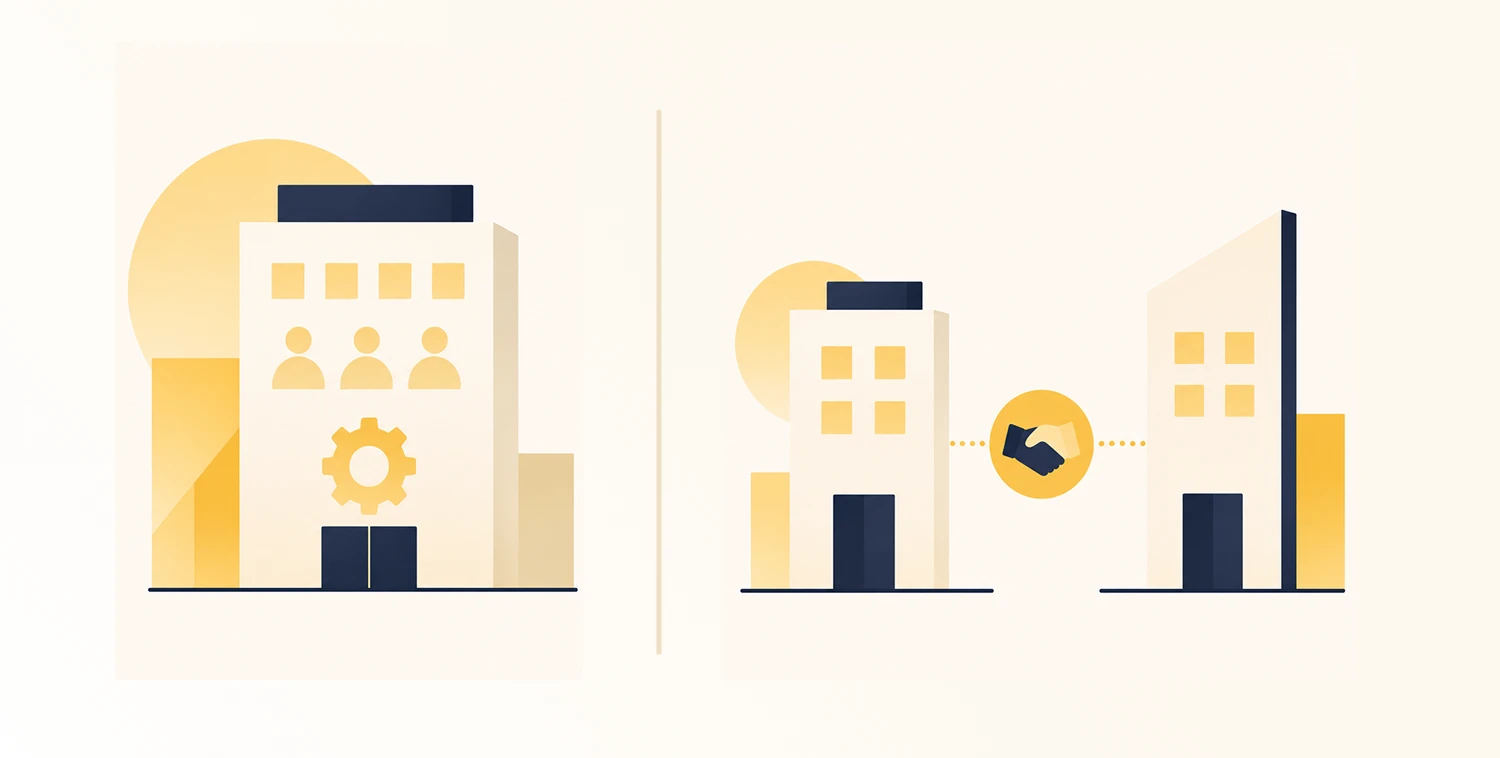
The case for a vendor comes down to speed, specialized skill, and flexible cost. These are the advantages that matter most when the clock or the skill gap is your binding constraint.
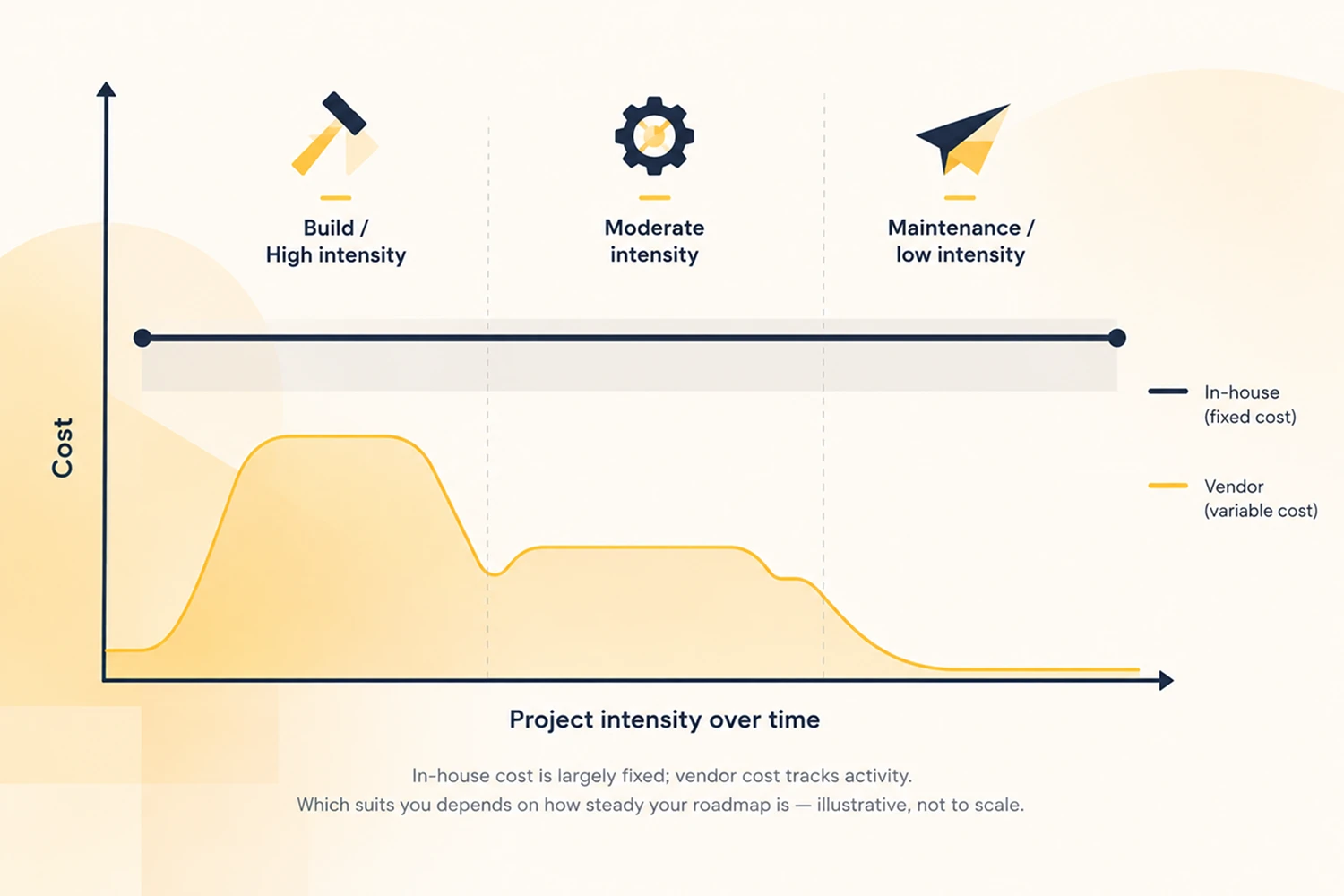
- Cost that scales with scope, not headcount. An early-stage PropTech company can staff a full MVP build through a vendor without committing to permanent salaries, benefits, and infrastructure. You pay for defined work rather than standing capacity.
- Specialized expertise on day one. A vendor fluent in PropTech data models (Yardi and AppFolio on the PMS side, MLS feeds, AVM logic) shortens discovery because there’s no domain to teach. The same applies to AI-enabled products, where success depends as much on governed property data and system architecture as on model selection.
- Elastic capacity. You scale the team up during a heavy build and down through maintenance, without hiring and later cutting.
- No HR overhead. For time-boxed work, you skip recruiting cycles and the cost of a bad hire.
- Faster time-to-market. A formed team can often begin delivery within weeks, while assembling an equivalent in-house team typically requires months of hiring and onboarding. Once a vendor model is on the table, top destinations to look for software development vendor is a useful next read on where to search and what to expect by region.
- Established process and partner networks. A mature vendor brings tested delivery practices and existing relationships: security auditors, analytics tooling, cloud providers. You’d otherwise assemble these from scratch.
Advantages of In-House Software Development
The advantages of in-house software development cluster around control, alignment, and retained knowledge.
- A stack and process tuned to your domain. You architect around your own product. A custom real estate analytics platform can be built on a data model shaped by how your team actually queries it.
- Durable product alignment. An internal team lives with its own decisions and the roadmap they serve, which tends to produce sharper judgment about what’s worth building next.
- Direct control over priorities and quality. You reprioritize in a standup, not through a change request. That’s the case for planning the role mix deliberately: how a software product benefits from having a QA engineer is worth reading before you assume velocity alone protects quality.
- Faster, informal communication. Context is shared in the room rather than transferred across a contract boundary.
- Knowledge that compounds. Domain expertise, including sensitive areas like security handling, stays inside the company and carries into the next project instead of leaving with a vendor.

Disadvantages and Risks of In-House vs Vendor Development
Neither model is free of trade-offs, and the advantages and disadvantages of in-house software development mirror each other: the same control that helps you also costs you.
In-house drawbacks
- High fixed cost. Salaries, benefits, tooling, and infrastructure run whether or not there’s active work in the pipeline.
- Slow to staff. Senior engineers take time to recruit, and a mis-hire may be expensive to unwind. That’s a real risk when a deadline is already set.
- Skill-gap exposure. A generalist internal team may lack specific experience in MLS integrations, AVM modeling, ML pipelines, or IoT and energy-system integration, and has to build that skill on your timeline and budget.
Vendor drawbacks
- Alignment risk. A vendor that executes specs without pushing back can deliver exactly what was requested and still miss the intent.
- Less real-time control. Priorities move through process and contract rather than a hallway conversation.
- Continuity and lock-in. You depend on the vendor’s stability, and knowledge transfer has to be deliberate rather than assumed. If a partnership stops working, moving on is its own project, the vendor transition process in software development is worth understanding before you’re forced into it.
- Governance overhead. Sharing proprietary data and source with an external team demands explicit controls. Whichever model you choose, an application security audit on critical platforms is how you see your real risk profile.
In-House vs Vendor Software Development: Key Comparison Areas
Most decisions turn on two or three dimensions. The table summarizes how each model typically performs. The constraint that dominates your situation should carry the most weight.
| Dimension | In-house | Vendor | Where it bites |
| Cost | High fixed cost; potentially lower over the long run once the team is productive | Variable and scope-based; efficient for defined or uneven work | An MVP portal usually favors a vendor; a decade-long core platform can favor in-house |
| Time-to-market | Slower to start, hiring per role | Faster; a formed team begins delivery immediately with an established team. | A vendor can be bulding analytics dashboard while you’re still interviewing |
| Expertise | Deep in your domain over time; may lack niche skills early | Broad, pre-existing niche skills (MLS, AVM, AI) | An AVM engine leans vendor unless you already employ data scientists |
| Control & alignment | Direct and continuous | Mediated by process and contract | A fast-shifting roadmap favors in-house control |
| Flexibility/
scale |
Bounded by headcount | Flexes up and down easily | Milestone-heavy or seasonal roadmaps favor vendor elasticity |
| Risk & continuity | Knowledge retained; key-person risk | Vendor-stability and lock-in risk; transferable if managed | Mission-critical IP can favor in-house retention |
| Long-term evolution | Compounds internal capability | Compounds the vendor’s cross-client learning | A platform you’ll own for years favors in-house or a hybrid |
How to Choose Between In-House and Vendor Software Development
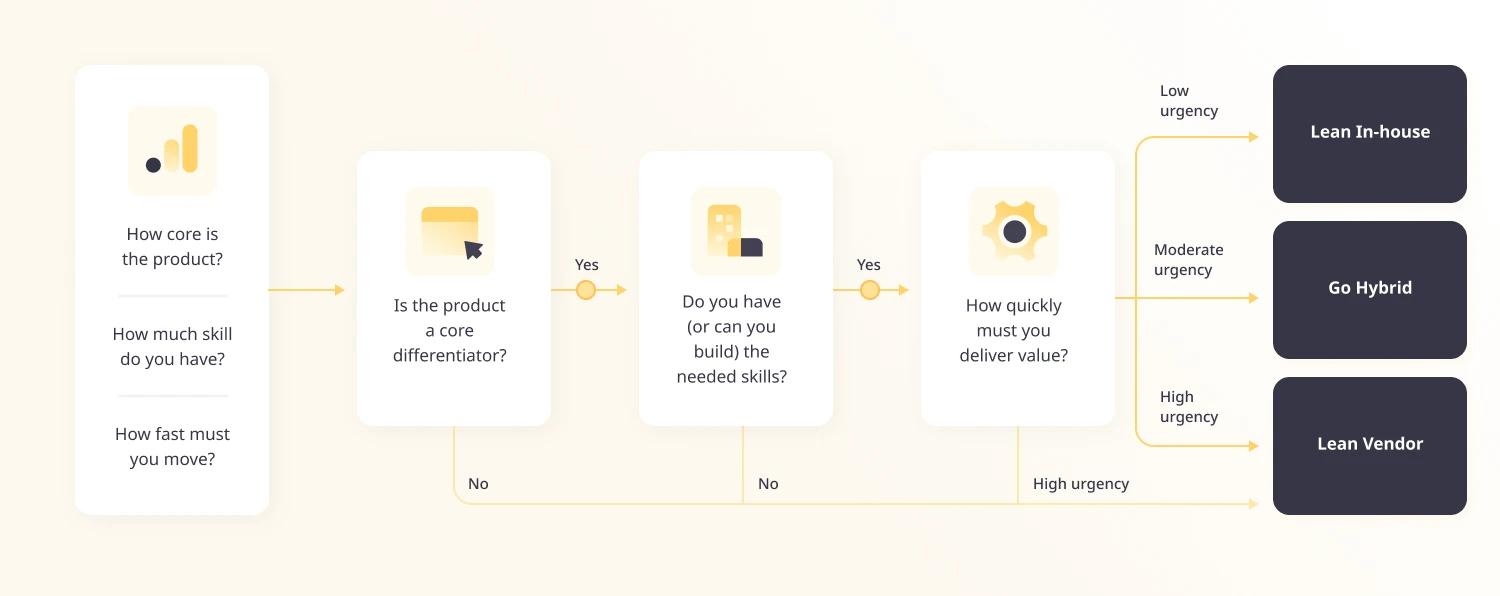
The decision reduces to three questions:
- How core is the product?
- How much of the needed skill do you already have?
- How fast do you have to move?
Those three, more than budget alone, separate the cases.
Lean in-house when the product is core to the business, and you’ll own it for years, you have the budget and patience to build and keep a team, and deep domain embedding matters more than early speed.
Lean vendor when time-to-market is decisive, the work needs skills you don’t have, like real estate analytics, valuation modeling, or AI enablement for PropTech. Or, if the scope is defined and time-boxed.
Go hybrid when you want a small internal core team owning direction while a vendor absorbs spikes and specialized modules. This is where a lot of mature product teams actually land, and the question of what a firm adds versus building in-house usually resolves in favor of using each for what it does best.
Two adjacent decisions sit next to this one and shouldn’t be folded into it. Choosing who builds is separate from choosing what to build. If you’re still weighing custom against off-the-shelf, that’s the build vs buy real estate software question.
Infrastructure is a third axis: self-hosting vs cloud infrastructure affects cost and control regardless of who writes the code. When a vendor path looks right, choosing a software development partner turns the strategic call into a concrete shortlist.
Real Estate and Data-Heavy Product Scenarios
The abstract comparison gets clearer against specific products. Here’s how the choice tends to break down across the systems these decisions usually involve.
Real estate listing platform
Regional MLS feeds vary in schema and access terms, and role-based access plus a long maintenance tail make this a durable commitment. In-house fits when the platform is your flagship and iterates constantly. A vendor with custom real estate software development experience gets you live faster and skips the MLS learning curve.
AVM or valuation engine
This needs data science and data engineering together, a genuinely scarce combination. Unless that talent is already on staff, a vendor usually wins on both time and quality.
Real estate analytics platform or investor portal
Data-heavy products reward domain-specific architecture. If analytics is your moat, in-house ownership may justify the cost. If it’s a supporting capability, analytics and data platforms expertise from a vendor can shortcut the foundational build.
Real estate data enrichment
Property records (ownership, parcel, mortgage, and valuation) come from fragmented sources with data-sourcing relationships that are hard to reproduce internally. At low volume a specialized vendor typically wins. As enrichment becomes core to the product, bringing it in-house starts to pay off.
Demand-sensing and value-based analytics
Time-to-first-signal usually decides it: a vendor ships a working baseline faster. However, if the model becomes central to the business, plan to bring it in-house as it matures.
IoT, smart-building, and energy platforms
These pull live data from sensors, meters, and building systems, each with its own protocol and a long maintenance tail. A vendor with existing IoT and energy-management experience gets past the integration groundwork faster. Once the platform becomes core to how you run or price assets, in-house ownership of that data layer starts to pay off.
Across these products, the pattern holds: the delivery model you choose shapes how well the product scales later. In ORIL’s PropTech work, the deciding factor is almost always how core and how data-heavy the product is, not a fixed preference for building or buying.
What the Strongest Product Teams Actually Do
The teams that build durable platforms rarely treat this as a one-time verdict. They match the model to the moment. Early on, when speed and specialized skill matter most, they lean on a vendor to get a working product into the market.
As the platform becomes core to the business, they pull the parts that define their edge in-house, where the knowledge can compound, and the roadmap stays under their control.
What separates good decisions from expensive ones is being honest when the answers are inconvenient: admitting a product is more core than you’d like, or that the skill gap is wider than the timeline allows.
For complex, data-heavy real estate products, the answer often lands in the middle, with a small internal core team owning direction and a specialized vendor handling the hard technical work and the spikes.
So run your own product through the seven dimensions in the table before your next planning cycle. Mark where each one points for your situation, and the pattern usually speaks more clearly than any single rule.
If it points toward a vendor for your listing platform, analytics tooling, or AI work, ORIL’s PropTech expertise shows how those partnerships tend to take shape in practice.


