

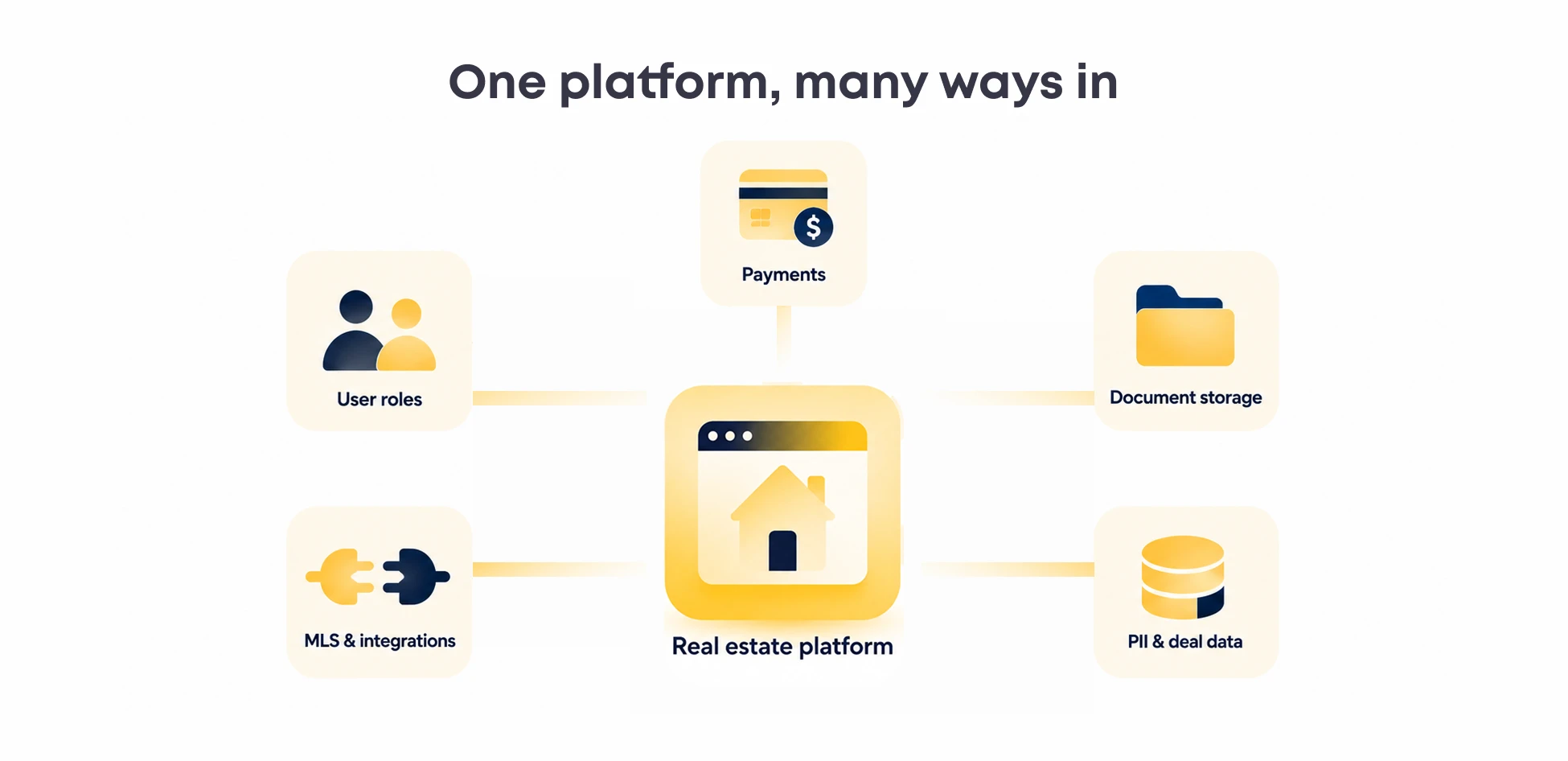
A real estate listing platform runs on more moving parts than it looks like from the front end: multiple user roles, MLS and payment integrations, document storage, and a database full of PII and deal terms. Every one of those is part of the attack surface.
An application security audit maps that surface. It is a structured evaluation of your application’s code, configuration, and infrastructure that identifies vulnerabilities and weak controls, then ranks them by the risk they actually carry. The exact mix varies by scope: a security audit may include vulnerability scanning, manual code review, configuration assessment, and penetration testing, but these are distinct activities rather than interchangeable terms.
For custom products like listing platforms, AVM tools, investor dashboards, and property management portals, this matters more than for a generic marketing site. These apps combine multiple user roles, third-party integrations, and sensitive datasets, which is exactly the kind of surface where access-control and data-handling flaws hide.
This article explains what an application security audit is, what a web app security audit covers, when to run one, and how it fits into the way you already build and ship software.
What Is an Application Security Audit?
An application security audit is a structured assessment of your application’s code, configuration, and infrastructure that identifies vulnerabilities, weak controls, and gaps against security best practices.
Its scope is deliberately wide. An audit looks at how the application is built, how it’s deployed, and how your team handles access and secrets, then ranks what it finds by risk. A penetration test sits inside that scope as one technique: it probes specific paths to confirm whether a given weakness can actually be exploited. The audit is the full assessment; the pen test is one of the tools it uses to get there.
Good application security auditing combines automated scanning with manual review, because many high-impact issues in custom platforms, such as broken access control and business-logic flaws, are difficult to identify through automated scanning alone.
An app security audit typically covers the running web application, its APIs, the services it depends on, and the environment it runs in. The output is a prioritized view of where your real risk sits and what to fix first.
What a web application security audit focuses on
For a browser-based product, most of your risk lives in the web app and the APIs behind it, so that’s where the audit concentrates. It works through authentication and session handling, input validation, access control, configuration, and third-party integrations. Along the way, it traces how data moves from login through the front end, the API, and into the database.
This is the layer that matters most for a listing platform or investor portal, where a single access-control gap can expose exactly the data your users trusted you with.
What Is the Main Purpose of a Security Audit?
An audit exists to answer one question your team usually can’t answer with confidence: of everything that could go wrong in this application, what is most likely to, and what would it cost you? It surfaces the vulnerabilities and weak controls across your code and environment, then ranks them so you fix the ones that matter before someone exploits them.
That ranking is the point. Most teams already have a backlog of security concerns; what they lack is a defensible order. A good audit gives you one, and along the way it:
- Finds vulnerabilities in code and configuration, not just the known CVEs a scanner would flag anyway.
- Confirms your controls actually hold: that authentication, authorization, encryption, and logging do what you assume they do under real conditions.
- Produces the evidence a SOC 2 assessor, enterprise customer, or investor will ask for.
- Lowers the cost of a fix. Closing a design flaw before launch is far cheaper than handling it after a breach, and the gap is large: IBM’s Cost of a Data Breach Report 2026 puts the global average breach at USD 4.99 million, a record high and a 12% jump year over year.
What Does an Application Security Audit Cover?
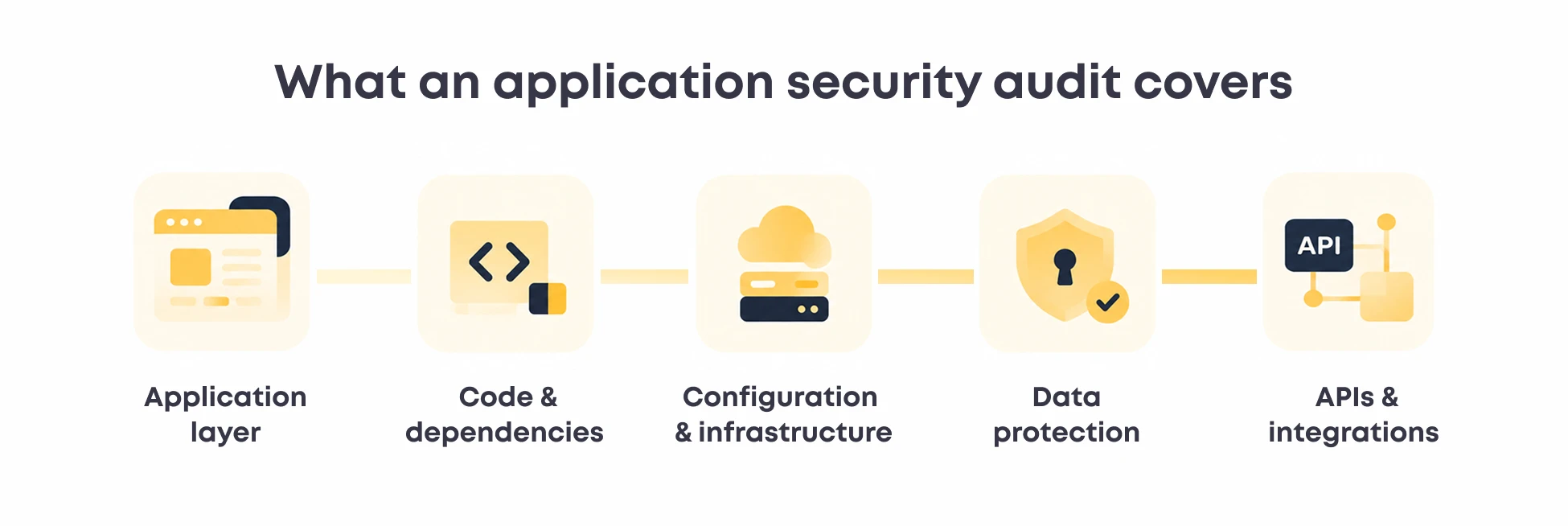
The scope of an audit decides what it can and can’t catch. A tightly scoped code review will never find a misconfigured storage bucket, and an infrastructure scan will never find broken business logic, so a real audit covers all five layers below rather than the one a given tool happens to see.
Application layer
Authentication, authorization, session handling, and business logic. On a listing platform with public, agent, and admin roles, the question is whether changing a record ID in a request lets an agent pull another brokerage’s leads. Broken access control like that is among the most common findings in any multi-role real estate app, and it’s the kind of flaw automated scanners can miss.
Code and dependencies
Source-code review and third-party library risk. An AVM application pulling MLS and external data tends to carry dozens of dependencies and a few stored API keys. The audit hunts for outdated libraries and secrets committed to the repo.
Configuration and infrastructure
Cloud config, network exposure, storage settings. An investor portal that writes signed documents to a misconfigured bucket leaks confidential files with nobody ever “breaking in.”
Data protection
Encryption in transit and at rest, PII handling, and what lands in your logs. A property management portal holding tenant identity and payment data has to keep those fields encrypted and out of plaintext logs, which is exactly where they tend to end up.
APIs and integrations
Auth, rate limiting, and input handling on every endpoint. An MLS or PMS integration is a recurring weak point for a simple reason: it often gets built once, passes its tests, and then may sit untouched for a long time.
Inside an Application Security Audit: The Five Phases
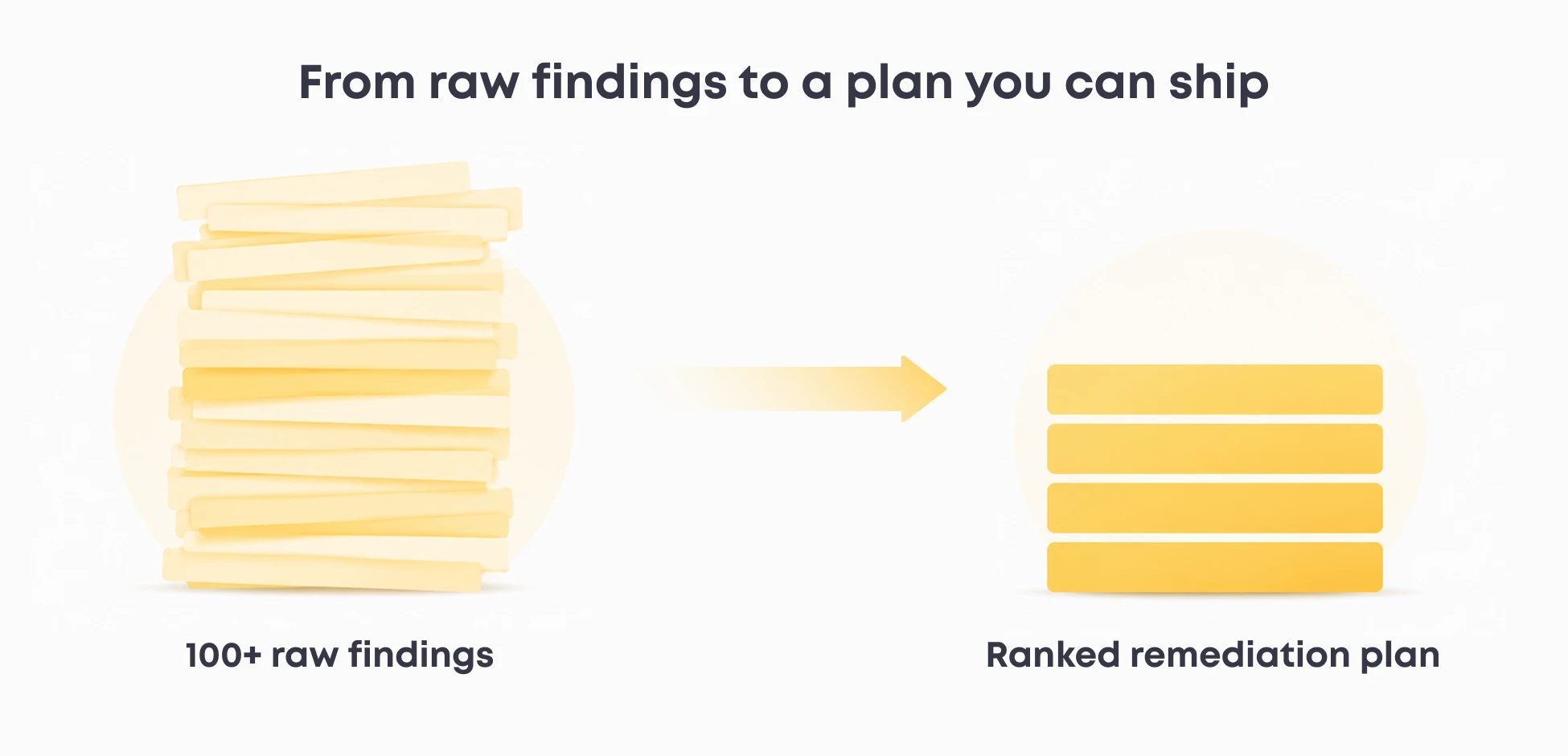
A thorough audit can produce a large number of findings. On its own, that number is useless, and occasionally worse than useless, because a long list with no priority order tends to get triaged into “we’ll get to it” and then never gets to it. The five phases below are built to prevent that: each one exists to turn raw findings into a shorter list your team will actually work through.
- Plan. Set the scope: which apps, APIs, roles, and integrations are in and out. For a listing platform, that’s the web app plus its MLS feed, payment, and e-signature integrations, since the integrations are usually where the surprises live.
- Assess. Run the testing across that scope: vulnerability scanning, penetration testing, code review, and configuration review, tooling and manual work in combination.
- Analyze. Rank findings by impact and likelihood. A flaw that exposes deal or investor data sits far above a low-risk header misconfiguration, even though a raw report lists them side by side.
- Report. Deliver an executive summary for the people funding the fix and technical detail for the people making it, with remediation steps instead of a scanner dump.
- Remediate and validate. Work through the prioritized fixes, then re-test to confirm each one actually closed the gap rather than moving it. A finding isn’t resolved until it’s been checked again.
Continuous monitoring picks up where the audit ends. It’s an ongoing security program rather than a phase of the engagement, keeping your security posture current as the platform keeps changing. Once you’ve acted on the audit’s findings, Key Features of Top Monitoring and Logging Services covers the tooling that keeps the next issue from going unnoticed.
Judge an audit on the remediation plan, not the finding count. A ranked plan tied to your own data and workflows drops onto a sprint board with little translation needed. A raw, unranked list just moves the triage work from the auditor to your engineers, which is the part you were paying to have done.
When Should You Audit Application Security?
Audits are worth most at the moments when your risk profile has just changed, and your knowledge of it hasn’t caught up yet. That gap may open predictably, sometimes right after the team ships something big, and these are the triggers that open it widest:
- A new critical web app going live. A real estate marketplace or investor portal reaching production carries a full attack surface that has never been tested under real traffic.
- A major release or refactor. Replatforming is the clearest trigger. A Full Guide to Revamping a Large App covers planning the change, and an audit confirms the new architecture reduced risk instead of relocating it into unfamiliar code.
- New high-stakes data entering the system. An MLS feed, financial records, or confidential investor documents raise the cost of any single flaw, so the bar for the controls around them rises too.
- A compliance or customer requirement. A SOC 2 assessment or enterprise security review may require evidence that your technical controls work, and an application security audit can provide part of that evidence.
- A suspected incident, where the audit scopes how far the exposure may have reached.
- A vendor transition. Vendor Transition Process in Software Development covers managing the handover. An audit gives you a documented baseline before the codebase changes hands, so later problems can be traced to before or after the switch.
The pattern underneath all six is the same: each one adds code, data, or access faster than anyone fully tracks it. Auditing right before or after a change of that size is how you close the gap between what your platform now exposes and what your team believes it exposes.
The Business Case for Auditing a Real Estate Platform
The generic argument for audits is easy to nod along to and easy to defer. What makes it concrete for a real estate or PropTech team is the kind of data these platforms carry and the kind of flows they run.
- Protection for the data you hold. Buyer and seller PII, deal terms, and investor records are the kind of data that can turn a breach into client phone calls and regulatory notifications.
- Detection in the flows that branch the most. Offers, valuations, and document-signing paths carry more conditional logic than standard CRUD, and the added branches are a common home for logic errors that functional tests pass straight over.
- Trust with people on both sides of a deal. Sellers, buyers, landlords, and investors hand these platforms sensitive information, and a documented security posture is part of what keeps that relationship intact.
- A lower cost of remediation. Closing a design flaw before launch generally costs a fraction of handling the same flaw after a breach and the disclosure conversations that follow it.
- Faster due diligence. A documented posture can answer a partner or investor security review on its own terms, rather than turning the review into a fire drill.
Where an Audit Focuses, by Product Type
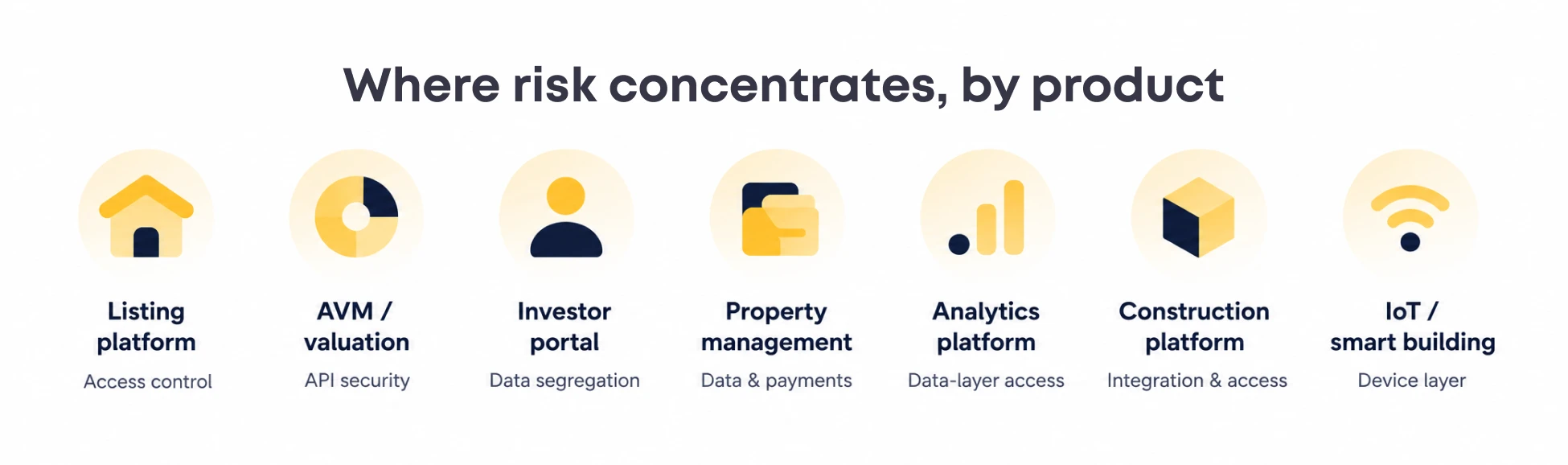
Risk concentrates differently depending on what the product does, so a good audit weights its time toward the layer each product type stresses most.
Listing platform with multi-role access
Public listings, agent back office, and admin tools often share one codebase, so access control and role separation tend to dominate the scope: confirming that a lower-privilege user cannot reach data or actions intended for a higher one. For teams designing one, How to Create a Real Estate Listing Platform is a useful companion, and Features You Might Miss While Creating a Real Estate Listing Platform covers the advanced flows, such as offers, e-signatures, and document storage, that usually warrant the closest scrutiny.
AVM or valuation application
Because these run on MLS and external data, the audit tends to center on API security and integration handling: authentication on data endpoints, input validation, and how far the system trusts data it did not produce.
Investor portal or portfolio app
Performance figures often sit alongside confidential documents, so data segregation and file handling lead the scope: who can see which fund, and how documents are stored and served.
Property management portal
Tenant and owner PII combined with payment flows tend to put the weight on data protection and the security of the payment path.
Analytics platform
Sitting on combined sensitive datasets, the priority is usually access control across the data layer and how the platform enforces which users can query what. For products of this kind, analytics and data platforms expertise covers how security, governance, and performance get handled together in systems built to last.
Construction or field-data platform
Data flows in from job sites, subcontractor systems, and sometimes on-site sensors, so the audit centers on integration security and data integrity, plus the multi-party access where owners, GCs, and subs share one system with very different permissions.
IoT or smart-building product
When a platform talks to physical devices, sensors, access controls, energy or HVAC systems, the audit widens to the device layer: how devices authenticate, whether update channels are protected, and whether one compromised device can reach the rest of the network.
When an audit surfaces something a team would rather redesign than patch, custom real estate software development is where that engineering work happens.
Build Platforms That Survive the Audit
A findings report is the easy part of an audit. The harder and more valuable work is engineering a platform where the findings stay short: access control designed into the role model rather than bolted on, integrations built as maintained relationships rather than one-time tickets, sensitive data handled correctly by default. An audit measures how well that work was done. It doesn’t do the work.
That distinction matters most for real estate and PropTech products, where the surface keeps expanding, and each addition is a chance to reintroduce the exact risks the last audit cleared.
A platform stays secure not because it passed an audit once, but because the team building it treats security as an engineering property of the system, maintained release over release.
That is the standard worth holding a build partner to. Use this article to scope your next audit with your team or an external firm.
And if you are planning a major launch or replatforming and want that security review designed into the engineering from the start, talk to us about your real estate or analytics platform rather than treating the audit as a step you bolt on at the end.


