
A real estate platform keeps running during a vendor transition. Listing feeds refresh overnight, payment jobs fire on schedule, and a property database serves search queries continuously, all while ownership of the codebase moves from one team to another and the people who configured it step away.
That is what makes a real estate transition harder than a generic one. Much of what keeps a PropTech product running lives outside the repository: how a specific MLS (Multiple Listing Service) feed handles listing retractions, the job that reconciles property data each night, the reason one RESO field was mapped by hand.
The repository may transfer quickly. Turning the operational context around it into documented, owned knowledge is the real work. Companies take this on for practical reasons: when delivery has slowed, technical debt is compounding, or the roadmap needs data and AI work the current team cannot staff, choosing a new software development partner is often the right call.
This guide outlines how to structure a vendor transition so the live product stays stable, critical knowledge becomes transferable, and the incoming team can take ownership without inheriting avoidable risk.

What Is Vendor Transition in Software Development?
Vendor transition is the structured process of moving an existing software product from one development team to another while keeping it in production. It spans the business handover (goals, stakeholders, governance), the technical handover (code, infrastructure, credentials, documentation), and the knowledge transfer that connects the two.
Two things often get conflated and are worth separating:
- Vendor replacement (transition): the same product continues, with a new team taking ownership of the existing codebase, integrations, and roadmap.
- Redevelopment (rebuild): the product is rewritten, in whole or in part, often on new architecture.
A transition can lead into a rebuild, but the two carry different risk profiles and different budgets. A disciplined vendor transition process keeps the live product stable first and treats modernization as a separate, deliberate decision.
Why Real Estate Software Makes Vendor Transition More Complex
Real estate platforms carry live external dependencies that keep operating whether or not the transition is going well. A generic SaaS product may depend on a payment gateway and an email service. A PropTech platform often depends on multiple regional MLS feeds, RESO (Real Estate Standards Organization) data mappings, IDX (Internet Data Exchange) display rules, syndication pipelines, geocoding services, and a property database that other features read from continuously.
Each dependency changes what “handover” actually means:
| Dependency | Why it raises transition risk |
| MLS feeds (RESO Web API, legacy RETS) | Each MLS can have its own access agreement, implementation details, data coverage, and operational rules, even when the integration uses RESO standards. Credentials and compliance terms transfer through specific paperwork, not a config change. |
| Listing sync and data normalization | Overnight sync and normalizing MLS data jobs are easy to miss and expensive to break. A skipped job can corrupt listing state silently. |
| IDX and syndication | Display and syndication behavior is governed by MLS and portal terms. Misconfiguration risks a compliance violation, not just a bug. |
| CRM and PMS (property management system) sync, e.g. Yardi, AppFolio | Bi-directional flows mean a broken mapping surfaces as bad data downstream, often days later. |
| IoT and building-systems integrations (smart building, access control, sensors) | Device protocols and firmware dependencies are often undocumented, and a broken integration can affect physical building operations. |
| Payments, escrow, rent collection | Money movement leaves little room for downtime and frequently sits under financial regulation. |
| Valuation and AVM (automated valuation model) or AI models | Model inputs, training data, and evaluation logic are often undocumented. Retraining is not a handover artifact. |
| Analytics and reporting | Dashboards depend on pipeline lineage that rarely lives in the repository. |
The MLS landscape also remains highly distributed. As of June 2026, RESO’s certification map lists 484 functioning MLS systems in the United States, with additional systems in Canada and other regions. RESO identifies its Web API as the common data-transport standard for MLS systems while RETS remains a deprecated legacy method.
For a vendor transition, that means an MLS integration inventory needs to capture the specific systems, credentials, mappings, and API implementations the product depends on.
Because these systems stay live during the switch, transition planning for a real estate product leans heavily on real estate data integration validation. It confirms that every feed, mapping, and sync job survives the move before the outgoing team steps away.
The Most Common Reasons Companies Replace Their Software Development Vendor
Most transitions trace back to a small set of triggers, usually more than one at once:
- Delivery has slowed. Velocity drops, estimates stop holding, and the roadmap slips quarter after quarter, delaying revenue-generating features.
- Quality is degrading. Recurring production incidents, thin test coverage, and rising bug counts start costing more in support than the team saves in build time.
- Documentation is missing. Undocumented architecture and integrations make every change slower and every departure risky.
- The platform has outgrown the team. The system needs to scale, and the current team’s architecture or skill set does not extend to it.
- Communication has broken down. Time zones, unclear escalation, or misaligned incentives make the relationship expensive to run.
- Security concerns have surfaced. Access practices, dependency hygiene, or compliance gaps raise real exposure.
- Domain expertise is thin. The team can write code but does not understand MLS behavior, lease workflows, or valuation logic, so the same domain bugs recur.
- The roadmap now needs capabilities the team lacks. AI, data engineering, or modernization work sits outside what the current partner can deliver.
Weighing these against the cost of switching is its own decision. A comparison of in-house versus vendor software development can help clarify whether the incumbent no longer fits the roadmap or whether the relationship is recoverable.
Signs Your Product Is Ready for a Vendor Transition
Readiness is less about a single failure and more about a pattern across several dimensions. The signals below tend to cluster before a transition becomes the sensible move.
Technical signals
- Test coverage is low or unknown, and releases regularly introduce regressions.
- Deployment depends on one or two people and steps that live in chat threads rather than runbooks.
- Accumulating data debt makes reporting unreliable and slows every data-dependent feature.
Operational signals
- Incident response depends on the outgoing team’s memory rather than documentation.
- You cannot get a straight answer to “what would break if this vendor disappeared on Monday.”
Financial and strategic signals
- Maintenance cost is rising while output falls.
- The roadmap requires scaling, modernization, or AI work the current team cannot staff.
A short readiness check before you act:
- Do you own the repository, cloud accounts, DNS, and CI/CD in your organization’s name?
- Is there an internal technical owner who can evaluate what gets handed over?
- Do you have a current architecture diagram and a deployment runbook?
- Is there an inventory of scheduled jobs, MLS feeds, and third-party integrations?
- Are you clear of a critical deadline (launch, migration, compliance date) in the transition window?
If several of these are open, the first work is closing them, not switching vendors. Securing ownership and documentation while the current relationship is stable is a reasonable request of any partner, and it makes every later step cheaper.
Vendor Transition Framework: From Assessment to Stabilization
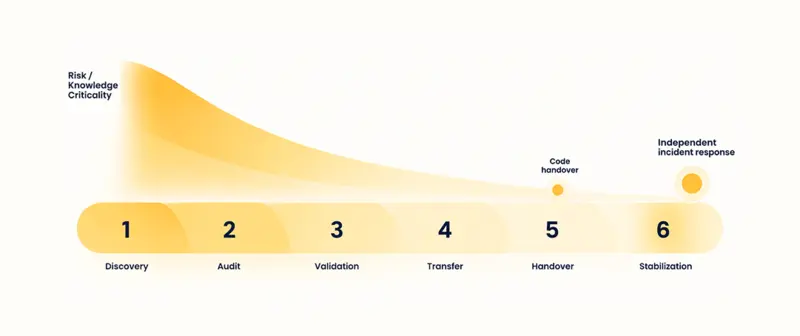
A structured transition runs in six phases, sequenced so the highest-risk knowledge moves first, while the outgoing team is still engaged. The goal of the sequence is simple: the incoming team should be able to handle a production incident without calling the previous vendor before the transition is declared complete. Code handover is the easy part and a poor definition of “done.”
Delivery performance should also be measured before and after the handover. DORA’s current five-metric model tracks change lead time, deployment frequency, failed-deployment recovery time, change-failure rate, and deployment rework rate. Establishing these measures before the transition gives both teams a baseline for determining whether delivery actually stabilizes after ownership changes.
| Phase | Focus | Primary outcome |
| 1 | Business discovery and readiness | Goals, stakeholders, ownership, and exit terms confirmed |
| 2 | Technical due diligence and codebase audit | Honest picture of code health and risk |
| 3 | Infrastructure and integration validation | Every environment, feed, and integration verified |
| 4 | Knowledge transfer and documentation | Undocumented context converted into owned artifacts |
| 5 | Team onboarding and delivery handover | Incoming team owns delivery and release |
| 6 | Stabilization and long-term delivery | Predictable operation, then modernization |
Phase 1: Business Discovery and Transition Readiness Assessment
Before any code is reviewed, the incoming team needs the business context. This is also where governance gets defined: who signs off on releases and how decisions are made during the overlap.
The context to establish first:
- Product goals and the reasons behind the switch.
- Stakeholders and their decision authority.
- Delivery commitments already in flight.
- Governance and sign-off for the transition window.
Readiness work here is contractual as much as technical. Confirm that the repository, cloud accounts, and CI/CD sit in your organization’s name, and read the outgoing contract’s termination terms so you know what assistance the vendor owes after notice. These terms are easiest to secure while the relationship is healthy. Thorough PropTech business analysis at this stage prevents misalignment once the incoming team starts work.
Phase 2: Technical Due Diligence and Codebase Audit
This phase produces an honest picture of technical health. The output is a written assessment with prioritized findings. It covers:
- Architecture and code quality.
- Technical debt and dependencies.
- CI/CD maturity and test coverage.
- Security: access control, secrets handling, and dependency vulnerabilities.
Security deserves particular attention during a vendor transition. Verizon’s 2026 Data Breach Investigations Report found that 31% of breaches began with vulnerability exploitation, making it the leading initial breach vector. For a handover, that makes dependency vulnerabilities, exposed services, access controls, and unpatched infrastructure part of the transition audit.
Phase 3: Infrastructure and Integration Validation
Production systems have to keep running through the transition, so infrastructure and integrations get validated before ownership shifts. What to confirm:
- Cloud setup, repositories, and CI/CD pipelines.
- Monitoring and alerting.
- MLS and RESO feeds, mapping services, and payment providers.
- Listing sync jobs and feed credentials, tested end to end.
Environment parity matters more than it appears. Verifying staging against production establishes development environment alignment so the incoming team is not debugging configuration drift on top of unfamiliar code. Where the platform is moving hosts, decisions about cloud infrastructure management are validated here.
The listing sync check deserves particular care on real estate products. A silent sync failure can corrupt data long after the outgoing team has left, so it gets tested before they step away.
Phase 4: Knowledge Transfer and Documentation
Knowledge transfer works best when the incoming team performs real operations while the outgoing team is available to unblock, rather than sitting through demonstrations. During the overlap, the incoming engineers:
- Run a deployment on their own.
- Take an on-call shift with the outgoing team shadowing.
- Fix a real issue end to end.
Anything they cannot do unaided is a gap found while there is still someone to ask.
Every session should leave a written artifact in your repository: a runbook, an architecture decision record, an integration map. A recording is nearly unsearchable during an incident months later. Design assets belong in this phase too, and an application design audit confirms the component library and design system transfer cleanly alongside the code.
Phase 5: Team Onboarding and Delivery Handover
Delivery continuity is the point of this phase. The incoming team takes ownership of:
- The backlog and sprint planning.
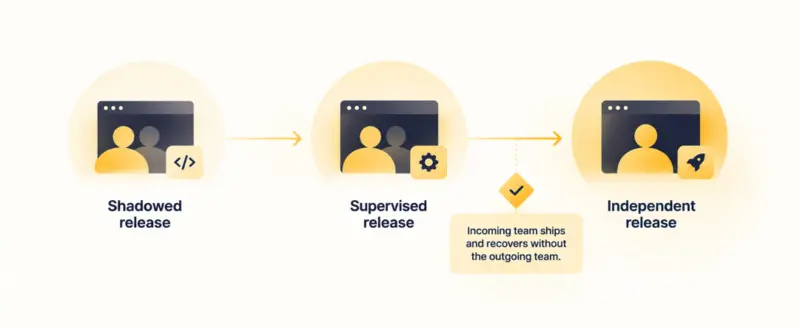
- Release management, shipping under supervision before shipping alone.
- QA and a communication model the stakeholders understand.
A structured dedicated development teams model helps here, because a stable team that owns the product end to end helps sustain sprint velocity through the handover. QA continuity deserves specific attention on real estate products, where a regression in listing display or valuation logic reaches customers directly.
Phase 6: Stabilization, Optimization, and Long-Term Delivery
Stabilization comes before improvement. The incoming team runs the platform, monitors it, handles incidents independently, and validates the roadmap against what the code and data can actually support. Only once operation is predictable does modernization begin.
At that point, the transition becomes a foundation for revamping legacy applications. The modernization work usually includes:
- Reducing technical debt.
- Tightening MLS and API integrations.
- Improving data quality.
- Preparing the platform for AI or scaling work.
One structural caution applies throughout the transition: avoid large rewrites during the overlap. Refactoring unfamiliar code makes it hard to tell inherited bugs from newly introduced ones, at exactly the moment that distinction matters most.
This is the type of transition ORIL regularly supports: taking over an existing PropTech product, whether it’s a brokerage platform, a property-management system, an investment or construction tool, or an IoT-enabled building product, stabilizing it, and preparing it for what comes next.
Technical Handover Checklist for Real Estate Software Products
A handover is complete when the incoming team can rebuild and operate the system from what it owns. Enumerate the artifacts rather than trusting a general obligation. The list below covers a typical PropTech product.
Code and repositories
- Full source code and, where contractually available, repository history
- Repository ownership in your organization’s name
- Branching strategy and release process documented
Environments and infrastructure
- Development, staging, and production environments documented
- Infrastructure-as-code definitions
- CI/CD pipeline configuration and access
- DNS, certificates, and domain control
Secrets and access
- Inventory of secrets and credentials, with secure transfer/rotation procedures
- MLS and RESO credentials, plus associated data-license agreements
- Payment, escrow, and rent-provider credentials
- Third-party API keys (mapping, geocoding, CRM, PMS)
- Third-party contracts or licenses identified where vendor or provider approval is required before credentials can transfer
Integrations and data
- Inventory of every scheduled job (listing sync, normalization, reconciliation)
- IDX and syndication configuration
- Data pipeline lineage and analytics dependencies
- AVM or AI model artifacts, inputs, and training data
- Current, verified backups and a tested restore procedure
- Control of production data and backups confirmed in your name
Documentation
- Architecture diagram and decision records
- Deployment and rollback runbooks
- Incident response and on-call procedures
Common Vendor Transition Risks and How to Mitigate Them
Most transition risk is predictable, which means it is manageable with sequencing and documentation. The matrix below pairs each risk with a concrete mitigation.
| Risk | Impact | Mitigation |
| Business continuity loss | Downtime on listings, payments, or search | Validate infrastructure and feeds (Phase 3) before ownership shifts; keep the outgoing team engaged through overlap |
| Knowledge loss | Undocumented context walks out the door | Run hands-on knowledge transfer; require a written artifact per session |
| Security and access gaps | Credentials linger or leak | Rotate all secrets, deactivate old accounts, confirm IP and repository ownership |
| Integration failure | Broken MLS, RESO, or API sync | Map and test every dependency end to end; sequence feed validation first |
| Data quality corruption | Silent bad data downstream | Verify sync and normalization jobs; monitor data integrity through stabilization |
| Stakeholder misalignment | Delayed decisions, scope confusion | Define governance and a RACI model in Phase 1 |
| Release delays | Roadmap slips during handover | Transfer release ownership under supervision before the outgoing team exits |
Applying established software project management practices across the overlap keeps operational risk contained while the two teams work in parallel.
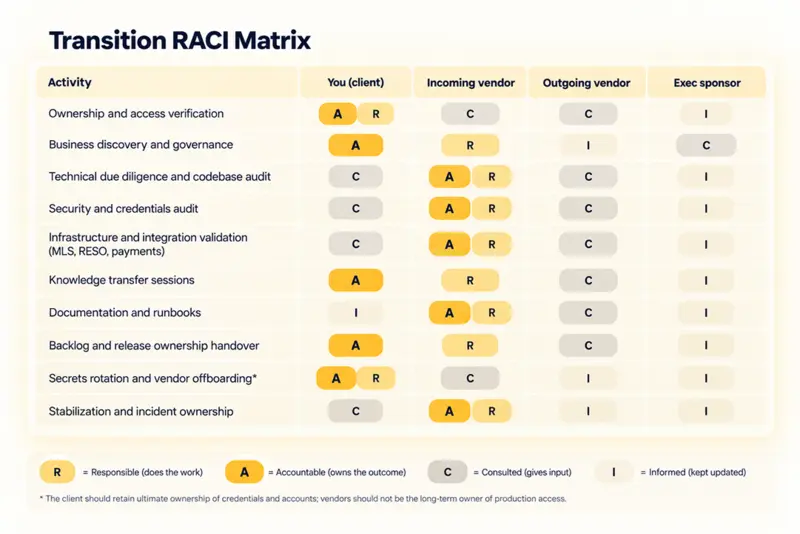
Assigning Ownership: The Transition RACI Matrix
A transition stalls when nobody is sure who decides. Mapping responsibility before the overlap begins keeps that from happening. The matrix below assigns each transition activity across the four parties involved, so every task has a single accountable owner and no decision sits in limbo during the handover.
Vendor Transition Best Practices for PropTech Platforms
Beyond the general framework, real estate products have platform-specific handover priorities. The practices below apply the framework to common PropTech systems.
- Property listing platforms: validate MLS feed credentials, RESO mappings, and IDX display rules before the switch. Compliance misconfiguration can create legal exposure, not just a defect.
- Property management systems: confirm bi-directional CRM and PMS sync (Yardi, AppFolio) and reconcile data on both sides before cutover.
- Investment and valuation platforms: treat AVM and model logic as first-class handover artifacts, including inputs and evaluation criteria. They are frequently undocumented.
- Analytics platforms: document pipeline lineage explicitly, because dashboards depend on transformations that rarely live in the repository.
- AI-enabled products: capture training data, model versions, and retraining procedures, which do not transfer with the codebase.
- Marketplaces: protect search, ranking, and syndication behavior, where a regression is immediately visible to users.
- Construction and project-management platforms: preserve integrations with BIM, scheduling, and field tools, where a handover gap stalls active projects on site.
- Smart-building and energy platforms: treat device integrations, telemetry pipelines, and control logic as handover artifacts, since a lapse affects live building systems.
These priorities reflect standard PropTech software development practice: the systems that carry the most business risk during a transition are the ones tied to live data, money movement, and compliance.
How ORIL Approaches Vendor Transition for Real Estate Software
ORIL runs vendor transitions the way the framework above describes, with the emphasis on real estate specifics.
Engagements typically begin with business discovery and a technical due diligence pass, including a codebase audit and security review, and produce a written transition roadmap rather than a verbal plan.
Infrastructure and integration validation come next, with particular attention to MLS feeds, RESO mappings, and listing sync pipelines, because these carry the most operational risk in real estate transitions.
From there, knowledge transfer and delivery handover move the team into ownership, and stabilization establishes predictable operation before any modernization begins.
Where the roadmap calls for it, custom real estate software development work follows: reducing technical debt, strengthening data integration, and preparing the platform for scaling or AI. The through-line is engineering judgment about PropTech systems, applied so the product keeps running while it changes hands.
Where a Vendor Transition Sets Up the Next Phase
A successful transition should leave the company less dependent on undocumented knowledge, individual people, and fragile integrations than it was before the switch.
If you’re planning a move, ORIL can assess the inherited platform, validate its integrations and risks, and build a transition roadmap before ownership changes hands.


