

There’s a version of an internship that most people have heard about: you sit in the corner, make coffee, complete isolated tasks that never quite connect to anything real, and leave three months later with a line on your résumé and not much else.
ORIL’s PropTech Internship Program is built around a different idea entirely. As a software development company specializing in PropTech solutions, we designed the PropTech internship program to give aspiring tech professionals hands-on experience in real product development environments.
Now halfway through a two-month software internship program, six interns — four full-stack developers and two manual QA engineers — are working on a real internal product alongside experienced engineers. They’re attending planning sessions, participating in code reviews, presenting their work in demos, and navigating the kind of feedback loops that define professional software development. And they’re learning things that no classroom curriculum quite prepares you for.
This is a look inside that experience.
What You’ll Learn in This Article
- Why ORIL created a hands-on PropTech internship program — and what makes it different from typical internships
- What real project interns are building and the product skills they’re developing alongside technical ones
- How mentorship works at ORIL and why it’s designed to build independence, not dependency
- Unexpected lessons six interns learned about architecture, documentation, communication, and product thinking
- Advice interns would give to anyone starting a software development internship
Why ORIL Built Its PropTech Internship Program
ORIL works at the intersection of software engineering and the property technology industry, building products that help real estate companies operate more effectively. That work demands developers and QA engineers who can do more than just write clean code or file accurate bug reports — it demands people who understand the business problem behind every feature, who can communicate trade-offs, and who know how to collaborate under real constraints.
That last part is harder to teach than it sounds.
Modern software development is a discipline that rewards technical depth, but it also rewards communication, product thinking, and the ability to take ownership without waiting to be told exactly what to do. Most educational internship programs do a reasonable job with the former. Very few prepare people for the latter.
The software development internship was created to bridge that gap. Rather than assigning interns to artificial training exercises, the program places them inside an actual product development team, working on a real deliverable with real stakes. The goal of our PropTech internship program is to create an environment where growth happens the same way it does in a professional setting — through doing, making mistakes, receiving feedback, and doing better.
The Biggest Revelation: Software Development Is a Team Sport
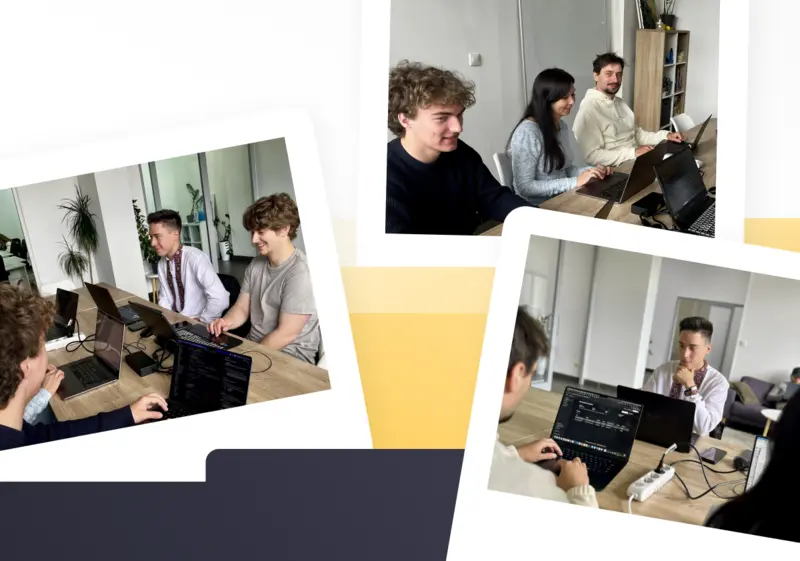
Ask any of the interns what surprised them most, and the theme emerges quickly: it’s not the technology. It’s the collaboration.
Ivan Synchuk, a full-stack developer intern and student at Lviv Polytechnic National University, put it simply:
“The biggest difference is the scale of responsibility and teamwork. In commercial development, every line of code directly impacts business goals and real users.”
Vadym Kuhartchuk, who came into the program with React, Next.js, and Node.js experience from both personal and commercial projects, expected to lean on his existing skills. What he didn’t expect was how fundamentally different it would feel to work within an established system rather than creating one from scratch.
“In personal projects, I make all decisions myself. Here, I need to follow existing architecture, coding standards, and collaborate with teammates.”
That shift — from individual decision-maker to contributor within a shared system — is one the QA interns recognized too.
For Oleksandr Kolodiichuk, a Manual QA Engineer intern studying at Lviv Polytechnic, the contrast with independent work was immediate:
“The biggest difference is team collaboration and the real-world scale. In pet projects, you’re often working independently. Here, I collaborate with a team, follow professional development standards, and see how our project evolves from idea to product.”
This is one of the things that makes a real product environment so different from academic work — every decision ripples outward. You can’t just refactor something without thinking about how it affects the people working alongside you.
What Interns Actually Work On: A Real Product, Not a Training Exercise
The interns aren’t working on a simulated project or a sandbox exercise. They’re building an internal communication and collaboration platform — a tool designed to help teams manage discussions, share knowledge, coordinate work, and organize ideas more effectively.
It’s the kind of platform that addresses challenges familiar to any growing organization, including the PropTech companies. Managing knowledge, aligning teams, and keeping communication structured are problems that show up everywhere.
Working on something with genuine utility changes how interns relate to the work. Bohdan Rubakha, a final-year Computer Science student and full-stack developer intern, described the shift in perspective that came from moving beyond pure implementation:
“Planning and defining tasks helps me see the whole project, its main goals, and its business value.”
Coding teaches you how things work technically. Understanding why a feature exists — what user needs it addresses, what business problem it solves — teaches you something different.
That understanding shapes the product. Vlad Prysiazhniuk, another full-stack developer intern, worked on features including AI-powered document summarization and real-time chat. What changed his relationship with the work wasn’t the complexity of the features — it was the accountability.
“My opinion matters here, and I’m accountable for every commit I push. That accountability makes the work meaningful.”
Unexpected Lessons from ORIL’s Software Internship
When interns are asked what surprised them most about the program, the answers tend to drift away from technical topics and toward things they hadn’t thought to prepare for.
Ivan found himself navigating something that doesn’t come up in personal projects: the tension between architectural idealism and business momentum.
“In pet projects, you have infinite time to over-engineer everything. Here, I had to learn how to make pragmatic, scalable choices that move the product forward.”
Learning to balance clean architecture with business speed is one of the more nuanced skills in software development — and it’s very hard to learn without real stakes.
Bohdan’s unexpected lesson was about requirements. “How to define requirements and communicate them clearly.” The ability to articulate what a feature needs to do — before writing a single line of code — turned out to be as important as the implementation itself.
Vadym discovered a skill he hadn’t anticipated needing: how to present technical work.
“Throughout the internship, I’ve had opportunities to showcase my work, explain technical decisions, walk teammates through solutions, and communicate project progress.”
Technical communication — the ability to make a decision legible to people who weren’t in the room when you made it — is a professional skill that compounds over an entire career.
For Liliia Dymytriieva, a Manual QA Engineer intern who came to the program from a background in localization, the volume and variety of documentation was a genuine surprise. “I definitely didn’t expect to write so much documentation,” she said.
Before the internship, she mostly reviewed documents others had created. Now she’s writing test documentation, building test matrices, and creating project documentation from scratch. “Learning how everything connects throughout the product lifecycle” turned out to be as valuable as the testing work itself.
How Mentorship Works at ORIL: Guidance Without Hand-Holding
Every intern in the program works with a dedicated mentor — experienced engineers who provide guidance, review work, and help navigate challenges. But the way interns describe that support reveals something specific about how ORIL approaches mentorship.
The word that comes up most often isn’t “helpful.” It’s “hands-on” combined with something like “independent.”
Oleksandr described his mentor as providing “exactly the right amount of guidance to help me grow while letting me figure things out on my own.”
Liliia used almost the same language: “supportive, practical, and always focused on helping me grow through real project experience.”
Vlad offered the clearest description of what effective mentorship looks like in practice:
“My mentor points me toward better solutions without solving them for me.”
That distinction matters. A mentor who solves your problems for you is providing short-term relief. A mentor who helps you develop the instincts to solve them yourself is investing in something that lasts.
Ivan experienced this through the hardest technical challenge of his first month — implementing an effective request caching strategy for a system with complex architectural requirements. He worked through it by analyzing system requirements, researching caching mechanisms, and then consulting his mentor — not to get the answer, but to validate that his solution aligned with the project’s architecture.
Beyond Writing Code: Developing a Product Mindset as a Junior Developer
One of ORIL’s explicit goals for the program is to help interns develop what Bohdan called a “product mindset” — the ability to see beyond the immediate technical task toward the user experience, business goal, and broader system it serves.
Bohdan articulated why this matters:
“ORIL doesn’t just teach us how to write code, but also how to present our work and propose our own features. This approach helps us develop a product mindset, which has always been important, but is now a top priority in the era of AI.”
That last observation cuts to something real. As AI tools become increasingly capable of generating code and test cases, the differentiating skill for developers and QA engineers isn’t the ability to produce solutions quickly — it’s the ability to evaluate them. Bohdan noticed this directly:
“The real challenge isn’t generating solutions with AI. It’s evaluating different options and choosing what works best for a specific situation.”
Vlad arrived at a similar conclusion through a different route. Working on technically ambitious features forced him to think carefully about architecture from the start.
“Initiative matters as much as technical skill. Defending your decisions and thinking about architecture early makes later work easier.”
Ownership isn’t just about delivering — it’s about arriving with a point of view.
Real Challenges Junior Developers and QA Engineers Face in Their First Internship
Real growth rarely comes from things that go smoothly. The moments interns describe most vividly are the hard ones.
For Ivan, it was untangling architectural decisions in a complex system.
“The most challenging part was solving architectural bottlenecks, specifically determining the best design decisions and implementing correct request caching strategies. I handled it by analyzing the system requirements, researching optimized caching mechanisms, and consulting with my mentor to ensure the solution aligned with the project’s architecture.”
For Vadym, it was making sense of how the different parts of the platform connected to each other — “not always immediately clear how different parts of the system were connected” — and building that understanding incrementally through implementation.
For Vlad, it was implementing an email service that resisted all the approaches he tried independently, until he and his mentor worked through it together.
For Liliia, the challenge was more conceptual: learning to write user stories with requirements that were complete and that anticipated the questions that would naturally arise during development. “Understanding that requirements evolve” was itself a lesson — that the definition of done shifts as you learn more about the problem.
Oleksandr ran into coordination challenges early: managing task distribution and keeping milestones on track across a team.
“I handled it by communicating more openly with my teammates and breaking down large tasks into smaller, manageable chunks.”
It is exactly the kind of adaptive behavior that professional environments require.
What these challenges share is that they aren’t artificial. They emerged from real work on a real product, and solving them required thinking that goes beyond any specific technical skill.
Advice from Interns: What They’d Tell Anyone Starting a Software Internship

At the midpoint of the program, we asked each intern what advice they’d give themselves before day one.
The answers converge around a few themes. Ask questions sooner — nearly every intern wished they’d reached out to their mentors earlier rather than spending time stuck in uncertainty. Understand the architecture before diving into implementation — several developers noted that a clearer picture of the system structure would have accelerated their onboarding significantly. Set up the project structure carefully from the beginning — Vadym observed that “a well-structured initial setup saves significant time later and helps avoid many unnecessary issues during the workflow.”
And perhaps most importantly: expect the meetings and feedback sessions to be genuinely useful. Oleksandr reflected that “I would have felt more confident asking questions earlier if I had realized how welcoming and helpful the mentors really are.” The feedback cycles that can feel intimidating at the start of a program turn out to be where most of the learning actually happens.
In short, here’s what interns say they wish they’d known on day one:
- Ask questions early — mentors are more approachable than they seem
- Study the project architecture before writing your first line of code
- Set up project structure properly from the start — it saves hours later
- Treat daily standups and feedback sessions as learning opportunities, not formalities
- Expect to learn things that have nothing to do with your tech stack
What the Internship Is Really About
Halfway through the program, something is visible in how these six interns talk about their work that wasn’t there before they started: a sense of professional identity. They’re not students completing tasks. They’re contributors to a product team, with opinions about architecture, accountability for their commits, and an understanding of why the features they build exist.
That’s the actual goal of the program — not just teaching technologies, but helping people become better teammates, better communicators, better problem solvers, and professionals who think about the product as well as the code.
At ORIL, we believe the best way to learn software development is by building real products alongside experienced professionals, taking ownership of meaningful work, and growing through collaboration. The classroom gives you the foundation. The product team gives you the practice. And practice — the real, accountable, feedback-driven kind — is where engineers are made.
Key Takeaways
- Real product, real stakes. Interns build an actual internal platform — not a sandbox exercise.
- Collaboration is the biggest shift from personal projects to professional development.
- Mentorship at ORIL guides without solving — interns are pushed to find answers, not handed them.
- Product mindset matters as much as coding skill, especially in the age of AI-assisted development.
- Growth comes from real challenges — architectural decisions, writing requirements, managing tasks across a team.
If you’re a student, junior developer, or QA engineer looking for exactly this kind of experience, follow ORIL for updates to apply for future ORIL internships and to stay connected with what our team is building.


